Introduction
According to IBM's 2025 Cost of a Data Breach Report, 13% of organizations across 600 surveyed enterprises reported breaches of AI models or applications — and another 8% couldn't confirm whether their AI systems had been compromised at all. Of those that reported an AI-related incident, 97% lacked proper AI access controls.
That's not a tooling gap. That's a fundamental mismatch between how organizations are deploying AI and what they're doing to protect it.
When an AI system is compromised, the consequences don't look like a traditional breach:
- Autonomous agents exfiltrate data through legitimate tool channels
- Manipulated prompts redirect business logic without triggering alerts
- Training data surfaces through inference attacks
- Compliance violations accumulate silently — invisible to WAFs and SAST scanners watching for CVEs that never arrive
AI applications aren't just software. They're probabilistic, adaptive systems with an attack surface that traditional security tools were never designed to address. This guide breaks down the AI-specific threat landscape, the controls that actually reduce exposure, and how to build a testing cadence that keeps pace with how AI systems change.
Key Takeaways
- AI systems face attack vectors — prompt injection, model poisoning, training data leakage — that conventional security tools cannot detect
- Securing AI requires coverage across the full lifecycle: data pipelines, model training, deployment, and runtime
- Overpermissioned AI agents dramatically expand blast radius — least privilege applies to every agent and integration
- AI behavior can be manipulated subtly without triggering standard alerts — continuous behavioral monitoring fills that gap
- NIST AI RMF, ISO 42001, and the OWASP LLM Top 10 2025 are the governance frameworks to build your security program around
What Is AI Application Security?
AI application security is the discipline of protecting machine learning models, training data, inference pipelines, and AI-powered systems from attacks that exploit their unique architecture.
Unlike traditional application security, which targets static code vulnerabilities and known attack patterns — SQL injection, broken authentication, misconfigured servers — AI threats don't follow predictable signatures. They can't simply be scanned for.
Why AI Requires a Different Security Mindset
An LLM doesn't execute deterministic logic. It interprets natural language, generates probabilistic outputs, and makes autonomous decisions — sometimes interacting with sensitive enterprise resources in ways no developer fully anticipated. The attack surface shifts with every model update, every new tool integration, and every change to the retrieval pipeline.
The scope of AI application security covers:
- Large language models (LLMs) — the core model layer and all prompt interfaces
- RAG pipelines — retrieval paths, vector databases, and document sources
- Autonomous agents — orchestration layers, tool access, and credential handling
- Inference APIs — REST and GraphQL interfaces feeding AI systems
- Training data and model registries — provenance, integrity, and access controls
- Cloud infrastructure — storage, IAM, and workload isolation for AI environments
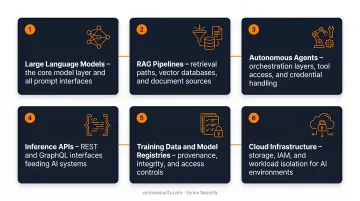
Securing an AI system means securing every layer it depends on — not just the model itself.
The AI Threat Landscape: Attacks That Traditional Security Misses
Traditional security tools — WAFs, SAST scanners, CVE databases — were built for a different threat model. The attacks below travel through the same channels as legitimate traffic, which is precisely what makes them so dangerous.
Prompt Injection
OWASP defines prompt injection as input that alters an LLM's behavior or output in unintended ways. It can be direct (a user crafting inputs that override system instructions) or indirect (malicious instructions embedded in documents, tool outputs, or retrieved web content that the model processes).
The consequences include sensitive data disclosure, unauthorized tool execution, and manipulation of downstream decisions. Because these attacks arrive through normal API channels, signature-based detection is useless. Google DeepMind identifies indirect prompt injection as a primary threat to tool-using AI agents specifically — when an agent reads an external document containing embedded instructions, those instructions execute.
Vynox tests across five families of prompt injection techniques: direct injection, indirect injection via documents and tool outputs, role-play and persona exploits, token manipulation and boundary attacks, and multi-turn attack chains. A full system prompt can be extracted in under 10 queries — invisible to CVE scanners.
Training Data Poisoning
OWASP classifies data and model poisoning as manipulation of pre-training, fine-tuning, or embedding data to introduce vulnerabilities, backdoors, or bias. This is a supply chain attack — it happens upstream and manifests silently in production.
The threshold is lower than it sounds. An Anthropic experiment found that as few as 250 malicious documents could create backdoor behavior across models from 600M to 13B parameters. For RAG systems, vector database poisoning is the equivalent: corrupted embeddings corrupt retrieval, and corrupted retrieval corrupts outputs.
Model Inversion and Data Leakage
AI models trained on proprietary or sensitive data can memorize and inadvertently reveal that information through inference. In foundational research, Google confirmed that over 600 of 1,800 candidate sequences queried from GPT-2 were verbatim memorized content from training data — including personally identifying information.
For organizations using fine-tuned models, this creates direct regulatory exposure. If PII is recoverable through adversarial probing, GDPR and HIPAA obligations attach regardless of whether a formal breach occurred.
Identity Spoofing and Excessive Agent Permissions
Autonomous agents typically operate with elevated, long-lived API credentials. A compromised agent doesn't just return bad output — it can send emails, write files, delete records, and escalate privileges through agent chaining.
OWASP's Excessive Agency category (LLM08) identifies three distinct failure modes:
- Excessive functionality — agents granted capabilities beyond what the task requires
- Excessive permissions — overly broad access rights that survive across sessions
- Excessive autonomy — agents acting without sufficient human oversight or confirmation gates
Microsoft's security guidance explicitly calls out managed agent identities, narrowly scoped RBAC, and tool binding as separate control points — each of which can independently become a pivot point when misconfigured.
The OWASP Top 10 for Agentic Applications 2026 — published December 2025 — extends this further, covering agent goal hijacking, tool misuse, identity and privilege abuse, and insecure inter-agent communication as distinct threat categories.
AI Application Security Best Practices
AI security isn't a pre-launch checklist. It's an ongoing discipline that must be embedded across every layer of the AI lifecycle. The controls below are organized by where in that lifecycle they apply.
Foundational Controls: Identity, Access, and Least Privilege
Enforce least privilege for every AI agent and service account. Map exactly what data sources, APIs, and actions each agent requires — then scope permissions tightly. A compromised agent with broad access becomes an enterprise-wide pivot point. One with narrowly scoped permissions limits blast radius to its defined function.
Practical controls to implement:
- Short-lived credentials with automated rotation for all machine identities
- MFA on human access to training environments and model registries
- OIDC or SAML integration with enterprise identity providers for centralized policy enforcement
- Zero Trust authorization — evaluate every agent request against current policy in real time, factoring in user attributes, data classification, and behavioral signals
Don't rely on previously granted trust. AI systems accumulate permissions as features expand, and privilege audits rarely keep pace.
Securing the Development and Deployment Pipeline
Shift AI security left into the SDLC before a model ships to production. This means:
- Validate training data provenance — signed datasets, hash verification, documented lineage
- Scan model dependencies and open-source components for known vulnerabilities
- Gate deployments on security checks — treat model registries with the same rigor as code repositories
- Maintain versioned model registries with full audit trails linking every deployment to specific training data, configuration approvals, and code changes
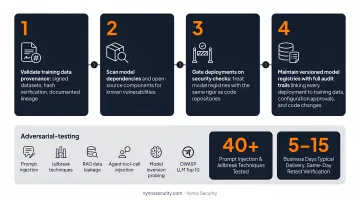
Adversarial testing before production is required. Run prompt injection attempts, jailbreak techniques, and data leakage probes using AI-native methodology — conventional penetration testing tools scan infrastructure and stop there. They don't simulate LLM-specific attack patterns.
Vynox's pre-production testing covers 40+ prompt injection and jailbreak techniques, RAG pipeline data leakage probes, agent tool-call injection, model inversion probing, and full OWASP LLM Top 10 coverage. Most engagements deliver in 5–15 business days, with same-day retest verification when fixes are pushed to staging.
Runtime Monitoring and Behavioral Detection
Once deployed, AI systems require continuous behavioral monitoring. Static security checks don't catch prompt manipulation that gradually erodes guardrails or agent behavior that drifts over multiple sessions.
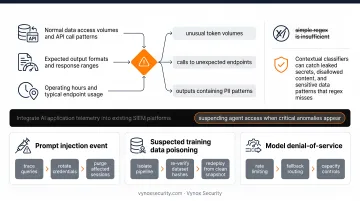
Establish behavioral baselines for each AI agent and model:
- Normal data access volumes and API call patterns
- Expected output formats and response ranges
- Operating hours and typical endpoint usage
Deviations — unusual token volumes, calls to unexpected endpoints, outputs containing PII patterns — should trigger automated alerts. Integrate AI application telemetry into existing SIEM platforms and use SOAR playbooks to automate initial response actions like suspending agent access when critical anomalies appear.
Output filtering is a post-generation control that matters. Pass model responses through semantic classifiers before delivery to end users — simple regex is insufficient because paraphrased or obfuscated content evades pattern matching. Contextual classifiers can catch leaked secrets, disallowed content, and sensitive data patterns that regex misses.
Define AI-specific incident response playbooks — and test them:
- Prompt injection event: trace queries, rotate credentials, purge affected sessions
- Suspected training data poisoning: isolate pipeline, re-verify dataset hashes, redeploy from clean snapshot
- Model denial-of-service: rate limiting, fallback routing, capacity controls
Infrastructure and Supply Chain Security
AI training environments should be isolated from production systems using network segmentation and separate credential stores. Lateral movement from a compromised training pipeline to production data should require multiple additional barriers — not just a single access control.
Treat the AI supply chain with the same rigor as any software dependency:
- Vet third-party model providers, open-source datasets, and LLM APIs before integration
- Require SBOMs for AI components
- Monitor for concept drift that could indicate upstream tampering
- Avoid relying on community-published models without provenance verification
For cloud environments, a single misconfigured storage bucket can expose model weights, training data, and source code simultaneously. IAM privilege escalation paths, secrets management gaps, and AI workload isolation are all active attack surfaces — not hypothetical risks.
Map AI systems to applicable compliance frameworks:
| Framework | Scope |
|---|---|
| NIST AI RMF 1.0 | Lifecycle risk governance |
| ISO/IEC 42001:2023 | Organization-wide AI management system |
| OWASP LLM Top 10 2025 | LLM and GenAI application vulnerabilities |
| GDPR | Automated decisions affecting individuals |
| HIPAA | Clinical AI systems handling protected health information |
| EU AI Act Article 15 | High-risk AI systems — robustness and cybersecurity |
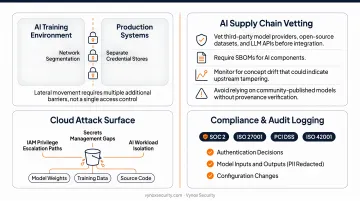
Ensure audit logs capture all authentication decisions, model inputs and outputs (with PII redaction), and configuration changes required by each applicable framework.
Common AI Security Mistakes to Avoid
Three mistakes account for the majority of preventable AI security failures:
Assuming traditional penetration testing is sufficient. Conventional tools test static code and network boundaries, not prompt behavior, model inference, or agent decision chains. Organizations that skip AI-native security testing ship products with vulnerabilities their security program has never examined. IBM found that 97% of organizations reporting AI security incidents lacked proper access controls — that gap exists precisely because teams treat AI security as an infrastructure problem.
Granting AI agents excessive permissions "for convenience." Agents accumulate access over time as features expand. Without regular privilege audits, a single compromised agent becomes a high-value pivot point. The OWASP Excessive Agency category exists because this is a documented, recurring failure mode.
Treating AI security as a one-time deployment gate. Model updates, new training data, and evolving prompt injection techniques shift the threat surface with every sprint. A validation that passed in version 1.0 may fail in version 1.1 after a model update alters guardrail behavior. Security checks must keep pace with development cadence.
Conclusion
AI application security requires treating the model, the data it learns from, the code it calls, and the actions it takes as parts of a unified attack surface. Protecting that surface requires AI-specific controls layered across identity management, development pipelines, runtime monitoring, and infrastructure — not just a WAF update and an annual pentest.
Organizations shipping AI products with confidence are those that test, monitor, and validate security continuously — with every model update, every sprint, every new agent capability. A structured AI security assessment gives you a clear picture of where those gaps exist before an attacker finds them first.
Vynox's AI security assessments cover the full OWASP LLM Top 10 across LLMs, RAG pipelines, and autonomous agents, with findings mapped to compliance requirements for SOC 2, ISO 27001, and ISO 42001. Engagements deliver in 5–15 business days. For teams shipping on a sprint cadence, continuous PTaaS testing keeps security validation in step with every model update and release.
If you're ready to map your AI attack surface, a free 30-minute discovery call with Karan is the fastest way to scope the right engagement: cal.id/karan-singh.
Frequently Asked Questions
What makes AI application security different from traditional application security?
AI systems face threats targeting prompts, training data, and model behavior — attack surfaces that don't exist in traditional applications. Conventional tools like WAFs and SAST scanners cannot detect prompt injection, model poisoning, or inference-based data leakage because they were never designed to parse probabilistic model behavior.
What are the most critical vulnerabilities in AI applications?
The OWASP LLM Top 10 2025 identifies the key risks: prompt injection, sensitive information disclosure, data and model poisoning, improper output handling, and excessive agency. These can lead to data exfiltration, manipulated business logic, and compliance failures across GDPR, HIPAA, and SOC 2 requirements.
How do LLMs, RAG pipelines, and autonomous agents each present different security risks?
LLMs are vulnerable to prompt injection and training data leakage. RAG pipelines add retrieval-layer risks — vector database poisoning and cross-tenant document access. Autonomous agents go furthest: they execute real-world actions with live credentials and can be hijacked via tool-call injection or agent chaining.
How should AI security be integrated into a DevSecOps pipeline?
Validate training data provenance in CI/CD, gate deployments on prompt injection and adversarial testing results, and maintain versioned model registries with full audit trails. AI-native assessments should run before every production release, with PTaaS providing continuous coverage aligned to sprint cadence.
What compliance frameworks apply to AI application security?
Core frameworks include NIST AI RMF (lifecycle risk management), ISO 42001 (AI management systems), and OWASP LLM Top 10 2025 (practitioner-level vulnerabilities). Sector-specific rules — GDPR for automated decisions, HIPAA for clinical AI — layer on top based on deployment context.
How often should AI applications be security tested?
At every significant model update, major prompt change, or new agent capability release — not annually. AI systems change with every sprint, and a security posture that passed last quarter may have gaps today. A continuous testing cadence aligned to development velocity ensures validation keeps pace with how rapidly AI systems evolve.