AI-related incidents hit 233 reported cases in 2024, a 56.4% jump from the year before and a record high, according to Stanford HAI's 2025 AI Index Report. Many businesses struggle to keep pace, because LLMs, RAG pipelines, and autonomous agents now handle sensitive data and customer-facing decisions that used to sit behind much simpler software.
Unlike traditional applications, LLMs introduce attack surfaces that generic QA and standard pentesting tools simply don't check: prompt injection, jailbreaks, data leakage, and biased outputs. This guide walks through what you need to audit an LLM, the core testing methods, how to interpret findings, and the mistakes that undermine most audits.
Key Takeaways
- LLM audits combine red-teaming, fairness testing, and privacy checks — no single method covers every risk.
- Core tooling includes OWASP LLM Top 10 checklists, red-teaming frameworks, fairness tests, and DLP scanners.
- Findings fall into acceptable, minor, or critical bands, each triggering a distinct response.
- Most audits fail by testing the model alone, skipping RAG pipelines and agent permissions.
What You Need to Audit Large Language Models
The depth and accuracy of an LLM audit depend almost entirely on what you bring to it: the right mix of automated tooling, hands-on red-teaming expertise, and full documentation access. Skip any one of these, and findings get shallow fast.
Tools and Resources Required
A functional audit toolkit includes:
- Automated LLM red-teaming/scanning frameworks for repeatable adversarial testing
- Curated jailbreak and prompt-injection libraries covering direct and indirect attack techniques
- Bias/fairness test datasets built for correspondence-style testing
- DLP/PII detection tools to catch sensitive data before it reaches the model
- A documented OWASP LLM Top 10 checklist as your structural baseline: the 2025 edition maps ten application-level risks across prompts, RAG, tools, and outputs
You'll also need representative test datasets: diverse demographic samples and edge-case document formats (scanned PDFs, malformed JSON, mixed-language text) that let you evaluate fairness and robustness accurately. A test set built only from clean English text will miss most real-world failure modes.
Preconditions and Setup
Before testing starts, get these in place:
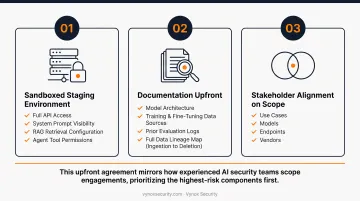
- A sandboxed staging environment with full API access, system prompt visibility, RAG retrieval configuration, and agent tool permissions.
- Documentation upfront: model architecture, training/fine-tuning data sources, prior evaluation logs, and a full data lineage map from ingestion through deletion.
- Stakeholder alignment on scope: confirm which use cases, models, endpoints, and vendors are in play before testing begins. This upfront agreement mirrors how experienced AI security teams scope engagements, prioritizing the highest-risk components first.
Methods to Audit Large Language Models
Most organizations need a combination of three audit types, not just one. Security testing catches exploitable vulnerabilities, fairness testing surfaces discriminatory outcomes, and compliance testing flags data-handling failures. Each answers a different question.
Method 1: Security and Adversarial Penetration Testing
This method measures resilience against prompt injection, jailbreaks, insecure output handling, and agent/tool-calling exploits, mapped against the OWASP LLM Top 10.
Tools needed: Dedicated LLM red-teaming frameworks, curated jailbreak libraries, and a logged sandbox environment.
Step-by-step:
- Map the attack surface (chat interface, API, RAG pipeline, agent tool calls) and identify trust boundaries.
- Run systematic adversarial prompts, including document-embedded (indirect) injection and multi-turn jailbreak chains, logging every response. Indirect injection is particularly dangerous because it can drive data theft or unauthorized tool use without the attacker ever touching the chat interface directly.
- Test agent/tool-calling boundaries for unauthorized actions, data exfiltration, or excessive agency.
- Document reproduction steps and severity for every successful exploit.
This method catches exploitable vulnerabilities before production, but it requires specialized AI security expertise that generic pentest firms often lack.
Testing against 40-plus prompt injection and jailbreak variants (direct injection, role-play exploits, token manipulation, multi-turn chains, encoding bypasses) takes purpose-built methodology, not a repurposed web app scanner. This is exactly the gap AI-native testing providers like Vynox Security were built to close.
Method 2: Bias and Fairness Auditing
This method evaluates whether outputs systematically differ across protected demographic groups in ways that create unfair outcomes.
Tools needed: Matched correspondence-experiment test sets and fairness metrics that go beyond simple adverse impact ratios.
Step-by-step:
- Build paired test cases: identical résumés or queries differing only by name or pronoun signals tied to race or gender.
- Run each pair through the model multiple times and compute disparity scores across responses.
- Vary prompt wording and context to check whether disparities hold up. A Stanford audit ran 168,000 responses across 40 names and 42 templates and found white-male-associated names received the most favorable aggregate outcomes overall, though effects shifted depending on context.
- Flag statistically significant, persistent disparities for mitigation.
This testing is essential for regulated use cases like hiring or credit decisions. It also demands larger sample sizes than most teams expect: a single-prompt test proves almost nothing, since names are demographic proxies and effects are model-, task-, and prompt-specific.
Method 3: Privacy, Data Leakage, and Compliance Auditing
This method verifies how sensitive data moves across ingestion, retrieval, inference, and deletion, and whether controls satisfy frameworks like SOC 2, ISO 27001, GDPR, or HIPAA.
Tools needed: DLP/PII scanning tools, retrieval access-control logs, and data lineage/retention tracking.
Step-by-step:
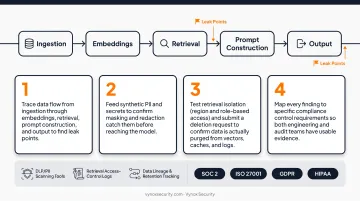
- Trace data flow from ingestion through embeddings, retrieval, prompt construction, and output to find leak points.
- Feed synthetic PII and secrets to confirm masking and redaction catch them before reaching the model.
- Test retrieval isolation (region and role-based access) and submit a deletion request to confirm data is actually purged from vectors, caches, and logs.
- Map every finding to specific compliance control requirements so both engineering and audit teams have usable evidence.
This audit type is critical for anyone under compliance obligations, but it's easy to under-scope. Caches and backups get forgotten constantly, and without automated lineage tools, tracing a single data point end-to-end can eat days of manual effort.
How to Interpret the Results
Misreading findings cuts both ways: you either ship an exploitable system or block safe functionality unnecessarily. Getting interpretation right determines whether a finding needs a launch delay, ongoing monitoring, or an immediate fix.
| Severity Band | What It Looks Like | Next Step |
|---|---|---|
| Acceptable/Low | Model resists tested adversarial prompts; bias disparities are statistically insignificant; sensitive data is consistently masked | Schedule the next audit before the following model update |
| Minor | Occasional jailbreak success under narrow conditions; small non-critical bias disparities; inconsistent masking on edge-case formats | Targeted guardrail hardening and re-testing within a defined SLA |
| Critical | Reproducible data exfiltration; successful injection leading to unauthorized tool execution; persistent bias against protected groups; failed PII deletion | Halt deployment, require full remediation, retest before release |
Reporting matters as much as the finding itself. Document reproduction steps and severity ratings so both engineering and compliance stakeholders can act on them, not just security specialists reading a technical writeup.
NIST's Generative AI Profile recommends red-teaming at a regular cadence tied to risk context, not a one-size-fits-all interval. That cadence question is exactly where most audit programs break down.
Common Errors and Best Practices in LLM Audits
Common Errors
The same three mistakes show up across most failed audits:
- Testing the model in isolation: skipping the full RAG pipeline, system prompts, or agent permissions, which is where most real exploits actually occur.
- Relying on a single aggregate score instead of segmenting results by intent, cohort, or document type. This hides long-tail failures that only show up in edge cases.
- Auditing once at launch and never again, even as prompts, models, or fine-tuning data change underneath the deployed system.
Best Practices
Fix these by building audit discipline into your development process:
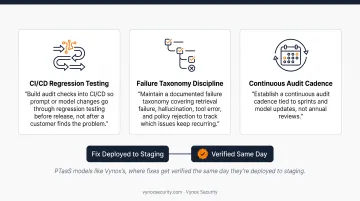
- Build audit checks into CI/CD so prompt or model changes go through regression testing before release, not after a customer finds the problem.
- Maintain a documented failure taxonomy covering retrieval failure, hallucination, tool error, and policy rejection to track which issues keep recurring.
- Establish a continuous audit cadence tied to sprints and model updates, not annual reviews. This is the logic behind PTaaS models like Vynox's, where fixes get verified the same day they're deployed to staging.
Conclusion
Auditing LLMs is the only reliable way to catch AI-specific risks such as prompt injection, bias, and data leakage that traditional testing misses.
A trustworthy audit combines security red-teaming, fairness evaluation, and privacy/compliance verification, measured against clear acceptable, minor, and critical thresholds.
Teams without deep in-house AI security expertise often move faster by partnering with a specialized provider than building this capability from scratch under deadline pressure. Vynox Security delivers developer-ready findings and compliance-mapped evidence for SOC 2, ISO 27001, and EU AI Act requirements within 5-15 business days.
Frequently Asked Questions
What is LLM auditing?
LLM auditing is the systematic evaluation of a model's security, fairness, privacy, and compliance posture. It uses methods like red-teaming, bias testing, and data flow tracing to surface risks before they reach production.
How often should an LLM be audited?
Continuous validation aligned with sprints and model updates is ideal, since prompts and fine-tuning data change constantly. Comprehensive formal audits should happen at least quarterly, with retesting after any material system change.
What is the OWASP LLM Top 10 and why does it matter for audits?
It's the standardized checklist of critical LLM vulnerabilities, covering everything from prompt injection to insecure output handling. It forms the baseline structure for nearly all security-focused LLM audits today.
How is auditing an LLM different from traditional penetration testing?
Traditional pentesting targets infrastructure and code. LLM audits must also test prompt-based attacks, output bias, and AI-specific data handling across the model, RAG pipeline, and agent tools.
Is LLM auditing required for SOC 2 or ISO 27001 compliance?
Neither framework names LLM auditing explicitly, but both increasingly expect evidence of AI-specific risk controls. Audit findings mapped to existing trust services criteria typically satisfy that expectation.
Who should conduct an LLM audit — internal teams or third parties?
A combination works best: internal teams handle continuous monitoring between releases, while specialized third-party firms like Vynox Security provide the independent, expert red-teaming that auditors and enterprise customers expect to see.