Introduction
Most security teams running traditional penetration tests on their AI systems are leaving entire attack surfaces completely untested. A conventional web application pen test checks for server misconfigurations and known CVEs. It won't attempt prompt injection, probe RAG retrieval boundaries, or evaluate whether an autonomous agent's tool permissions can be abused.
The numbers reflect the urgency. Gartner forecasts that by 2028, 25% of enterprise GenAI applications will experience at least five minor security incidents per year, up from 9% in 2025 — and that's before accounting for how fast AI deployments are scaling.
Closing that gap starts with understanding what AI penetration testing actually involves. This guide covers:
- What AI penetration testing is and how it differs from traditional assessments
- Which vulnerabilities it uncovers across LLMs, RAG pipelines, and autonomous agents
- How the assessment process works from scoping through remediation
- When a point-in-time test isn't enough
Key Takeaways
- AI pen testing uncovers attack classes traditional tools miss: prompt injection, data poisoning, model extraction, and agentic abuse.
- Automated adversarial testing scales pattern discovery; human expertise validates complex exploitation chains.
- Testing cadence should align with model updates and sprint releases — not annual audits alone.
- Findings should map to SOC 2 and ISO 27001 controls, producing audit-ready evidence packs.
- Scope completeness determines outcomes — untested components are untested risks.
What Is AI Penetration Testing?
AI penetration testing is a form of ethical hacking that evaluates the security of AI systems by simulating real-world adversarial attacks against models, data pipelines, integrations, and AI-driven workflows.
Unlike traditional penetration testing — which checks for server misconfigurations, authentication flaws, and known software vulnerabilities — AI pen testing also probes how a model interprets inputs under adversarial pressure, whether safety controls hold, and how AI-generated outputs propagate through connected systems. Traditional scanning tools were never built to evaluate these surfaces.
The goal is to expose exploitable weaknesses across the AI lifecycle: from training data and model behavior to API integrations and agent actions, before real attackers get there first.
Why Traditional Testing Falls Short
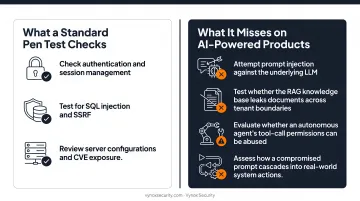
A standard web application pen test conducted on an AI-powered product will:
- Check authentication and session management
- Test for SQL injection and SSRF
- Review server configurations and CVE exposure
It will not:
- Attempt prompt injection against the underlying LLM
- Test whether the RAG knowledge base leaks documents across tenant boundaries
- Evaluate whether an autonomous agent's tool-call permissions can be abused
- Assess how a compromised prompt cascades into real-world system actions
That's a significant blind spot — and one that attackers targeting AI-powered products are already exploiting.
Key Vulnerabilities AI Penetration Testing Uncovers
Prompt Injection and Jailbreaking
OWASP ranks prompt injection LLM01:2025 — the top vulnerability in LLM applications. Attackers craft inputs designed to override system instructions, bypass safety guardrails, or force the model to produce restricted outputs.
Indirect prompt injection is particularly dangerous and frequently missed. Rather than attacking the model directly, adversarial instructions are embedded in documents, tool outputs, or retrieved content that the LLM processes as part of its workflow. In RAG pipelines, this means a single poisoned document in the knowledge base can manipulate every user who retrieves it.
Data Poisoning
Data poisoning targets training or fine-tuning pipelines directly. Attackers inject malicious data to alter model behavior, plant hidden triggers, or degrade reliability in specific scenarios. The key risk: these changes persist silently across deployments.
A model that behaves correctly 99% of the time may behave predictably for an attacker in the 1% that matters.
Model Inversion and Extraction
Repeated API querying can allow attackers to reverse-engineer proprietary model behavior or extract sensitive training data. Research from Google DeepMind, ETH Zurich, and OpenAI demonstrated projection-layer extraction from production models for under $20 for smaller models and an estimated under $2,000 for GPT-3.5-turbo components — making fine-tuned models with embedded proprietary data high-value targets.
RAG Pipeline and Agentic System Vulnerabilities
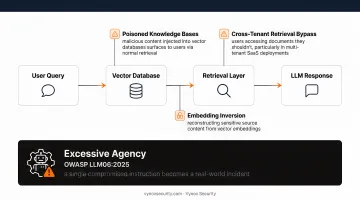
RAG systems introduce multiple distinct attack surfaces:
- Poisoned knowledge bases — malicious content injected into vector databases surfaces to users via normal retrieval
- Cross-tenant retrieval bypass — users accessing documents they shouldn't, particularly in multi-tenant SaaS deployments
- Embedding inversion — reconstructing sensitive source content from vector embeddings
Autonomous agents compound these risks significantly. OWASP identifies excessive agency (LLM06:2025) as a top concern — when a manipulated prompt can also invoke tool calls, write to databases, or trigger external actions, a single compromised instruction becomes a real-world incident.
API and Integration-Layer Risks
AI systems don't operate in isolation — and neither do their attack surfaces. APIs, orchestration layers, plugins, and downstream services that consume AI outputs all introduce authentication weaknesses, data leakage points, and injection paths. A complete AI security assessment must cover the entire stack, not just the model.
How AI Penetration Testing Works: The Automated Assessment Process
AI pen testing pairs automated adversarial tooling (capable of running thousands of test cases at machine speed) with human-led validation to confirm genuine exploitability, assess business impact, and surface complex multi-step attack chains that automation alone cannot replicate.
Scoping and Threat Modeling
Every engagement starts by defining the attack surface:
- Identifying all in-scope AI components: LLMs, RAG pipelines, agents, APIs, data stores, training pipelines
- Documenting user roles, data sensitivity levels, and business-critical workflows
- Conducting threat modeling to prioritize realistic abuse paths over theoretical ones
A poorly scoped AI pen test is one of the most common reasons organizations miss critical vulnerabilities. At Vynox Security, every engagement begins with a scoping discovery call where the team maps the client's full AI and infrastructure stack before testing begins.
Reconnaissance and Attack Surface Mapping
Testers map the AI system's architecture — how the model accesses data, what tools or APIs it can call, what permissions it holds, and how outputs flow into downstream systems. This phase frequently surfaces:
- Undocumented integrations that weren't part of the original threat model
- Over-privileged agent configurations that create escalation paths
- Tool-call exposures where an agent can be redirected toward unintended API calls
Automated Adversarial Testing
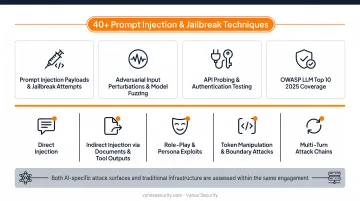
Automated tools execute large volumes of test cases at scale, covering:
- Prompt injection payloads and jailbreak attempts
- Adversarial input perturbations and model fuzzing
- API probing and authentication testing
- Full coverage of the OWASP LLM Top 10 2025 vulnerability taxonomy
Vynox Security tests 40+ prompt injection and jailbreak techniques across five categories: direct injection, indirect injection via documents and tool outputs, role-play and persona exploits, token manipulation and boundary attacks, and multi-turn attack chains. Both AI-specific attack surfaces and traditional infrastructure are assessed within the same engagement.
Manual Validation and Exploitation
Manual validation is where genuine exploitability gets confirmed — automated findings alone don't tell you what an attacker can actually do. Human testers:
- Confirm genuine exploitability of automated findings
- Chain vulnerabilities into multi-step attack paths
- Assess real-world business impact in the specific deployment context
- Identify novel attack paths that require adversarial creativity and domain knowledge
Automation cannot determine whether an unsafe model output would cause harm given a deployment's specific permission structure, data sensitivity, and downstream behavior. A human tester working that context can distinguish a theoretical flag from an actual exploit path — and that distinction determines which findings get escalated and which get closed.
Reporting, Remediation Guidance, and Retesting
Complete findings documentation includes:
- Severity ratings using CVSS scores alongside a Critical/High/Medium/Low taxonomy
- Proof-of-exploitation evidence: screenshots, reproduction steps, raw HTTP request/response pairs for API findings
- Stack-specific remediation guidance written for engineers — not generic recommendations
- Compliance mapping to SOC 2 Trust Services Criteria, ISO 27001 Annex A, ISO 42001, and PCI DSS
Retesting after fixes are deployed confirms vulnerabilities are genuinely resolved. Vynox's PTaaS model supports same-day retest turnaround when engineers push fixes to staging — verified by a G2 reviewer who confirmed fixes were validated the same day they were deployed.
Key Factors That Determine AI Penetration Testing Effectiveness
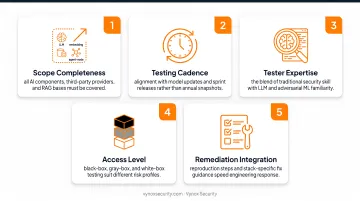
Assessment quality isn't uniform — it depends heavily on how engagements are scoped and executed. These five factors consistently separate thorough AI penetration tests from those that leave critical attack surfaces uncovered:
- Scope completeness — All AI components must be in scope: third-party LLM providers, embedding models, RAG knowledge bases, and agent tool integrations. Gaps in coverage leave entire attack surfaces untested.
- Testing cadence — Annual point-in-time assessments provide false assurance for systems that change continuously. Testing should align with model updates, prompt changes, and sprint releases.
- Tester expertise — Effective AI pentesting requires both traditional cybersecurity skills and hands-on familiarity with LLM behavior, adversarial ML, RAG architecture, and agentic system design. That combination directly determines what gets found.
- Access level — Black-box, gray-box, and white-box testing yield different findings and suit different risk profiles. The right choice depends on deployment context and what the assessment is designed to validate.
- Remediation integration — Findings paired with reproduction steps and stack-specific fix guidance reduce time-to-remediation. Reports without technical detail slow down engineering teams regardless of how severe the findings are.
Common Misconceptions and Limitations
Several assumptions about AI security testing lead organizations to either skip it entirely or approach it incorrectly. Each one carries real risk.
"Our traditional pen test covers AI systems."
A conventional web application assessment checks for server-side flaws. It won't attempt prompt injection, evaluate RAG retrieval boundaries, or probe how an agent's tool-calling permissions could be abused. These aren't gaps in execution — they're gaps in methodology. AI attack surfaces require purpose-built testing approaches that most traditional firms simply don't offer.
"Automated tools are sufficient for AI security."
Automation handles scale well: running thousands of adversarial prompts, mapping known OWASP LLM Top 10 patterns, flagging obvious misconfigurations. What it can't do is chain findings into realistic exploits, assess business impact, or surface novel attack paths that require contextual reasoning. Automated scans produce a starting point, not a verdict. Human expertise is non-negotiable for validation.
"Black-box models make testing unreliable."
Complex models don't expose their internal decision logic, which makes it harder to determine whether an unexpected output is a genuine security flaw or normal probabilistic behavior. That ambiguity doesn't make testing unreliable — it makes tester expertise more important. Distinguishing exploitable vulnerabilities from model quirks requires deep LLM familiarity, not better tooling.
"AI pen testing is a one-time compliance checkbox."
Unlike static infrastructure, AI systems change constantly — retraining, prompt updates, new tool integrations, provider swaps. Each change can introduce new vulnerabilities or quietly regress existing mitigations. A test that was accurate six months ago may not reflect your current security posture. Teams must re-validate whenever significant changes occur.
Frequently Asked Questions
How is AI penetration testing different from traditional penetration testing?
Traditional pen testing targets static software, networks, and infrastructure vulnerabilities. AI pen testing extends this to cover model behavior under adversarial inputs, RAG pipeline data boundaries, prompt injection, agent tool-call abuse, and how AI-generated outputs propagate through connected systems — none of which conventional tools were built to assess.
What are the most critical vulnerabilities found in LLM and AI systems?
The primary categories are prompt injection (direct and indirect via retrieved content), training data poisoning, model extraction via repeated API querying, unsafe agent actions from compromised prompts, and sensitive data leakage through inference-time retrieval. The OWASP LLM Top 10 2025 provides the authoritative taxonomy.
How often should AI systems undergo penetration testing?
AI systems should be tested after significant changes — new model versions, prompt updates, new tool integrations, or major releases — not only on an annual cycle. Organizations with high-risk deployments or fast release cadences should consider continuous testing aligned with development sprints.
Can AI penetration testing be fully automated, or is human expertise still required?
Automation handles scale well: running thousands of adversarial payloads, fuzzing APIs, and covering known vulnerability taxonomies. Human testers remain essential for validating complex exploitation chains, assessing real-world business impact, and finding novel attack paths that require contextual reasoning automated tools can't replicate.
What frameworks and standards guide AI penetration testing methodology?
The OWASP Top 10 for LLM Applications provides the primary vulnerability taxonomy, MITRE ATLAS covers adversarial ML threat modeling, and the NIST AI Risk Management Framework addresses broader AI governance. These frameworks structure scope and test design but don't replace hands-on testing.
How does AI penetration testing support SOC 2 and ISO 27001 compliance?
AI pen test findings can be mapped directly to SOC 2 Trust Services Criteria (particularly availability, confidentiality, and security) and ISO 27001 Annex A controls — providing documented evidence of vulnerability identification and remediation that auditors require. Vynox Security delivers assessor-ready compliance evidence packs covering SOC 2, ISO 27001, ISO 42001, and PCI DSS as part of the same engagement.