That price spread isn't a scam. It's the result of three vendors scoping the same environment differently, with different depth, different testers, and different deliverables hiding behind similar-sounding line items.
Choosing the cheapest quote can mean paying for a vulnerability scan with a pentest label slapped on it. It can mean missing the exact business-logic flaw an attacker would find first, or handing an auditor a report that doesn't actually satisfy the compliance requirement you needed it for.
This guide breaks down what's actually inside a pentest quote, why prices diverge so widely, and how to compare proposals on the things that matter instead of just the bottom line.
Key Takeaways
- A pentest quote is a proposal — scope, methodology, deliverables, and timeline all shape the final price.
- Identical environments can yield quotes 3-5x apart, driven by testing depth and tester seniority, not markup.
- The cheapest quote is often an automated scan mislabeled as a manual pentest.
- Match scope, methodology, deliverables, and retesting terms across proposals before comparing price.
- AI products need LLM, RAG, and agent testing; a quote skipping these misses real risk.
What Is a Penetration Testing Quote?
A penetration testing quote is a formal proposal outlining the scope, methodology, deliverables, timeline, and cost for a simulated cyberattack against your systems. It's the vendor's answer to "here's what we'll test, how we'll test it, and what you'll get at the end."
Here's the catch: pentest quotes aren't standardized. Two firms looking at your exact same application can produce wildly different proposals, because each one fills in scope, depth, and deliverables according to its own methodology and staffing model.
Core Components of a Pentest Quote
Every legitimate proposal should spell out five things clearly:
- Scope of work — the applications, APIs, IP ranges, user roles, environments, and explicit exclusions covered by testing
- Methodology — black-box (no internal knowledge), white-box (full access), or grey-box (partial access), each requiring different tester effort
- Deliverables — the report format, CVSS severity ratings, proof-of-concept evidence, and remediation guidance you'll receive
- Timeline — testing days, reporting time, and retest windows, broken out separately
- Pricing structure — fixed-price (predictable, scope-locked) versus time-and-materials (flexible, but budget risk if scope creeps)
If a proposal is missing any of these, that's your first sign it needs more questions before you compare it against anything else.
Typical Quote Ranges by Test Type (2026 Benchmark)
Published industry pricing gives a useful starting point, though your actual number depends on asset count, complexity, and depth:
| Test Type | Typical Range (USD) |
|---|---|
| Web application | $5,000 – $30,000 |
| API | $5,000 – $20,000 |
| Mobile (iOS/Android) | $5,000 – $30,000 |
| Network | $5,000 – $35,000 |
| Cloud (AWS/GCP/Azure) | $10,000 – $50,000 |
| Red team | $10,000 – $85,000 |
Overall, a typical penetration test lands between $10,000 and $30,000, with the full published spread reaching $5,000 to over $100,000 depending on scope and complexity.
Notice what's missing from that table: AI and LLM-specific testing. Most traditional quotes skip it entirely, so if your product has a chatbot, RAG pipeline, or autonomous agent, a "standard" quote may not touch it.
Specialized firms such as Vynox Security list AI red teaming and prompt injection testing as separate line items, because the attack surface for an LLM or autonomous agent looks nothing like a standard web app.
Why Quotes Vary So Much Between Providers
Three factors drive most of the price spread:
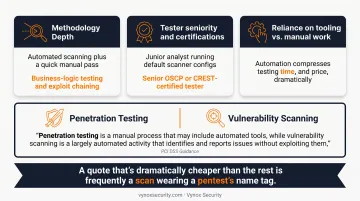
- Methodology depth — a proposal built around automated scanning plus a quick manual pass costs far less than one built around business-logic testing and exploit chaining.
- Tester seniority and certifications — a senior OSCP or CREST-certified tester costs more per day than a junior analyst running default scanner configs.
- Reliance on tooling vs. manual work — automation compresses testing time, and price, dramatically.
This distinction explains the sharpest price gaps you'll see: PCI's own guidance states plainly that penetration testing is a manual process that may include automated tools, while vulnerability scanning is a largely automated activity that identifies and reports issues without exploiting them. A quote that's dramatically cheaper than the rest is frequently a scan wearing a pentest's name tag.
What to Look for When Comparing Pentest Proposals
Comparing proposals on price alone is like comparing car quotes without checking whether one includes an engine. These six factors let you compare value per dollar instead.
Scope & Coverage Match
Check line-by-line that every proposal covers the same assets, user roles, and environments. If one vendor scopes 15 endpoints and another scopes 40, the lower price simply reflects less testing, not better value. Incomplete scope means blind spots attackers can walk straight through.
Testing Methodology & Depth of Manual Work
Ask specifically how much time is spent on authenticated testing, business-logic abuse cases, and exploitation chaining versus running automated tools. This single factor most directly influences how many exploitable, high-severity findings actually get uncovered, rather than how many findings simply appear on a page.
Tester Experience & Certifications
Request named tester profiles, not just company credentials. Certifications like OSCP, CREST, or CISSP signal technical caliber, but experience with your specific stack matters just as much. This affects both finding quality and your false-positive rate during triage.
Reporting & Deliverable Quality
A good report includes reproduction steps, CVSS-based risk ratings, and developer-ready remediation guidance, rather than a raw vulnerability dump. Ask to see a sample report before signing anything. Deliverable quality directly determines how fast your engineering team can close findings.
Retesting & Post-Engagement Support
Nail down whether retesting is included or billed separately, how many rounds you get, and the turnaround time. A vendor offering unlimited retests within scope changes your total cost of ownership completely compared to one charging per retest round. Faster retest turnaround shortens your actual window of exposure.
Compliance Evidence & Coverage of Modern Attack Surfaces
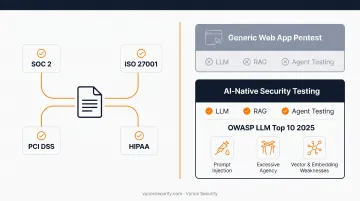
If compliance is driving the engagement, findings should map directly to frameworks like SOC 2, ISO 27001, PCI DSS, or HIPAA, without requiring you to translate them yourself. And if your product involves AI, check that the scope explicitly names LLM, RAG, or agent testing.
OWASP's 2025 LLM Top 10 lists risks like prompt injection, excessive agency, and vector/embedding weaknesses — categories a generic web app pentest was never built to test. This is the single most overlooked comparison point in proposals today.
Red Flags to Watch Out for in a Pentest Quote
Some warning signs matter regardless of what number sits at the bottom of the page:
- Vague scope descriptions: "web application testing" with no asset count, endpoint list, or role breakdown
- No named tester experience, meaning the proposal describes the company but never the person doing the work
- No sample report available: a legitimate vendor should show you exactly what you'll receive
- Unrealistically short timelines for a complex environment (three days for a 200-endpoint API is a scan, not a pentest)
- A price dramatically below every other quote with no explanation for the gap
- Hidden or missing retest costs — a low headline price that turns into a much higher total once you add mandatory paid retests
Any one of these should prompt a direct follow-up question before you sign, not after.
How Vynox Security Can Help You Get a Clear, Comparable Quote
We built Vynox's proposal process specifically so it's easy to hold up against any other quote you're evaluating. Scope, methodology, and deliverables are spelled out clearly enough that you can compare line by line, not just number by number.
A few things that show up in every Vynox proposal:
- Full OWASP LLM Top 10 coverage and 40+ prompt injection and jailbreak techniques on every AI engagement, closing the exact gap most traditional quotes leave open
- 5-15 business day delivery for most engagements, compared to 4-8 weeks at traditional firms
- Same-day retest verification once a fix reaches staging
- Findings mapped directly to SOC 2 and ISO 27001 control requirements, producing audit-ready evidence packs as part of the standard deliverable, not an add-on
- A 30-minute discovery call (book at cal.id/karan-singh) to scope your engagement precisely before we send a developer-ready proposal
We're rated 4.6/5 on G2 across verified reviews. Reviewers specifically call out testers who "clearly invested time in understanding our application's architecture and business logic before probing it" — the kind of manual depth a scan-based quote can't replicate.
Want to see what a real deliverable looks like before you commit? Ask for a sample report on the discovery call.
Conclusion
Comparing pentest quotes isn't about finding the lowest number on the page. Focus on the scope, depth, and deliverables that actually match your risk profile.
An underscoped quote can look attractive on paper and still leave real vulnerabilities undiscovered, including the AI-specific gaps most traditional proposals never mention.
A pentest isn't a one-time purchase, either. Your application, infrastructure, and AI stack keep evolving, so your scope should too. Revisit and re-scope on a recurring basis, whether through a fresh engagement or a continuous PTaaS cadence, rather than treating one report as permanent proof of security.
Frequently Asked Questions
Why are some penetration testing quotes more expensive than others?
Differences come from testing depth, tester expertise, methodology, and post-test deliverables, not markup alone. A quote built around manual, authenticated testing will cost more than one relying on automated scanning.
What should I look for in a penetration testing quote?
Check scope and asset coverage, methodology (black/white/grey-box), tester credentials, deliverable quality, and retesting terms. These five factors determine what you're actually paying for.
What is a reasonable penetration testing quote in 2026?
A focused web, API, or mobile pentest typically runs $5,000-$30,000. Cloud, network, red team, or AI-specific engagements can run higher depending on complexity.
Should I choose the cheapest penetration testing quote?
The cheapest option can work for a narrow, well-documented scope. But unusually low quotes often signal fewer testing days or minimal manual testing — ask why before assuming it's a bargain.
Does a lower quote mean the provider will only use automated scanning?
Not always, but confirm it directly. Ask about testing days, manual authenticated testing, and exact report contents to rule out scanner output dressed up as a pentest.
How many penetration testing quotes should I get before deciding?
Two to three quotes is usually enough to compare scope, methodology, and deliverables without the process becoming overwhelming.