According to Verizon's 2025 Data Breach Investigations Report, human involvement is present in roughly 60% of breaches — a figure that covers everything from stolen credentials to an employee simply being tricked into helping an attacker. Many organizations pour budget into MFA, endpoint detection, and next-gen firewalls, yet a single convincing phone call or spoofed email can walk right past all of it.
That's the gap social engineering penetration testing exists to close. This guide covers what it is, the techniques testers use, how a real engagement runs, the benefits organizations see, and how to do it without damaging employee trust.
Key Takeaways
- Human factors factor into roughly 60% of data breaches, making people the largest single attack surface
- Testing covers phishing, vishing, pretexting, and physical intrusion — not just email
- AI voice cloning and deepfakes already show up in real attacks, so tests must simulate them
- Proper scoping protects employees from blame and targets systemic gaps, not individuals
- Findings map directly to SOC 2, ISO 27001, and HIPAA control requirements
What Is Social Engineering Penetration Testing?
Social engineering penetration testing is an authorized, controlled engagement where ethical testers mimic real attacker tactics (phishing, pretexting, physical intrusion) to see how employees and processes actually respond to deception. It's carried out under a signed contract that explicitly authorizes the specific methods being tested.
The distinction from technical penetration testing matters. A web application VAPT engagement probes code, authentication logic, and session handling. A network penetration test looks for exposed services, firewall gaps, and lateral movement paths. Those exercises ask, "Can an attacker break the system?" Social engineering testing asks a different question entirely: "Can an attacker convince a person to open the door?"
The Goal Isn't to Catch Anyone Out
A well-run test is a diagnostic tool, not a gotcha exercise aimed at whoever clicks the link. The real output is a picture of where training, detection, and incident response break down. Those are organizational problems, not individual failures.
Why the Stakes Keep Rising
Business email compromise remains one of the costliest categories of cybercrime. The FBI's 2024 IC3 Annual Report recorded 21,442 BEC complaints with $2.77 billion in adjusted losses in a single year, alongside nearly 200,000 phishing and spoofing complaints. That's real money leaving real companies because someone believed a fraudulent request was legitimate.
Now add AI into the mix. Attackers are using voice cloning and deepfake video to impersonate executives convincingly enough to authorize wire transfers. In one case, a Hong Kong finance employee approved a $25 million transfer after a video call where every other "participant" was a deepfake. Realistic tests now need to account for that level of impersonation, not only email lures.
Not everyone agrees on how far testing should go, though. Overly aggressive scenarios can backfire on trust and morale. We'll come back to that in the ethics section below.
Common Social Engineering Attack Techniques Tested
Testers draw from the same playbook real attackers use. The techniques generally split into two categories: things done remotely through a screen or phone, and things done in person.
Digital & Remote Attack Techniques
These attacks don't require a tester to ever set foot in the building:
- Phishing — a mass or targeted email designed to trick recipients into clicking, downloading, or entering credentials—for example, a spoofed "CEO" email to finance requesting an urgent wire transfer.
- Spear phishing — a researched, personalized phishing message aimed at one individual, often using details from LinkedIn or a company bio page.
- Vishing — voice phishing over a phone call, often impersonating IT support or a vendor requesting account access.
- Smishing — the text-message version, frequently spoofing a delivery notification or internal HR system.
- Pretexting and impersonation — testers invent a plausible story (a new vendor, an auditor, a help-desk technician) to extract credentials or other sensitive information without ever sending a suspicious link.
AI has changed the difficulty curve here. KnowBe4's 2025 Phishing Threat Trends Report found that 73.8% of the phishing emails it analyzed showed signs of AI involvement, climbing to over 90% among messages with polymorphic elements designed to slip past filters.
Cloned executive voices are following the same trajectory. Testing programs increasingly need methodologies built to simulate that level of realism, not just a generic "click here" email from 2015.
Physical & On-Site Attack Techniques
Some engagements test whether the front door is actually locked:
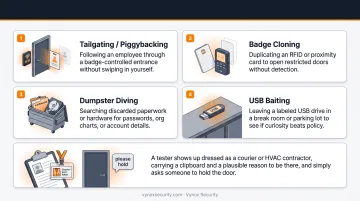
- Tailgating/piggybacking — following an employee through a badge-controlled entrance without swiping in yourself.
- Badge cloning — duplicating an RFID or proximity card to open restricted doors without detection.
- Dumpster diving — searching discarded paperwork or hardware for passwords, org charts, or account details.
- USB baiting — leaving a labeled USB drive in a break room or parking lot to see if curiosity beats policy.
A common real-world scenario: a tester shows up dressed as a courier or HVAC contractor, carrying a clipboard and a plausible reason to be there, and simply asks someone to hold the door.
Types of Social Engineering Penetration Tests
Engagements typically fall into three categories, depending on how much physical presence is involved.
| Test Type | What It Covers | Typical Use Case |
|---|---|---|
| On-site | Physical access attempts, badge policy checks, employee vigilance | Testing facility security controls directly |
| Off-site/remote | Phishing, vishing, and smishing campaigns run entirely from outside | Testing email filters, help-desk response, and reporting behavior |
| Hybrid | A remote attack chained into a follow-up physical visit | Simulating a realistic, multi-stage attacker |
Hybrid tests tend to be the most revealing because real attackers rarely stick to one channel. A phishing email that harvests a name and department can give a tester the exact pretext to talk past a front-desk receptionist an hour later.
The Social Engineering Penetration Testing Process
Every legitimate engagement follows a structured path. Skipping steps is usually where things go wrong.
Step 1: Scoping and Rules of Engagement
Before anything happens, scope must define which departments, attack vectors, and methods are permitted. This is backed by a signed contract granting explicit authorization. Without it, testers have no legal cover, and the client has no way to limit what's tested.
Step 2: Reconnaissance and OSINT
Testers gather intelligence in two ways:
- Passive reconnaissance: reviewing LinkedIn profiles, company websites, press releases, and leaked credential databases. This carries lower detection risk since nothing touches the target directly.
- Active reconnaissance: test calls, physical site observation, or probing questions. This is more detectable but yields sharper detail.
Step 3: Scenario Design and Execution
Testers map specific attack vectors to specific roles. Phishing aims at finance. Tailgating attempts target facilities and reception. Testers document every call, email, and door held open as it happens, not reconstructed afterward.
Step 4: Reporting, Remediation, and Retesting
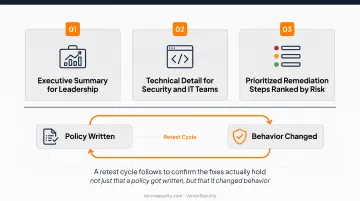
The final report should translate raw findings into three layers:
- An executive summary for leadership
- Technical detail for security and IT teams
- Prioritized remediation steps ranked by risk
A retest cycle follows to confirm the fixes actually hold: not just that a policy got written, but that it changed behavior.
Key Benefits of Social Engineering Penetration Testing
Generic phishing-click statistics only tell you how many people clicked a link. They don't tell you what happened next. A proper engagement reveals:
- Concrete, exploitable gaps in employee awareness that click-rate metrics alone can't capture
- Whether technical controls actually work: email filtering, MFA, badge systems, and anomaly detection under real attack conditions
- How fast staff report suspicious activity to security teams, a critical detection and incident-response metric
- Compliance-mappable evidence for human-risk requirements in SOC 2, ISO 27001, and HIPAA security awareness rules under 45 CFR 164.308(a)(5)(i)
That last point matters more than it sounds. A finding that says "22% of employees provided credentials over the phone" is far more useful to an auditor, and to a CISO's budget request, than a training completion checkbox.
Ethical Considerations and Choosing the Right Testing Partner
Social engineering testing has a real reputational risk if it's scoped poorly. The most cited cautionary example: a UK rail operator promised staff a bonus in a test email, and the backlash after the deception was revealed made national news.
Threatening scenarios, tracking employees' personal devices, or exploiting family-emergency pretexts cross a line fast, legally and ethically.
A Blameless Approach Works Better
The organizations that get the most value from these engagements treat every "failure" as a systemic signal, not a personnel issue. Remediation should target detection gaps, reporting workflows, and training content — not the individual who happened to answer the phone that day.
Vetting a Testing Partner
Before signing a contract, check for:
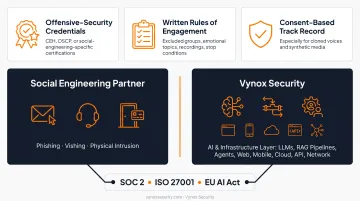
- CEH, OSCP, or social-engineering-specific credentials that prove offensive-security competence
- Written rules of engagement covering excluded groups, emotional topics, recordings, and stop conditions
- A consent-based track record, especially for cloned voices or synthetic media
That last point is where AI complicates vendor selection. Attacks now blend human deception with generated voice, video, and text, and those skills rarely sit in one firm.
A specialized social engineering partner can still own phishing, vishing, and physical intrusion. Pair that with a firm like Vynox Security for the AI and infrastructure layer attackers use next: LLMs, RAG pipelines, and agents that craft phishing content or hold the data behind a successful human-layer breach.
Vynox also tests the web, mobile, cloud, API, and network controls that matter after a social engineering attempt lands. Findings ship with developer-ready fixes and map to SOC 2, ISO 27001, and the EU AI Act, so they fit the same audit package as your social engineering report.
Frequently Asked Questions
What is the difference between social engineering testing and a phishing simulation?
Phishing simulation is one narrow technique focused on email. Social engineering testing is broader, covering vishing, pretexting, smishing, and physical intrusion attempts alongside email-based attacks.
How often should organizations run social engineering penetration tests?
At least annually is a reasonable baseline, with more frequent testing for organizations handling sensitive data, undergoing compliance audits, or facing elevated fraud risk. Frequency should ultimately be risk-based rather than a fixed calendar rule.
Is social engineering penetration testing legal?
Yes, when conducted under a signed authorization contract that defines scope, methods, and boundaries in advance. Without that written permission, the same activity is indistinguishable from actual fraud or trespassing.
What certifications should a social engineering penetration tester have?
Broad credentials like CEH or OSCP demonstrate general offensive-security skill. Specialist programs focused on social engineering tradecraft (OSINT, phishing, vishing, and report writing) provide more direct proof of relevant expertise.
Can social engineering tests now include AI-generated deepfake attacks?
Yes. Some testing providers now incorporate cloned voice content into vishing scenarios, always with explicit consent from anyone whose voice is used. That approach shows how convincing modern AI-assisted attacks have become.
What happens if an employee fails a social engineering test?
A "failure" should trigger targeted training and process improvements, not punitive action. The goal is reducing systemic risk across the organization, not identifying individuals to blame.