Some blogs say it's mandatory. Others say it's optional. Both are technically right, which is exactly the problem.
This guide clears up the confusion: what the AICPA's Trust Services Criteria actually say, how a pentest maps to specific controls, realistic scope and cost benchmarks, and what changes when you're running LLMs, RAG pipelines, or autonomous agents in production.
Key Takeaways
- SOC 2 doesn't explicitly mandate a pentest, but auditors now treat it as default proof of due diligence
- Pentests supply direct evidence for CC4.1, CC6.1/CC6.6/CC6.7, and CC7.1
- Test annually, and again after major app, infrastructure, or AI model changes
- LLMs, RAG pipelines, and AI agents need testing traditional SOC 2 pentests often miss
What Is SOC 2 Penetration Testing?
Penetration testing is a simulated, authorized cyberattack. Security professionals actively try to break into your systems the same way a real attacker would, then document exactly how they got in and what they could access.
A SOC 2 pentest applies that same methodology to the specific systems and controls in scope for your audit. Instead of testing everything you own, testers focus on what maps back to the AICPA's Trust Services Criteria (TSC), the benchmark auditors use to define what "good security" looks like.
That means production applications, APIs, cloud infrastructure, and authentication systems, not your marketing website or an internal tool nobody touches.
SOC 2 Type I vs Type II: Why Timing Matters for Pentesting
Type I is a point-in-time snapshot. It checks whether your controls are designed correctly on a specific date.
Type II is different. It evaluates whether those controls actually operated effectively over a review period, commonly three to twelve months.
That timing gap changes when you should run your pentest:
- Run the pentest early in the review window instead of waiting until the end.
- Build in time to remediate and retest findings, creating the clean detection-and-fix trail auditors expect.
- Avoid last-minute testing. It leaves no room to fix critical findings before evidence collection ends, turning a clean report into one full of noted exceptions.
Does SOC 2 Require Penetration Testing?
Here's the direct answer: no, SOC 2 does not explicitly require penetration testing.
The relevant criterion is CC4.1, tied to COSO Principle 16. The AICPA states that management uses several evaluation methods to assess controls:
"...a variety of different types of ongoing and separate evaluations, including penetration testing, independent certification made against established specifications... and internal audit assessments." — 2017 Trust Services Criteria, AICPA
Notice the word "including." Pentesting sits in a list of examples, not a required line item. An organization could theoretically satisfy CC4.1 through internal audits or other evaluation methods alone.
So why does everyone treat it as mandatory? Tradition and expectation. Most vendor security questionnaires now ask for recent pentest results or attestation letters as standard due diligence. Enterprise prospects and auditors alike have come to expect one, even though nothing in the TSC forces it.
Skipping the pentest carries real business risk:
- Face longer, more invasive security questionnaires from prospects seeking extra proof
- Handle ad-hoc pentest demands that surface mid-deal, often under a tight closing deadline
- Lose deals to competitors who can produce a recent report on request
Practical cadence follows a few clear triggers:
- Test at minimum annually to maintain baseline coverage
- Retest after major changes to applications, APIs, cloud infrastructure, or authentication systems
- Add a retest after significant AI model or pipeline updates if you're running AI-powered products
Mature organizations are increasingly moving away from a single annual test toward continuous, sprint-aligned testing. Release cycles have gotten faster, and a once-a-year snapshot doesn't keep pace with weekly deploys. PTaaS models, including Vynox's sprint- and model-update-aligned testing, keep evidence audit-ready year-round instead of scrambling before the assessment window closes.
What Tests Are Included in a SOC 2 Audit?
SOC 2 audits evaluate controls against up to five Trust Services Criteria:
| Category | Focus |
|---|---|
| Security | Protection against unauthorized access, disclosure, or damage |
| Availability | Systems available for operation as committed or agreed |
| Processing Integrity | Complete, accurate, and authorized processing |
| Confidentiality | Protection of information designated confidential |
| Privacy | Collection, use, and disposal of personal information |
Security is the one category every SOC 2 report addresses, and it's the category pentests most directly support.
How Penetration Testing Maps to Specific Trust Services Criteria
Pentest evidence doesn't map to one control. It supports several at once:
- CC4.1: Confirms an independent security evaluation actually happened, satisfying the "ongoing and separate evaluations" requirement
- CC6.1, CC6.6, CC6.7: Testers attempt real exploitation of authentication, authorization, and data-in-transit/at-rest protections, giving auditors proof beyond a policy document
- CC7.1 and CC7.2: Findings reveal whether your vulnerability identification and remediation process functions in practice, not just on paper
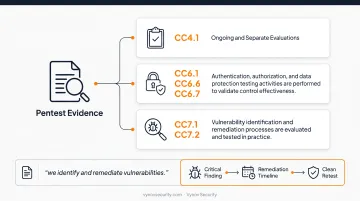
A pentest report that shows a critical finding, a remediation timeline, and a clean retest is often stronger evidence than a policy stating "we identify and remediate vulnerabilities."
Vulnerability Scanning vs. Penetration Testing as SOC 2 Evidence
Vulnerability scanning is automated and continuous. It scans your environment for known weaknesses on a recurring schedule. Like pentesting, it's not explicitly mandatory under SOC 2, but it's commonly used to support CC7.1.
Auditors generally view manual pentesting as stronger evidence, and for good reason. Scanners flag known signatures. They can't chain three low-severity issues into a critical account takeover, spot a business logic flaw in your checkout flow, or bypass access controls through a workaround a human tester would try.
This distinction matters because vulnerability exploitation was an initial access vector in 20% of breaches in 2025, a 34% year-over-year increase, according to Verizon's 2025 Data Breach Investigations Report. Known, exploitable weaknesses are increasingly how attackers get in.
The practical standard most SOC 2-bound companies land on: continuous scanning for ongoing visibility, paired with periodic or continuous pentesting for the deeper validation that scanning alone can't provide.
SOC 2 Pentest Scope, Types, Cost & Frequency
Choosing a Testing Methodology: Black, White, or Grey Box
- Black box — testers start with zero knowledge, mimicking an outside attacker
- White box — testers get full access to source code and architecture documentation
- Grey box — testers work with partial knowledge, such as a standard user account
Grey box testing tends to be the most efficient balance for SOC 2 validation. It mirrors realistic attacker scenarios (a compromised credential, an insider threat) without burning testing hours mapping your entire environment from scratch.
Defining the Right Scope
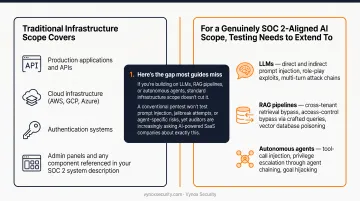
Traditional infrastructure scope should cover:
- Production applications and APIs
- Cloud infrastructure (AWS, GCP, Azure)
- Authentication systems
- Admin panels and any component referenced in your SOC 2 system description
Here's the gap most guides miss: If you're building on LLMs, RAG pipelines, or autonomous agents, standard infrastructure scope doesn't cut it. A conventional pentest won't test prompt injection, jailbreak attempts, or agent-specific risks, yet auditors are increasingly asking AI-powered SaaS companies about exactly this.
For a genuinely SOC 2-aligned AI scope, testing needs to extend to:
- LLMs — direct and indirect prompt injection, role-play exploits, multi-turn attack chains
- RAG pipelines — cross-tenant retrieval bypass, access-control bypass via crafted queries, vector database poisoning
- Autonomous agents — tool-call injection, privilege escalation through agent chaining, goal hijacking
Cost and Duration Benchmarks
This expanded scope directly shapes what a credible engagement costs. Published benchmarks put a third-party SOC 2 pentest at roughly $5,000 to $20,000, with most engagements clustering around $8,000 to $10,000, according to Secureframe's pen testing FAQ. Highly complex environments can run well past that range.
Scope and complexity drive the price. A single API with a handful of endpoints costs far less than a multi-tenant SaaS platform with mobile apps, cloud infrastructure, and an AI layer.
Duration typically runs one to four weeks, depending on scope. Be cautious of "express" one to three day tests that lean entirely on automated scanning. They'll produce a report, but not the manual exploitation depth auditors and enterprise buyers now expect.
How Vynox Security Helps You Meet SOC 2 Pentest Expectations
Most pentest firms test your infrastructure and stop there. If you're running AI in production, that leaves a gap exactly where auditors are starting to ask harder questions.
Vynox Security tests both layers in one engagement: traditional infrastructure (web, mobile, API, cloud, network) and the AI-specific attack surface (LLMs, RAG pipelines, autonomous agents). Every AI engagement covers the full OWASP LLM Top 10 and applies 40+ prompt injection and jailbreak techniques, an area generic pentest firms typically don't test for at all.
Findings come mapped directly to SOC 2 and ISO 27001 control requirements, packaged into assessor-ready evidence with executive summaries, reproduction steps, CVSS scores, and stack-specific remediation guidance. That's one workstream instead of two.
Speed and continuity matter just as much as coverage:
- Turnaround: Most engagements deliver in 5 to 15 business days, versus the industry-typical 4 to 8 weeks.
- Retest cadence: Vynox's PTaaS model aligns testing to sprints and model updates, with same-day retest verification once a fix hits staging.
- Visibility: A real-time dashboard tracks open vulnerabilities and posture score throughout the engagement.
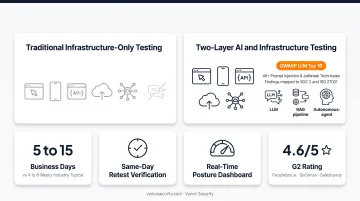
That continuous cadence is exactly what Type II audits reward, since it shows controls operating effectively across the whole review period rather than at one snapshot in time.
This reliability shows up in client feedback too. Vynox holds a 4.6/5 rating on G2 across verified reviews, with clients including Peoplebox.ai, SixSense, and Saleshandy. If you're mapping out a SOC 2 pentest strategy, the discovery team offers a free 30-minute scoping call to review your stack and recommend the right engagement tier.
Frequently Asked Questions
Does SOC 2 require penetration testing?
No. SOC 2's CC4.1 lists penetration testing as one acceptable evaluation method among several, not a mandatory requirement. In practice, though, most auditors and enterprise customers treat a recent pentest as the default proof of due diligence.
What tests are included in a SOC 2 audit?
Depending on your risk profile, a SOC 2 evaluation can draw on vulnerability scans, penetration tests, internal audits, and third-party assessments. Security is the one Trust Services Criteria category every audit covers.
What is penetration testing in cybersecurity?
It's a simulated, authorized cyberattack where security professionals actively try to exploit weaknesses in your systems. The goal is identifying and validating vulnerabilities before a real attacker finds them.
How often should a SOC 2 pentest be performed?
At least annually, plus after any major application, infrastructure, or authentication change. If you run AI products, add a retest after significant model or pipeline updates too.
How much does a SOC 2 penetration test cost?
Most credible third-party engagements run $5,000 to $20,000, with scope, complexity, and testing depth driving where you land in that range. Multi-tenant platforms with AI components typically sit at the higher end.
Can vulnerability scanning replace penetration testing for SOC 2?
Not fully. Scanning supports CC7.1 by flagging known weaknesses, but it lacks the manual exploitation depth, business logic testing, and attack-chaining that auditors expect from a full pentest.