Introduction
Most cloud breaches don't start with sophisticated attacks. They start with a misconfigured S3 bucket, an IAM role nobody remembers creating, or a developer account that stayed active six months after the employee left.
According to IBM's 2024 Cost of a Data Breach Report, breaches involving public cloud infrastructure averaged $5.17 million — the highest of any environment studied. Meanwhile, CSA's 2024 research found that 31% of organizations who experienced a cloud breach attributed it directly to misconfiguration or human error.
As teams layer AI workloads, microservices, and multi-cloud deployments on top of existing infrastructure, the attack surface grows faster than any manual process can track. New instances spin up, permissions shift, and third-party integrations get added — often without security review. A posture that passed last quarter's check can degrade to a critical vulnerability overnight.
A structured cloud infrastructure security assessment is built to solve exactly that — and this guide covers how to run one: what to examine, how to prioritize findings, and what a completed assessment should produce.
TL;DR
- A cloud infrastructure security assessment systematically evaluates your cloud environment's configurations, access controls, data security, and workloads to find vulnerabilities before attackers do.
- Misconfigurations, not sophisticated hacking, remain the leading cause of cloud breaches.
- Assessments cover IAM policies, network security, storage encryption, compliance posture, and vulnerability testing.
- Dynamic cloud environments develop blind spots fast — new instances and changed permissions can introduce critical risk overnight.
- Findings should map directly to compliance frameworks (SOC 2, ISO 27001, PCI DSS) and drive ongoing remediation priorities.
What Is a Cloud Infrastructure Security Assessment?
A cloud infrastructure security assessment is a structured evaluation of an organization's cloud environment — examining configurations, identity and access controls, network architecture, data storage practices, and workload security to identify vulnerabilities, misconfigurations, and compliance gaps.
What It Covers
A thorough assessment examines:
- IAM policies and user permissions: service accounts, role assignments, and MFA enforcement
- Network segmentation and firewall rules: open ports and overly permissive security groups
- Storage encryption — data at rest and in transit, including public bucket exposure
- Logging and monitoring: whether audit trails exist and capture the right events
- Workload security — VMs, containers, serverless functions, and AI pipelines running on cloud resources
- Platform service configurations: provider-specific settings across AWS, GCP, and Azure
Assessment Types
The main types differ in scope, frequency, and who runs them:
| Type | What It Is |
|---|---|
| Internal self-assessment | Team-led review using benchmarks like CIS Controls |
| Third-party assessment | External experts bring independence and broader threat context |
| Point-in-time evaluation | Snapshot of posture at a specific moment |
| Continuous posture management (CSPM) | Ongoing automated monitoring between formal assessments |
| Compliance-specific assessment | Scoped to SOC 2, HIPAA, ISO 27001 requirements |
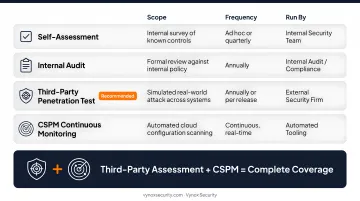
Each approach has its place. Most organizations get the most coverage by pairing a formal third-party assessment with CSPM tooling — the assessment provides depth and context that automated scanning alone won't surface.
Why Cloud Infrastructure Security Assessments Are Critical
Misconfigurations Are the Primary Attack Vector
CSA's 2024 Top Threats report ranked "Misconfiguration and Inadequate Change Control" as the number one cloud threat, with IAM issues ranked second. Both are operational failures — not exotic exploits — and they account for the majority of documented cloud breaches.
Exposed storage buckets, overprivileged IAM roles, and disabled audit logging consistently appear in breach post-mortems. The challenge isn't that organizations don't know these risks exist. It's that cloud environments change continuously, and misconfigurations accumulate silently.
The Shared Responsibility Model Gap
AWS's shared responsibility model is clear: AWS secures the underlying infrastructure; customers are responsible for securing their data, identities, applications, and configurations. The same division applies across Azure and GCP.
In practice, many teams underestimate the scope of what falls on the customer side — particularly around IAM configuration, guest OS patching, security group rules, and data classification. A cloud security assessment maps exactly which controls fall on the customer side — and tests whether they're in place.
Dynamic Environments Create Compounding Blind Spots
Developers spin up new instances, modify permissions, and deploy services continuously. A permission granted in January may quietly expand by June with no one noticing. Without regular assessment, these incremental changes compound into a security posture nobody has fully reviewed — and that gap is exactly what auditors look for.
Compliance Obligations Require Documented Evidence
Regulations don't just ask whether you have cloud security controls — they ask for proof:
- SOC 2 (AICPA CC3, CC7) requires risk identification, analysis, and monitoring for configuration changes
- ISO 27001 Annex A control 5.23 mandates information security processes governing cloud service acquisition and management
- HIPAA (45 CFR 164.308) requires an accurate and thorough risk assessment covering electronic protected health information
- GDPR Article 32(1)(d) requires regular testing and evaluation of technical security measures
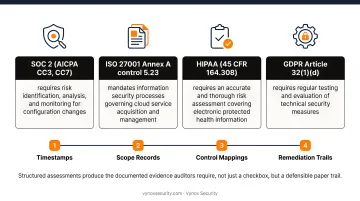
Structured assessments produce the documented evidence auditors require: timestamps, scope records, control mappings, and remediation trails — not just a checkbox, but a defensible paper trail.
How to Conduct a Cloud Infrastructure Security Assessment – Step by Step
The most common failure points in cloud assessments: rushing asset discovery, skipping penetration testing, and treating the whole exercise as a one-time event. The steps below are sequenced to avoid all three.
Step 1 – Define Scope and Objectives
Start by answering: which platforms (AWS, Azure, GCP), which environments (production, staging, dev), and what's the primary focus (compliance readiness, IAM hygiene, threat detection)?
A poorly scoped assessment wastes resources and leaves gaps. Stakeholders beyond the security team should be in this conversation — IT managers, compliance leads, and legal counsel may all have input on what needs to be covered and why.
Step 2 – Inventory and Classify Cloud Assets
Asset discovery needs to capture everything:
- Compute: VMs, containers, serverless functions
- Storage: buckets, databases, snapshots, AMIs
- Networking: VPCs, security groups, load balancers
- SaaS integrations and API connections
- AI workloads: model-serving infrastructure, training pipelines, vector databases
Classify assets by criticality and sensitivity. Resources handling customer data, credentials, or model outputs warrant deeper scrutiny than isolated dev environments.
Step 3 – Evaluate Security Controls and IAM
The IAM review is where most critical findings surface. Checks should cover:
- Overprivileged accounts and service roles
- Inactive users who still hold access
- Missing MFA on admin and privileged accounts
- Shared credentials
- Service accounts with excessive permissions
NIST defines least privilege as restricting access to the minimum necessary to accomplish assigned tasks — violations of this principle are among the most exploited weaknesses in cloud environments.
Configuration review runs in parallel: scan against provider-specific benchmarks to surface misconfigurations at the baseline level.
- CIS Controls v8.1
- CIS AWS Foundations Benchmark v5.0.0
- CIS Azure Foundations Benchmark v6.0.0
- CIS GCP Foundation Benchmark v5.0.0
Step 4 – Run Vulnerability Scans and Penetration Testing
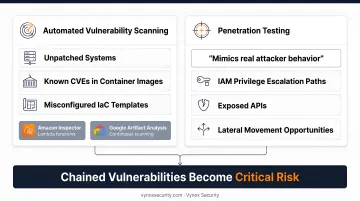
Automated vulnerability scanning identifies unpatched systems, known CVEs in container images, and misconfigured IaC templates. Tools like Amazon Inspector (for Lambda functions) and Google Artifact Analysis provide continuous scanning for new vulnerabilities against stored assets.
Penetration testing picks up what automated scanning misses. NIST frames it as mimicking real attacker behavior — finding combinations of vulnerabilities that scanners flag individually but can't fully evaluate together. It confirms exploitability for IAM privilege escalation paths, exposed APIs, and lateral movement opportunities that only become dangerous when chained.
Step 5 – Analyze Results and Prioritize by Risk
Rank findings by severity (critical/high/medium/low) combined with business impact. A publicly accessible S3 bucket in production warrants faster remediation than the same issue in an isolated test environment — even if the technical finding is identical.
Threat modeling at this stage helps engineering teams understand the "so what": how specific vulnerabilities chain into an actual attack path, and which fixes deliver the highest risk reduction.
Step 6 – Remediate, Document, and Plan for Continuous Assessment
Remediation guidance should be specific enough to act on immediately. Not "tighten IAM policies" — but which accounts, which permissions, and what to change.
Document everything. Findings and remediation steps form the compliance evidence pack that auditors will review for SOC 2, ISO 27001, and HIPAA. Schedule re-assessment as a recurring cycle tied to development sprints, major deployments, or model updates — not as a calendar obligation after a breach.
Cloud Infrastructure Security Assessment in Practice: A Walkthrough
A SaaS company preparing for a SOC 2 Type II audit ran a cloud security assessment of their AWS environment. What the team expected to find: a few minor configuration issues. What the assessment actually found: multiple critical gaps.
Asset discovery revealed resources the team didn't know existed:
- Staging environments containing production customer data
- Developer accounts from former employees still active with broad permissions
- A third-party analytics integration with AdministratorAccess granted via an IAM role nobody had reviewed in over a year
The IAM and configuration review surfaced the highest-risk findings:
- One service account had full AdministratorAccess with no MFA enforced
- Several S3 buckets had public read access enabled — each one a textbook SOC 2 failure and straightforward attacker entry point
Penetration testing confirmed what automated scans couldn't. Testers demonstrated that the overprivileged service account could be used to escalate privileges across multiple AWS services and exfiltrate data without triggering any existing alerts. The finding wasn't theoretical — testers produced a working exploit chain that existing monitoring would have missed entirely.
Remediation reporting produced a prioritized list with developer-ready guidance: specific IAM policy changes, S3 bucket policy corrections, logging configurations for CloudTrail and S3 access logs, all mapped to the relevant SOC 2 Trust Services Criteria controls. With everything scoped and mapped to audit controls, the team remediated within a single sprint and passed their SOC 2 audit.
How VYNOX Can Help With Your Cloud Infrastructure Security Assessment
Vynox covers cloud infrastructure assessments across AWS, GCP, and Azure — built specifically for organizations running AI workloads, not just routine misconfiguration checks.
Most firms treat cloud assessments as isolated infrastructure reviews. Vynox's methodology explicitly includes AI workload isolation and pipeline access review, because a single misconfigured bucket can expose model weights, training data, and source code.
What sets Vynox's cloud assessments apart:
- Two testing tiers: Standard (5–15 business days) for misconfiguration and access control review; Detailed (3–5 weeks) for active exploitation validation, including IAM privilege escalation path mapping, public exposure review, and secrets management assessment
- Compliance-ready evidence packs mapped to SOC 2, ISO 27001, PCI DSS, and ISO 42001 — assessor-ready from a single engagement, not a separate workstream
- Remediation guidance tailored to your actual stack — specific policy changes, specific resources, specific fixes — not generic CVE advisories
- PTaaS option for continuous sprint-aligned coverage, with same-day retest verification when fixes hit staging
- Cloud assessment findings connect directly to LLM security, API security, and AI pipeline testing for full-stack coverage
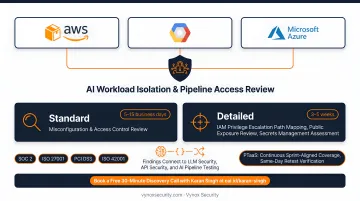
Those differentiators matter most when your cloud environment feeds an AI product — where misconfigurations carry downstream risk beyond infrastructure alone. Organizations preparing for a SOC 2 audit, completing a major cloud deployment, or building a continuous security program can book a free 30-minute discovery call with Karan Singh at cal.id/karan-singh to scope an engagement matched to their environment and compliance goals.
Frequently Asked Questions
What is a cloud infrastructure security assessment?
A structured evaluation of an organization's cloud environment covering configurations, IAM, network security, data protection, and workloads — designed to identify vulnerabilities, misconfigurations, and compliance gaps before they can be exploited. It applies across public, private, and hybrid cloud setups.
How do I prepare for a cloud infrastructure security assessment?
Document your cloud architecture, asset inventory, and existing IAM and logging configurations before the engagement starts. Define scope (prod/staging/dev) and align security, IT, compliance, and legal stakeholders early to avoid delays mid-assessment.
What are the security measures for cloud infrastructure?
Core controls include least-privilege IAM with MFA enforcement, encryption for data at rest and in transit, network segmentation and firewall rules, continuous logging and monitoring, and vulnerability scanning for workloads. Regular assessments validate that all controls remain effective as the environment evolves.
What are the 4 C's of cloud security?
A defense-in-depth model from the Kubernetes documentation: Code (securing application code and dependencies), Container (securing containerized workloads and images), Cluster (securing orchestration platforms like Kubernetes), and Cloud (securing the underlying cloud infrastructure). Weaknesses in an outer layer can't be fully corrected from an inner layer alone.
How often should a cloud infrastructure security assessment be conducted?
At minimum annually — but teams with active development cycles should align assessments with major deployments or significant infrastructure changes. NIST SP 800-53 Rev. 5 supports risk-based frequency over fixed intervals, and CSPM tooling can maintain continuous visibility between formal engagements.
What is the difference between a cloud security assessment and a penetration test?
A cloud security assessment is a broad evaluation of configurations, controls, and compliance posture across the entire environment. A penetration test is a targeted, adversarial exercise that attempts to exploit specific vulnerabilities. The two are often conducted together — the assessment identifies what to test, and the pentest confirms whether findings are genuinely exploitable.