Introduction
A traditional annual penetration test gives you one snapshot of your security posture, then goes stale the moment your next sprint ships. Meanwhile, attackers aren't waiting for your test cycle.
Mandiant's analysis of 138 vulnerabilities exploited in 2023 found the average time-to-exploit had dropped to just 5 days, down from 32 days the prior two years.
That gap is even wider for AI systems. Your LLM prompts, RAG pipelines, and agent permissions can change with every model update, yet most security programs still test once a year.
This guide breaks down what PTaaS is, how it works, what it costs, and what to look for in a provider, including coverage for AI-specific risks like prompt injection and jailbreaking.
Key Takeaways
- Traditional pentests capture one moment in time, while PTaaS tests continuously across every sprint and release
- Same-day retest turnaround closes remediation gaps that used to take weeks
- Findings map directly to SOC 2, ISO 27001, and emerging AI compliance frameworks
- Legacy PTaaS providers often miss LLM, RAG, and agent-specific attack surfaces
- Pricing follows subscription or scoped models rather than one large annual invoice
What Is Penetration Testing as a Service (PTaaS)?
PTaaS is a subscription or platform-based delivery model that pairs human-led manual penetration testing with a continuous, cloud-based platform for real-time findings, retesting, and reporting. It's different from the traditional model of a consulting firm showing up once a year, testing for two weeks, and handing over a static PDF.
A PTaaS engagement typically includes:
- Dedicated testing dashboard showing live findings and remediation status
- Hybrid testing that combines automated tooling with manual, expert-led exploitation
- Continuous or on-demand test cadence, not a single fixed date
- Direct access to testers and security engineers for remediation questions
Scope usually spans external and internal networks, web applications, mobile apps (iOS and Android), cloud infrastructure, APIs, and, increasingly, AI systems such as LLMs, RAG pipelines, and autonomous agents.
A common misconception: PTaaS is not just automated vulnerability scanning with a nicer interface, and it isn't the same thing as "cloud pentesting."
Scanners are great at catching known CVEs and misconfigurations. They're terrible at finding chained business-logic flaws, like an authorization bypass that only becomes exploitable when combined with a specific API sequence. That's where human testers still earn their keep.
Traditional Penetration Testing vs. PTaaS
The differences show up across four dimensions: how often testing happens, how findings get delivered, how you pay for it, and how fast retests turn around.
| Dimension | Traditional Pentest | PTaaS |
|---|---|---|
| Cadence | Annual or point-in-time | Continuous, sprint-aligned |
| Delivery | Static PDF report | Live dashboard with real-time updates |
| Cost structure | Large upfront project fee | Subscription or scoped pricing |
| Retest turnaround | Weeks, often a new engagement | Same-day in mature providers |
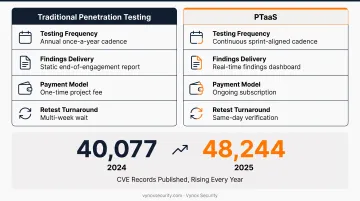
The stakes of that annual gap keep growing. The CVE Program recorded 48,244 published CVE records in 2025, up from 40,077 in 2024. Every one of those disclosures is a potential new hole in your stack that a once-a-year test simply won't catch until the next cycle.
How Does PTaaS Work? (The Process)
A PTaaS engagement follows a recognizable lifecycle, but it repeats far more often than a traditional pentest ever would.
- Scoping and planning — Define goals, in-scope systems, and rules of engagement, often during a discovery call before any testing begins
- Reconnaissance — Map the attack surface, including endpoints, APIs, and (for AI systems) prompt entry points and data sources
- Vulnerability assessment — Combine automated scanning with manual analysis to identify potential weaknesses
- Exploitation — Attempt to actively exploit findings to confirm real-world impact, not just theoretical risk
- Post-exploitation analysis — Assess what an attacker could do next: lateral movement, data exposure, or privilege escalation
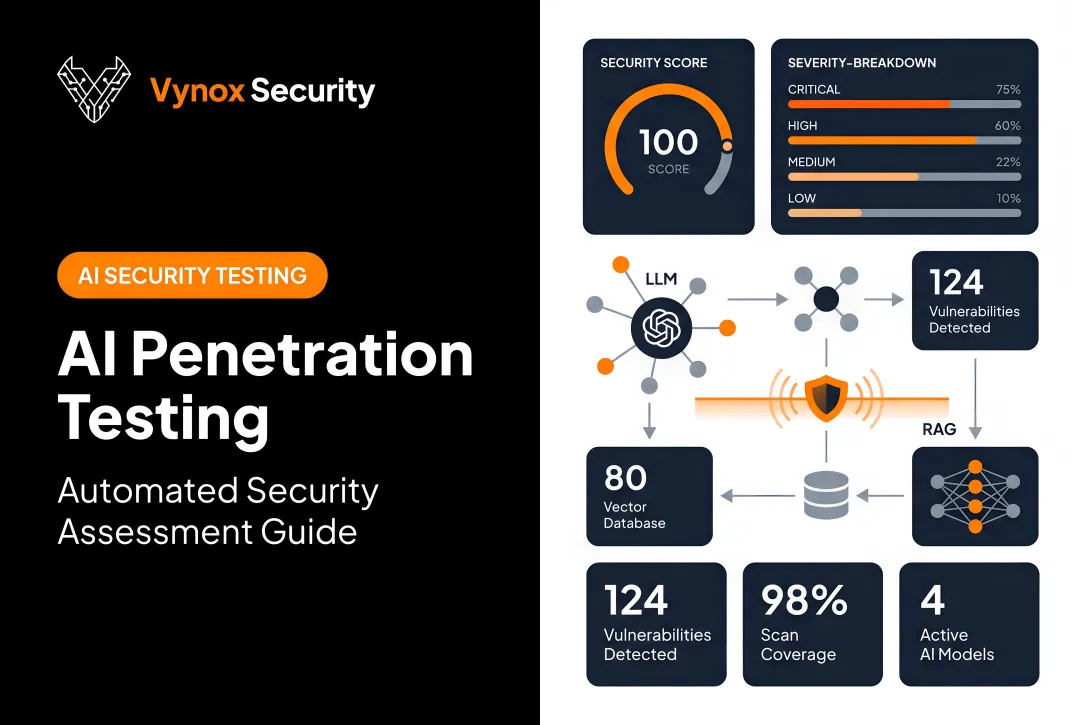
Findings don't wait for a final report. Mature PTaaS platforms surface issues on a live dashboard as testing progresses, complete with severity ratings, proof-of-concept steps, and business impact context. Vynox Security's platform, for example, tracks open vulnerabilities across four severity tiers, Critical, High, Medium, and Low, alongside an overall security posture score.
The remediation loop is where PTaaS earns its value. Once engineers push a fix to staging, they request a retest directly through the platform. Vynox commits to same-day retest verification, a standard confirmed by a verified G2 reviewer who noted fixes were "verified the same day our engineer pushed them to staging."
This cadence integrates naturally into DevSecOps and CI/CD workflows, triggering tests by code push, sprint, or scheduled interval rather than one annual event.
Engagement timelines reflect this speed too:
| Engagement Type | Typical Duration |
|---|---|
| API testing | 3-5 days |
| Standard PTaaS engagement | 5-15 business days |
| RAG pipeline or agent testing | 10-15 days |
| AI Red Teaming | 3-5 weeks |
| Legacy consulting-style pentest | 4-8 weeks |
Deeper AI Red Teaming engagements simulate a determined adversary pursuing an objective end-to-end, reflecting the added work of threat modeling and exploit chaining.
Key Benefits of PTaaS
PTaaS beats traditional testing on cost and coverage, delivering continuous protection that an annual snapshot can't match.
Key benefits include:
- Continuous visibility: Testing aligns with development cycles and model updates instead of a single annual snapshot, shrinking the window attackers have to work with.
- Cost-effectiveness and scalability: Full-time testers are scarce and expensive — 59% of practitioners report critical skills gaps, up from 44% in 2024. PTaaS delivers specialized talent without an internal build-out.
- Faster time-to-remediation: Developers get prioritized, reproducible findings with clear reproduction steps instead of a generic vulnerability list, so fixes happen in hours, not weeks.
- Compliance support: Findings map directly to frameworks like SOC 2 and ISO 27001, generating audit-ready evidence as testing happens rather than in a pre-audit scramble.
- Centralized posture tracking: A live dashboard tracks total assets, open vulnerabilities by severity, and active engagements, giving leadership a real-time risk view instead of a report that's outdated within weeks.
PTaaS for Modern AI Systems: LLMs, RAG Pipelines, and Agents
Here's the problem most companies don't realize until it's too late: most legacy PTaaS providers built their testing programs around web, network, and cloud attack surfaces. They never accounted for what happens when a user manipulates an LLM's system prompt or poisons a RAG retrieval pipeline.
AI systems introduce attack vectors that don't exist in traditional infrastructure:
- Prompt injection, where crafted inputs override a model's intended instructions
- Jailbreaking, a form of prompt injection that bypasses safety guardrails entirely
- Training data leakage, where models expose sensitive information learned during training
- Autonomous agent misuse, where excessive permissions let an agent take damaging actions
OWASP's 2025 LLM Top 10 now formalizes these risks, covering everything from prompt injection and sensitive information disclosure to vector and embedding weaknesses that directly affect RAG retrieval.
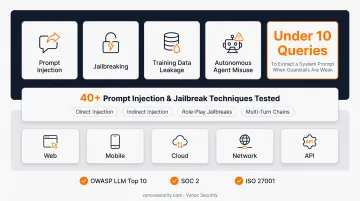
Vynox Security built its testing methodology around exactly this gap. Its AI Security Testing layer covers 40+ prompt injection and jailbreak techniques in a single engagement, including:
- Direct injection through user-facing prompts and inputs
- Indirect injection via retrieved documents and external content
- Role-play and persona-based jailbreak exploits
- Multi-turn attack chains that build toward a breach
System prompt extraction, for instance, is often achievable in under 10 queries when guardrails are weak. This sits alongside a supporting Infrastructure Testing layer covering web, mobile, cloud, network, and API surfaces, so nothing in the stack goes untested.
Findings from this AI-aware layer map to full OWASP LLM Top 10 coverage plus AI-specific controls under SOC 2 and ISO 27001, closing a compliance gap most traditional PTaaS vendors simply don't address.
How Much Does PTaaS Cost?
PTaaS pricing typically follows a subscription or pay-as-you-go structure rather than one large fixed-fee project, which makes budgeting far more predictable than a traditional consulting engagement.
Several factors shape the final price:
- Scope: number of applications, assets, and AI systems included in testing
- Testing frequency: one-time assessment versus continuous, sprint-aligned testing
- Depth of manual testing: standard vulnerability coverage versus full adversarial red teaming
- Compliance reporting requirements: basic findings versus assessor-ready evidence packs
There's no universal industry benchmark for what PTaaS "should" cost, since pricing varies enormously by scope and provider. That's exactly why transparent, stage-appropriate quoting matters.
Vynox structures pricing from startup to enterprise tiers, with Rapid Secure for compliance-ready, fast-turnaround needs and Deep Secure for comprehensive adversarial coverage including AI red teaming.
Before committing, compare total cost of ownership against hiring in-house testers or booking annual consulting engagements. A free discovery call, like the 30-minute scoping session Vynox offers, typically produces indicative pricing and timelines without a lengthy sales cycle.
What to Look for in a PTaaS Provider
Not every PTaaS vendor covers the same ground, so it pays to check a few things before signing anything.
- Full-stack coverage: Confirm the provider tests network, web, mobile, cloud, and AI systems together, since a gap in one area is a gap in your actual risk posture.
- Manual expertise, not just automation: Testers should hold credentials such as OSCP, OSCE, or OSWE, plus proven experience testing AI systems specifically.
- Actionable, fast reporting: Findings should include reproduction steps, severity ratings, and compliance-mapped evidence, with retest turnaround fast enough to match your sprint cycle instead of lagging weeks behind deployment.
Frequently Asked Questions
What is pen testing as a service?
PTaaS is a subscription-based model combining continuous human-led testing with a real-time platform for identifying and remediating vulnerabilities. Unlike a one-time engagement, it delivers ongoing visibility as your systems change.
How much does pen testing as a service cost?
Pricing varies by scope, frequency, and depth of testing, typically following subscription or tiered models rather than a single fixed fee. Request a scoped quote for figures relevant to your organization's size and requirements.
What are the steps of pen testing?
The core phases are planning and scoping, reconnaissance, vulnerability assessment, exploitation, reporting, and remediation with retesting. PTaaS repeats this cycle continuously instead of once a year.
Is PTaaS suitable for testing AI systems like LLMs?
Traditional PTaaS often lacks AI-specific methodology entirely. AI-native providers like Vynox extend PTaaS to cover LLMs, RAG pipelines, and agents against frameworks like the OWASP LLM Top 10, including dedicated prompt injection and jailbreak testing.
How is PTaaS different from a vulnerability scanner?
Vulnerability scanners rely on automated, signature-based detection alone. PTaaS combines automation with human expertise to uncover complex, chained, and business-logic vulnerabilities that scanners consistently miss.
How often should PTaaS testing occur?
PTaaS is designed for continuous cadence, ideally aligned with each sprint, release, or model update, rather than the traditional once-a-year schedule that leaves months of blind spots.