Introduction
Security teams shipped LLM features, RAG pipelines, and autonomous agents faster than most could write test plans for them. Manual pentesting cycles that once matched release schedules now lag weeks behind what engineering ships in a single sprint.
That gap is only widening. Gartner expects task-specific AI agents to appear in 40% of enterprise applications by the end of 2026, up from less than 5% in 2025. That growth is outpacing security coverage.
IBM's 2025 breach research found that 13% of organizations already experienced a breach involving AI models or applications, and 97% of those had no proper AI access controls in place.
AI-powered pentesting tools are stepping into that gap, running continuous CI/CD-native scans, chaining exploits autonomously, and validating findings before a human ever opens a ticket. This guide ranks the best AI pentesting tools of 2026 across the categories that actually matter for your stack.
Key Takeaways
- AI pentesting splits into five lanes: exposure validation, agentic offense, CI/CD testing, attack surface scans, and LLM red teaming.
- Most enterprises need 2-3 tools combined, not one platform that claims to do everything.
- Top picks: NodeZero (infra), Promptfoo (LLM red teaming), XBOW (web app offense), StackHawk (CI/CD), PentestGPT (open-source).
- Tools speed up discovery, but compliance reporting and business-context judgment still need human-led validation.
Overview of AI Pentesting Tools in the Cybersecurity Market
AI pentesting tools are software platforms that use machine learning or LLM agents to automate reconnaissance, vulnerability discovery, exploitation simulation, and reporting. Some target the systems you've always tested; others target the AI systems you just built.
That distinction matters more than most buyers realize, and the market has split into two lanes:
- AI-assisted automation for classic infrastructure, web, and API testing: faster scanning, smarter triage, automated exploit chaining
- AI-native testing for LLMs, RAG pipelines, and agents — the systems traditional tools were never built to see
StackHawk puts it bluntly in its own documentation: "Traditional AppSec testing wasn't built for LLM risks." Legacy DAST tools don't understand prompt injection, and SAST scanners can't flag a system prompt that leaks confidential instructions, since these are behavioral vulnerabilities, not code-pattern ones.
Open-source tools are closing the gap fast:
- BugTrace-AI (now evolved into BugTraceAI v2) automates AI-assisted reconnaissance
- Shannon runs autonomous, white-box exploitation directly against source code
- CAI gives teams a framework to build custom offensive and defensive agent workflows across 300+ models
None of these require enterprise licensing to start experimenting.
The rankings below weigh proof quality, coverage, and real-world deployment fit, not just whether a vendor slaps "AI" on the label.
Top 5 Best AI Pentesting Tools in 2026
Selection criteria: evidence and proof quality, state-awareness (auth, roles, workflows), operator control, reporting fidelity, and deployment fit. "Uses AI" alone didn't make the cut for anything on this list.
Horizon3.ai NodeZero
NodeZero is an autonomous exposure validation platform built to show how an attacker actually moves from initial foothold to real business impact, not just a list of theoretical CVEs. It runs self-directed pentests across infrastructure, cloud, and identity layers, then retests after remediation to confirm the fix held.
What sets it apart is the "path, proof, and impact" framework: a step-by-step attack path summary with evidence attached. A July 2026 expansion, NodeZero WebApp Pentest, chains authenticated application abuse through host compromise. Horizon3 reported beta use across 95 customers, including a Fortune 10 company, ahead of that launch.
| Attribute | Details |
|---|---|
| Primary Category | Autonomous exposure validation |
| Best Fit | Enterprises validating infrastructure and identity attack paths at scale |
| Key Differentiator | Path, proof, and impact framework with post-remediation fix verification |
Promptfoo
Promptfoo is the open-source-friendly standard for red-teaming AI applications: LLMs, copilots, RAG systems, and autonomous agents. It's MIT-licensed, runs as a CLI or library, and generates adversarial inputs paired with automated assertions.
Its documentation lists 157 red-team plugins covering prompt injection, RAG data exfiltration, context poisoning, agent tool abuse, and privilege escalation. That breadth is why it's one of the only tools purpose-built for AI-native risk rather than adapted from classic web/network testing.
| Attribute | Details |
|---|---|
| Primary Category | AI application red teaming |
| Best Fit | Teams securing agents, copilots, and knowledge-grounded LLM systems |
| Key Differentiator | Agentic red teamers tailored to specific AI application use cases |
XBOW
XBOW combines AI-driven discovery agents with deterministic validators for autonomous web application testing. Feed it a URL, and its agents discover, chain, and attempt to exploit vulnerabilities. Nothing surfaces in a report, though, until an independent validator confirms exploitability through controlled, non-destructive testing.
That proof gate is the whole point. AI-generated findings are notorious for false positives, and XBOW's design directly targets that problem. It backed the claim up in the field, too: XBOW became the first non-human researcher to top HackerOne's US leaderboard in June 2025.
| Attribute | Details |
|---|---|
| Primary Category | Autonomous web application offense |
| Best Fit | Deep authenticated web app testing with strict proof gates |
| Key Differentiator | AI discovers, deterministic logic validates before reporting |
StackHawk
StackHawk is a continuous, CI/CD-native runtime testing platform. It maps apps and APIs directly from source code and automates business logic testing inside your existing pipeline, rather than running as a separate periodic assessment.
It tests for BOLA and BFLA authorization flaws across multiple user roles. Its 2025 release also added five LLM-specific checks directly into existing DAST scans:
- Prompt injection
- Sensitive data disclosure
- Improper output handling
- Excessive agency
- System prompt leakage
| Attribute | Details |
|---|---|
| Primary Category | Continuous runtime and business logic testing |
| Best Fit | Teams needing pre-production security feedback on every pull request |
| Key Differentiator | Multi-user authorization testing integrated into CI/CD pipelines |
PentestGPT
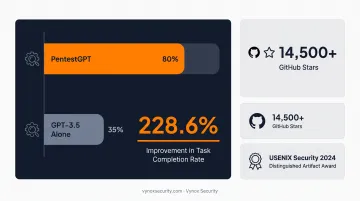
PentestGPT is an open-source agentic pentesting framework offering AI-assisted testing workflows and an extensible architecture, with over 14,500 GitHub stars. It's the most accessible entry point into agentic offensive testing for researchers and budget-constrained teams.
The academic case for it is solid: a USENIX Security 2024 study found PentestGPT completed 80% of benchmark tasks, versus 35% for GPT-3.5 alone. That's a 228.6% improvement in task completion, and the paper earned a Distinguished Artifact Award.
| Attribute | Details |
|---|---|
| Primary Category | Open-source operator acceleration |
| Best Fit | Security researchers, labs, and teams building internal AI testing capability |
| Key Differentiator | Free, adaptable, and community-driven agentic testing pipeline |
How We Chose the Best AI Pentesting Tools
This ranking came from reviewing public product documentation, evidence mechanisms, and deployment models — not vendor demos or marketing decks.
The most common buyer mistake we saw: treating "uses AI" as a single category. It isn't. Tools differ by:
- Attack surface — infrastructure vs. web/API vs. AI-native systems (LLMs, agents, RAG)
- Testing cadence — periodic snapshot vs. continuous, sprint-aligned validation
- Proof mechanism — vendor claims vs. deterministic, reproducible exploitation evidence
Each of those choices cascades into outcomes your team will feel directly:
- Proof quality — determines whether engineers trust the findings enough to act fast
- State-awareness — whether the tool understands auth, roles, and multi-step workflows to catch business logic flaws instead of just surface bugs
- Reporting fidelity — whether a finding survives an auditor's questions
- Deployment fit — whether the tool actually gets used after week one
Confidence in autonomous testing is shifting fast. Dark Reading found that confidence in fully autonomous pentesting fell from 29% in 2025 to just 9% in 2026 among security professionals surveyed. That decline signals one thing: autonomous tools need a validation layer that doesn't blink.
Why AI Pentesting Tools Alone Aren't Enough for AI-Native Risk
Automated AI pentesting tools are genuinely good at scale and speed. What they're not good at: assessing business impact, chaining findings into a real attack narrative, or separating theoretical risk from something an attacker could actually pull off tomorrow.
Here's the specific gap for AI-powered businesses. Promptfoo tests prompt injection patterns well. But full OWASP LLM Top 10 coverage, RAG pipeline security, and autonomous agent assessments need a structured, human-validated methodology behind the tooling, not just plugin output.
Compliance makes this gap non-negotiable. SOC 2 and ISO 27001 auditors expect documented evidence and audit-ready findings. Raw scanner output rarely satisfies that bar without expert interpretation attached.
This is the gap Vynox Security was built to close. Vynox is an AI-native security testing platform combining automated discovery with human-led validation, covering LLMs, RAG pipelines, AI agents, APIs, and cloud infrastructure in a single engagement, not five separate vendor relationships.
What that looks like in practice:
- Full OWASP LLM Top 10 coverage in every AI engagement, not as an upsell
- 40+ prompt injection and jailbreak techniques applied manually, including multi-turn attack chains that automated scanners can't replicate
- System prompt extraction tested directly: Vynox has demonstrated extraction in under 10 queries, a risk invisible to CVE scanners
- Developer-ready fix guidance with reproduction steps and stack-specific remediation, not generic CVE advice
- 5-15 business day delivery, compared to 4-8 weeks typical of traditional pentest firms
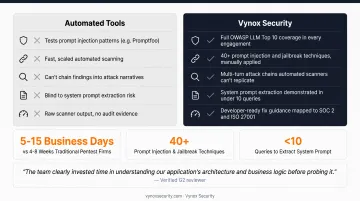
Vynox testers review architecture and business logic before probing anything.
"The team clearly invested time in understanding our application's architecture and business logic before probing it." — Verified G2 reviewer
That context turns a vulnerability list into a prioritized, defensible risk assessment.
Conclusion
The 2026 AI pentesting landscape is layered, built from multiple specialized tools rather than one universal platform. No single tool covers infrastructure, web/API, and AI-native systems equally well — and pretending otherwise is how gaps slip through.
Match your tool selection to your actual attack surface and testing cadence. A team running agentic workflows in production has different needs than one shipping a single RAG feature. Validate findings quality before you commit to any platform long-term: proof gates and reproducibility matter more than plugin counts.
If your stack spans both AI-specific risk and traditional infrastructure, and you need compliance-ready reporting without a six-week wait, book a scoping call with Vynox Security. It's free, thirty minutes, and you'll walk away with indicative pricing and a clear picture of your highest-risk testing areas.
Frequently Asked Questions
Can AI do pentesting?
AI-driven tools can automate reconnaissance, generate attack hypotheses, and execute exploitation chains autonomously. They still need human validation for business-context risk assessment and remediation prioritization.
Is pentesting illegal?
Pentesting is legal only with explicit written authorization from the system owner. Unauthorized testing is a crime in most jurisdictions, regardless of intent.
What is the difference between AI pentesting tools and AI red teaming?
Pentesting validates whether specific weaknesses are exploitable in your environment right now. Red teaming simulates sustained adversarial behavior over time to test detection and response.
Do AI pentesting tools replace human pentesters?
No. AI tools accelerate discovery and validation, but they can't fully replace human judgment for creative attack chaining, business-impact assessment, or compliance-grade reporting.
How much does AI pentesting cost in 2026?
Open-source tools can run for the cost of API tokens — a few dollars to $10+ per assessment. Commercial platforms and managed services are typically priced per engagement or subscription based on scope.
What is the OWASP LLM Top 10 and why does it matter for AI pentesting?
It's a standardized framework categorizing the most critical LLM application vulnerabilities, including prompt injection and data leakage. Comprehensive AI pentesting should test against all ten categories, not a partial subset.