Introduction
If your business accepts card payments, you're contractually bound to prove your systems are secure. That proof comes largely from PCI compliance scans.
Many teams get this wrong from the start. They treat a quarterly ASV scan as equivalent to a full penetration test, then get blindsided when an audit flags gaps a scan was never designed to catch.
Those missed gaps carry real risk. Verizon's 2024 Data Breach Investigations Report found that vulnerability exploitation as an initial attack vector nearly tripled year-over-year, now accounting for 14% of all breaches.
This guide covers what a PCI compliance scan is, which types you need, who must run them, how the process works, and the most common failure points — with practical fixes for each.
Key Takeaways
- PCI DSS 11.3 requires quarterly internal and external vulnerability scans for anyone handling cardholder data
- External scans must be run by a PCI SSC-certified Approved Scanning Vendor (ASV); internal scans can be done in-house
- A CVSS score of 4.0 or higher triggers an automatic scan failure, regardless of business context
- Scans catch known, automated vulnerabilities. They don't replace manual penetration testing for business-logic flaws
- Merchant and service provider levels change documentation rules, but quarterly scans are mandatory for everyone
What Is a PCI Compliance Scan?
A PCI compliance scan is an automated vulnerability check run against any system that stores, processes, or transmits cardholder data. It verifies that your environment doesn't have known, exploitable weaknesses before an attacker finds them first.
These scans exist to satisfy PCI DSS Requirement 11.3, which is split into two parts:
- 11.3.1 (internal scans): At least quarterly; remediate high-risk and critical findings, then confirm with a rescan
- 11.3.2 (external scans): Passing scan by an ASV at least once every three months, with evidence retained
Who runs each scan type is fixed by the standard. External scans (11.3.2) must be performed by a PCI SSC-certified Approved Scanning Vendor, with no exceptions. Internal scans (11.3.1) can be run by your own security team or a trusted third party, as long as they're qualified and organizationally independent from the systems being tested.
PCI DSS v4.0.1, published in mid-2024, didn't change this structure. According to the PCI Security Standards Council's ASV Resource Guide, the update added no new or deleted requirements to Requirement 11.3 — the quarterly scan obligation still stands as the baseline.
Scope is broad: merchants, service providers, payment gateways, and any other entity inside the cardholder data environment (CDE) are covered, regardless of size.
Scan vs. Penetration Test: Not the Same Thing
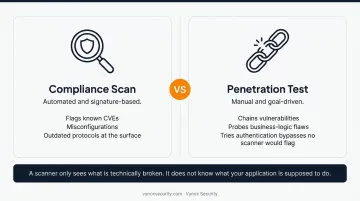
This is where most confusion starts. The two controls answer different questions:
- Compliance scan: Automated and signature-based. Flags known CVEs, misconfigurations, and outdated protocols at the surface.
- Penetration test: Manual and goal-driven. A tester chains vulnerabilities, probes business-logic flaws, and tries authentication bypasses no scanner would flag.
A scanner only sees what is technically broken. It does not know what your application is supposed to do.
Types of PCI Compliance Scans
PCI DSS doesn't rely on a single scan type to cover your cardholder data environment. Different scans target different layers of exposure, and skipping one leaves a gap.
External Vulnerability Scans
These scans target your internet-facing IPs, domains, and firewalls, simulating what an outside attacker sees when probing your network for open ports and exposed services.
- Must be run quarterly by an ASV
- Directly tied to formal PCI attestation and submission to your acquiring bank
- Any failing result above the CVSS threshold blocks a passing report
Internal Vulnerability Scans
Internal scans assess your private network, internal applications, and internal-facing systems: assets reachable by an insider, a compromised employee account, or an attacker who's already breached the perimeter.
PCI DSS now requires internal scans to include authenticated (credentialed) scanning wherever systems support it, alongside non-credentialed passes:
- Credentialed scans simulate an attacker with legitimate access
- Non-credentialed passes mimic a low-privilege intruder
- Running both surfaces weaknesses a single pass would miss
Application-Layer Scans
These scans probe custom and internal applications for common flaws:
- SQL injection
- Cross-site scripting (XSS)
- Remote file inclusion
Application scanning is valuable, but it has a blind spot. It can't detect business-logic flaws, such as a checkout flow that lets a user manipulate a price field, or an API that leaks another customer's order data. A manual web application penetration test is built to close that gap.
Who Needs to Run PCI Compliance Scans (and How Often)?
Scan frequency and documentation requirements scale with your merchant or service provider level, which is based on annual transaction volume — not on how sensitive your data is or how big your team is.
Merchant levels:
| Level | Transaction Volume | Documentation Required |
|---|---|---|
| 1 | 6M+ transactions annually | ROC (via QSA) + quarterly ASV scans + annual pentest |
| 2 | 1M–6M transactions | SAQ + quarterly ASV scans |
| 3 | 20,000–1M e-commerce transactions | SAQ + quarterly ASV scans |
| 4 | Under 20,000 e-commerce transactions | SAQ (as applicable) + quarterly ASV scans |
Service provider levels:
| Level | Transaction Volume | Documentation Required |
|---|---|---|
| 1 | Over 300,000 annually | ROC + quarterly ASV scans |
| 2 | Under 300,000 annually | SAQ + quarterly ASV scans |
Regardless of level, PCI DSS requires internal and external scans at least quarterly, plus immediately after any significant network or application change. Common triggers include:
- A new server or host in scope
- Firewall or network rule changes
- A new payment integration or application release
Businesses processing high transaction volumes or operating in higher-risk verticals often scan monthly instead of quarterly. Waiting three months to catch a newly disclosed vulnerability is a long window for an attacker to work with.
The PCI Compliance Scanning Process: Step by Step
The scanning process follows a defined cycle, and skipping steps — or rushing remediation — is usually what causes repeat failures.
- Scoping — Identify every in-scope IP, server, application, and network component that touches cardholder data. You own this step; the ASV scans only what you define.
- Scanning — The ASV (or your internal team for internal scans) runs the scan with PCI SSC-approved methodology and flags vulnerabilities as it goes.
- Reporting — You receive an executive summary, detailed findings, and severity ratings based on CVSS scoring.
- Remediation — Your team fixes flagged issues such as outdated TLS, default credentials, unpatched software, and exposed services.
- Rescanning — Systems are retested to confirm vulnerabilities are actually resolved—not just patched on paper.
- Attestation and Submission — Submit the final passing report and attestation to your acquiring bank or payment brand as formal proof of compliance.
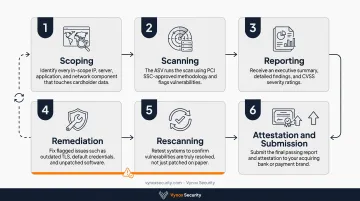
Steps 4 and 5 are where most timelines slip. Fixing a flagged issue is one thing; proving it under rescan is another—especially when changes touch production systems under change control.
Common Reasons PCI Scans Fail (and How to Fix Them)
Most scan failures aren't exotic. They're the same handful of issues showing up quarter after quarter, according to SecurityMetrics' analysis of top ASV scan vulnerabilities.
The usual culprits and how to fix them:
- Expired or misconfigured SSL/TLS certificates (wrong hostname, self-signed): renew before expiry, match the hostname exactly, and replace self-signed certs with CA-issued ones
- Legacy protocols still enabled (TLS 1.0, TLS 1.1, SSLv2/v3): disable them on servers and load balancers; allow TLS 1.2 or higher only
- Weak or obsolete ciphers, including SWEET32-vulnerable 64-bit block ciphers: remove weak cipher suites from your TLS configuration
- Default account credentials left unchanged: change defaults on every internet-facing system before you scan
- Unpatched, known CVEs on internet-facing systems: patch or mitigate first, then rescan to confirm
One rule to know cold: any vulnerability scoring 4.0 or higher on the CVSS scale triggers an automatic failure. There's no business-context exception. A 4.0 fails whether or not you think the risk is acceptable.
That said, you're not without recourse. If you believe a finding is a false positive, scan interference, or inconclusive, you can formally dispute it with your ASV.
Submit evidence such as configuration files, screenshots, and patch logs for the vendor to review. Legitimate issues still have to be resolved before you resubmit; a dispute isn't a way to skip remediation.
Where Deeper Security Testing Fits In: How Vynox Security Complements Your PCI Scans
ASV scans do one job well: they catch known, signature-based vulnerabilities on a fixed quarterly schedule. What they consistently miss are chained exploits, business-logic flaws, and application-specific weaknesses that only surface under manual testing.
Vynox Security closes that gap with web application, API, cloud, and network penetration testing aimed at real attack paths into cardholder data environments, including:
- Firewall and segmentation bypass testing, checking whether your CDE is actually isolated the way your network diagram claims
- Lateral movement simulation, assessing whether an attacker who breaches a low-sensitivity zone can reach payment systems
- API and web application testing mapped to the OWASP Top 10 and OWASP API Top 10, catching authorization and data exposure flaws scanners routinely miss
When a scan flags something, speed matters. Every Vynox finding ships with developer-ready, stack-specific remediation guidance: reproduction steps, evidence screenshots, and CVSS scores, so engineers aren't left decoding a generic CVE writeup under deadline pressure.
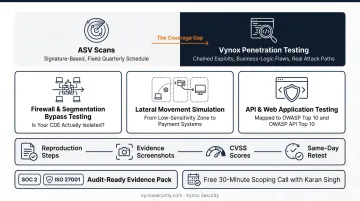
Fixes are verified with same-day retesting once they hit staging, which matters when you're racing a quarterly attestation deadline.
Findings also map to frameworks like SOC 2 and ISO 27001, giving you an audit-ready evidence pack that sits alongside your PCI scan reports rather than duplicating the work.
If you're deciding where a manual assessment should sit next to your existing scan cadence, book a scoping call with Karan Singh: a free 30-minute conversation to map your environment and pin down what actually needs testing before your next deadline.
Frequently Asked Questions
What is a PCI compliance scan?
A PCI compliance scan is an automated external or internal vulnerability check required under PCI DSS Requirement 11.3. It verifies that the cardholder data environment is free of known, exploitable flaws.
How often are PCI compliance scans required?
At least quarterly, plus immediately after any significant system or network change. Higher-risk or high-volume businesses often scan monthly to stay ahead of new vulnerabilities.
Who can perform a PCI compliance scan?
External scans must be run by a PCI SSC-Approved Scanning Vendor (ASV). Internal scans can be done by your own team or a trusted third party, if they are qualified and independent.
What happens if a business fails a PCI scan?
Flagged vulnerabilities must be remediated and rescanned before a passing report can be issued. Continued failure risks fines, higher transaction fees, or loss of card processing privileges, depending on your acquirer's terms.
How much does a PCI compliance scan cost?
Pricing varies by provider, transaction volume, and number of in-scope IP addresses. Costs typically range from a few hundred to several thousand dollars annually, often bundled through your acquiring bank's package.
What is the difference between a PCI scan and a PCI penetration test?
Scans are automated and run quarterly to catch known vulnerabilities. Penetration tests involve manual, hands-on exploitation and are typically required annually for higher-tier merchants and service providers.