What is penetration testing?
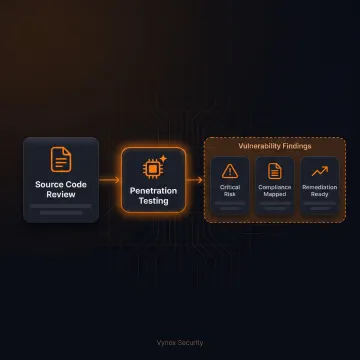
Penetration testing is an authorised security assessment that simulates how an attacker could identify, exploit and chain weaknesses in a defined system. Unlike a vulnerability scan, it uses manual investigation and validation to confirm practical impact. Vynox Security tests applications, APIs, cloud environments, networks, mobile apps and AI systems, then documents verified findings with evidence and remediation guidance.
What does a penetration test include?
A penetration test typically includes scope confirmation, attack-surface reconnaissance, manual vulnerability testing, exploitation validation and reporting. The precise coverage depends on the target, such as a web app, API, cloud account or AI product. Vynox reports include an executive summary, technical findings, evidence screenshots, CVSS scores, reproduction steps and developer-ready, stack-specific recommendations.
How long does a penetration test take?
Timelines vary by scope and service. Cloud and API security testing are typically delivered in 3–5 business days, while web and mobile application testing commonly takes 5–10 business days. Broader AI, RAG and agent assessments generally take 5–15 business days. Comprehensive AI red-teaming engagements typically require 3–5 weeks because they include scenario-driven attack chaining.
Is penetration testing different from automated vulnerability scanning?
Yes. Automated scanners identify known patterns and configuration issues, but they cannot reliably validate business-logic abuse, chained exploits, tenant-boundary failures or AI-specific attacks. Penetration testing uses expert judgement to test realistic attacker paths, confirm exploitability and assess impact. Vynox combines AI-augmented tooling with human-led validation, avoiding the unprioritised false positives that scanner-only reports can produce.
Do you test AI applications and LLMs?
Yes. Vynox tests LLM applications, RAG pipelines and autonomous agents for risks that conventional assessments often overlook. Coverage can include prompt injection, jailbreaks, system-prompt extraction, guardrail bypass, cross-tenant retrieval, vector database poisoning, tool-call injection and agent privilege escalation. AI engagements map findings to the OWASP LLM Top 10 and provide practical remediation guidance.
Can a penetration test support SOC 2 or ISO 27001?
A penetration test can provide the independent security-testing evidence often requested during SOC 2 and ISO 27001 programmes, customer questionnaires and procurement reviews. Vynox is not an audit firm or certification body, but its findings can be mapped to SOC 2 and ISO 27001 control evidence requirements. Reports prioritise remediation by security and certification impact for clearer audit preparation.
What happens after vulnerabilities are found?
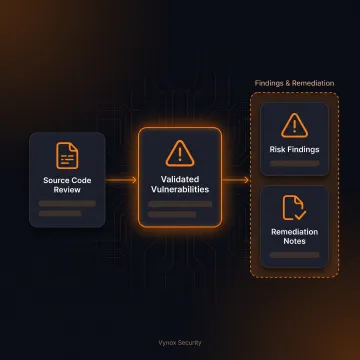
After testing, your team receives prioritised findings with severity ratings, evidence, reproduction instructions and remediation guidance tailored to the affected stack. Stakeholders can use the executive summary to understand material risk, while engineers receive technical detail to fix it. Through PTaaS, Vynox can track open issues and verify deployed fixes in staging with same-day retest turnaround.
How do we get started with Vynox Security?
Start with a free 30-minute discovery call. Vynox reviews your AI and infrastructure stack, identifies the highest-risk testing areas, recommends an appropriate engagement and explains likely timelines and indicative pricing. You can also request a sample report before committing, allowing your team to evaluate the expected executive summary, technical findings, evidence and remediation format.