That shift in expectations has real consequences. Organizations that treat penetration testing as an annual checkbox — or skip it entirely — often discover the gap when an auditor asks for evidence that their controls functioned during the observation period, not just that they existed.
The problem is compounded for businesses shipping AI products. LLMs, RAG pipelines, and autonomous agents introduce attack surfaces that traditional testing approaches were never designed to evaluate. A scan that covers your web infrastructure but ignores your AI stack leaves half the picture blank — which matters to auditors when those systems are in scope.
This article explains where penetration testing fits in a SOC 2 or ISO 27001 program, what it actually satisfies at the control level, and what compliance-grade testing looks like in practice.
Key Takeaways
- SOC 2 CC4.1 explicitly names penetration testing as an evaluation type auditors expect to see
- ISO 27001 Annex A controls A.8.8 and A.8.29 are most directly satisfied by pen testing, with no other method providing comparable audit evidence
- Vulnerability scanning is not a substitute; auditors expect evidence of actual exploitation attempts
- AI systems within your audit boundary require AI-specific testing methodology for complete coverage
- Closed-loop remediation evidence (test, fix, retest) carries as much weight with auditors as the findings themselves
What Penetration Testing Actually Does for Compliance
Penetration testing is a structured, simulated attack performed by security professionals to identify vulnerabilities that are genuinely exploitable — not just theoretically present. For SOC 2 and ISO 27001 auditors, that distinction is exactly what separates acceptable evidence from a gap finding.
Both SOC 2 and ISO 27001 require organizations to demonstrate that security controls are not just documented but functioning. Consider the difference:
- A written policy that says "we patch critical vulnerabilities within 30 days" documents intent — it doesn't prove the control works
- A penetration test that attempts exploitation, records findings, and ties to remediation evidence proves the control was validated under adversarial conditions
How This Differs from Vulnerability Scanning
Automated vulnerability scanners check systems against known CVE signatures. They're fast, low-cost, and useful for identifying unpatched software or common misconfigurations. What they cannot do:
- Trace chained attack paths that combine low-severity issues into a critical exposure
- Identify business logic flaws that require understanding how an application works
- Detect authorization bypasses that only appear in authenticated, context-aware sessions
- Evaluate AI-specific vulnerabilities like prompt injection or RAG retrieval bypass
Auditors understand this distinction. Submitting scan output as penetration testing evidence is a common mistake that creates friction in audit reviews, because scan output proves detection capability, not adversarial resilience.
How Penetration Testing Maps to SOC 2 and ISO 27001
SOC 2: The Specific Criteria Pen Testing Supports
The AICPA's 2017 Trust Services Criteria identifies penetration testing explicitly under CC4.1 (Monitoring Activities), listing it among the "variety of different types of ongoing and separate evaluations" that management may use — alongside ISO certifications and internal audit assessments. This is the clearest signal in any compliance framework that pen testing is expected, not optional.
Two related criteria extend that expectation:
- CC7.1 requires detecting configuration changes that introduce vulnerabilities. A pen test validates whether those vulnerabilities are actually exploitable — scan output doesn't go that far
- CC7.2 requires monitoring for anomalies indicative of malicious activity. A pen test simultaneously checks whether your detection systems fire when they should, exposing gaps in SIEM or alerting coverage that would otherwise remain invisible
One evidence challenge specific to SOC 2: Type II audits cover a period of operating effectiveness — typically months, not a single point in time. A single annual test often leaves most of that window without testing evidence. That gap is exactly what auditors look for when assessing whether controls operated continuously.
SOC 2 isn't the only framework where pen testing coverage matters — ISO 27001 creates parallel expectations through a different mechanism.
ISO 27001: The Annex A Controls That Pen Testing Satisfies
ISO 27001 doesn't mandate penetration testing by name, but two Annex A controls make a strong implicit case for it:
- A.8.8 (Management of Technical Vulnerabilities) requires proactive identification and evaluation of technical vulnerabilities. Pen testing goes further than scanning by proving whether vulnerabilities are exploitable in your specific environment — a meaningful difference for a certification auditor
- A.8.29 (Security Testing in Development and Acceptance) requires security testing processes in the development lifecycle. Testing against staging environments or pre-release builds satisfies this control and produces evidence for Clause 9.1 monitoring requirements
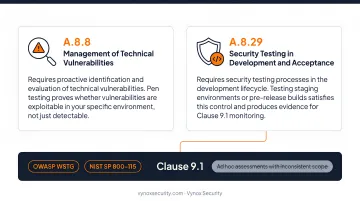
Clause 9.1 adds a further requirement: monitoring methods must produce comparable and reproducible results to be considered valid.
Pen testing aligned to a documented methodology — such as OWASP WSTG or NIST SP 800-115 — meets that bar. Ad hoc assessments with inconsistent scope do not, regardless of how thorough they appear.
Three Compliance Advantages of Penetration Testing
Advantage 1: Audit-Ready Evidence That Closes the Documentation Gap
A compliance-grade pen test produces a specific type of evidence: structured, auditor-readable documentation that traces the full security validation chain. That means more than a list of CVEs.
A well-constructed pen test report includes:
- Executive summary — leadership-facing overview of risk posture and findings
- Technical findings — detailed vulnerability descriptions with reproduction steps
- Exploitation proof — evidence screenshots confirming vulnerabilities are real, not theoretical
- CVSS-scored severity ratings — standardized risk rankings that map to compliance requirements
- Remediation guidance — developer-ready, stack-specific fix instructions
- Compliance control mapping — findings tied directly to SOC 2 Trust Service Criteria or ISO 27001 Annex A controls
- Retest verification — evidence that fixes were confirmed after remediation
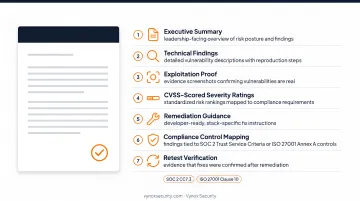
That last element is critical. SOC 2 CC7.3 and ISO 27001 Clause 10 both look for evidence that identified issues were resolved — not just found. A pen test report without retest evidence leaves the compliance loop open.
The AICPA's own 2026 guidance on SOC 2 peer review specifically flags over-reliance on boilerplate reports and testing not tailored to the examined system as risk indicators.
Vynox Security structures reports to address this directly. Findings are mapped to specific framework controls, and assessor-ready evidence packs are delivered as part of the standard engagement — eliminating the separate GRC documentation effort most teams would otherwise face.
This matters most for: SOC 2 Type II audits, first-time ISO 27001 certifications where evidence baselines must be established, and organizations with fast-moving engineering teams where the environment changes frequently.
Advantage 2: Real Risk Identification Across the Full Attack Surface — Including AI
Pen testing surfaces exploitable vulnerabilities that automated tools structurally cannot find. The difference is adversarial reasoning — skilled testers apply attacker logic to trace how individual weaknesses chain into actual impact.
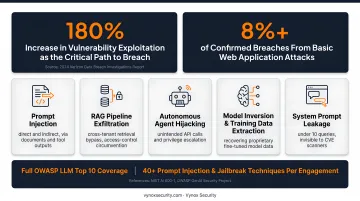
For modern businesses, this extends to the AI attack surface. According to the 2024 Verizon Data Breach Investigations Report, exploitation of vulnerabilities increased 180% as the critical path for initiating a breach — and basic web application attacks accounted for over 8% of confirmed breaches. Application-layer vulnerabilities are where real attacks happen, and AI systems are application-layer targets.
The vulnerability classes that matter for AI-powered organizations include:
- Prompt injection — direct and indirect variants, including through documents and tool outputs
- RAG pipeline exfiltration — cross-tenant retrieval bypass and access-control circumvention surfacing confidential documents
- Autonomous agent hijacking — redirecting agents into unintended API calls, data writes, or privilege escalation
- Model inversion and training data extraction — recovering proprietary fine-tuned model data through targeted probing
- System prompt leakage — often achievable in under 10 queries, invisible to CVE scanners
OWASP's GenAI Security Project states clearly that traditional application-security practices are no longer sufficient for AI systems. NIST AI 600-1 goes further, calling for AI-specific red teaming against prompt injection, data poisoning, model extraction, and membership inference. Most firms test infrastructure. They weren't built to test the model layer.
Vynox Security's AI security engagements cover the full OWASP LLM Top 10, including 40+ prompt injection and jailbreak techniques per engagement, reaching attack surfaces that infrastructure scans never touch. For organizations where LLMs, RAG pipelines, or agent workflows fall within the audit boundary, that coverage is what makes compliance evidence complete.
This matters most for: Organizations deploying AI in customer-facing products, any company pursuing SOC 2 or ISO 27001 where AI systems are in scope, and API-first infrastructure where BOLA and authorization bypass risks are high.
Advantage 3: Continuous Validation That Keeps Compliance Current
A single annual test covers one moment. SOC 2 Type II and ISO 27001 surveillance audits require evidence of operating effectiveness across a sustained period. That gap is a real problem.
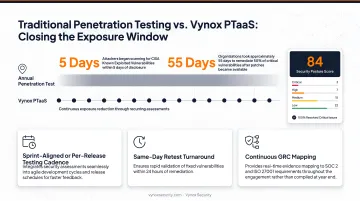
According to the 2024 Verizon DBIR, organizations took approximately 55 days to remediate 50% of critical vulnerabilities after patches became available — while attackers began scanning for CISA Known Exploited Vulnerabilities within 5 days of disclosure. Annual testing leaves that entire window undetected.
Penetration Testing as a Service (PTaaS) closes that window. Each testing cycle adds timestamped evidence to the compliance record, so the organization stays audit-ready year-round rather than scrambling before an audit window opens.
Vynox's PTaaS model delivers:
- Sprint-aligned or per-release testing cadence across AI and infrastructure attack surfaces
- Same-day retest turnaround once fixes are deployed to staging
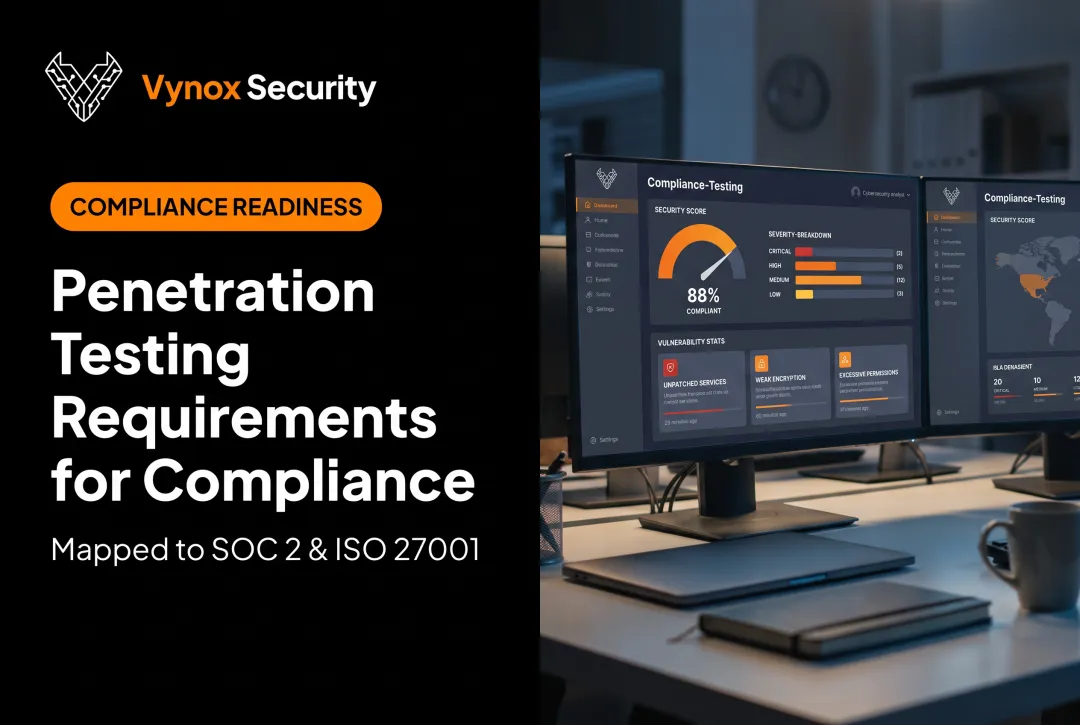
- Real-time findings tracking through a centralized dashboard showing open vulnerabilities by severity, resolved issues, and overall security posture score
- Continuous GRC mapping — findings are mapped to SOC 2 and ISO 27001 evidence requirements throughout the engagement, not retroactively compiled at year-end
This matters most for: Agile teams shipping frequent updates, organizations pursuing SOC 2 Type II where operating effectiveness must be demonstrated over a full period, and any company that experienced an infrastructure change or new feature deployment mid-audit cycle.
What Happens When Pen Testing Is Skipped
Without a pen test, auditors rely entirely on control documentation and vulnerability scans — neither of which proves controls hold up under adversarial conditions. Skipping the test typically produces one of three outcomes:
- Auditor findings that stall certification
- Extended audit timelines while evidence gaps are addressed
- Conditional certifications with required remediation before renewal
The financial stakes reinforce the urgency. IBM's 2024 Cost of a Data Breach Report put the global average breach cost at $4.88 million — up from $4.45 million the prior year. The cost of a meaningful pen testing program is a small fraction of that exposure.
For AI-powered organizations, the risk compounds further. If AI systems fall within the audit boundary but weren't tested with AI-specific methodology, compliance evidence covers only part of the attack surface.
When an AI-related breach or data exposure occurs afterward, an incomplete testing record demonstrates a failure to assess known risk vectors — precisely what auditors and regulators will examine first.
How to Get the Most Compliance Value from Penetration Testing
Three execution decisions determine whether a penetration test produces real compliance value or just a report that sits in a folder.
Scope must mirror your audit boundary. The pen test scope should match the SOC 2 system description or ISO 27001 ISMS boundary exactly. Testing systems outside scope adds nothing for auditors; leaving in-scope systems untested creates documented gaps. Confirm scope with your auditor before the engagement is scoped — not after the kickoff call.
Remediation and retesting are not optional. Findings without closed-loop remediation evidence are incomplete from an auditor's perspective. SOC 2 CC7.3 and ISO 27001 Clause 10 both require evidence that identified issues were resolved. A pen test that ends with a report but no retest record leaves the compliance loop open — auditors will notice.
Cadence matters as much as coverage. For SOC 2 Type II or ISO 27001 surveillance audits, a single annual test rarely provides sufficient coverage across the full observation period. Plan testing at minimum quarterly, and after major releases or cloud migrations, to ensure your evidence record reflects the current state of your environment — not a snapshot from six months ago.
Frequently Asked Questions
Is penetration testing required for SOC 2 compliance?
SOC 2 does not explicitly mandate penetration testing, but CC4.1 specifically names it as an expected evaluation type under Monitoring Activities. In practice, most auditors look for pen test evidence as confirmation that controls are functioning — treat it as a practical requirement regardless of whether it's formally mandated.
Is penetration testing required for ISO 27001 certification?
ISO 27001 does not mandate pen testing, but Annex A controls A.8.8 (technical vulnerability management) and A.8.29 (security testing in development) require proactive identification and evaluation of technical vulnerabilities. Penetration testing is the most direct way to satisfy both controls with reproducible, audit-ready evidence.
How often should penetration testing be done for SOC 2 or ISO 27001?
Annual testing is the minimum, but SOC 2 Type II observation periods and ISO 27001 surveillance audits benefit from quarterly or release-cadenced testing. PTaaS models support this cadence directly — especially after system changes, new deployments, or cloud migrations.
What is the difference between penetration testing and vulnerability scanning for compliance?
Vulnerability scans are automated and detect known misconfigurations or outdated software. Penetration testing involves active exploitation attempts that prove whether vulnerabilities are actually exploitable in your environment. Auditors expect pen test evidence for control validation — scan output alone doesn't demonstrate adversarial resilience.
What should a compliance-ready penetration test report include?
A compliance-ready report should include, at minimum:
- Executive summary and scope/methodology documentation
- CVSS-scored findings with exploitation proof
- Developer-ready remediation guidance
- Compliance control mapping (SOC 2 Trust Service Criteria or ISO 27001 Annex A)
- Retest evidence confirming remediated findings were verified
Missing any of these creates gaps auditors will flag.
Does penetration testing for AI systems count toward SOC 2 and ISO 27001 compliance?
If AI systems — LLMs, APIs, agent pipelines — fall within your audit boundary, they must be tested. Vulnerabilities like prompt injection or unauthorized RAG data access are directly relevant to SOC 2 confidentiality criteria and ISO 27001 information security controls. Skipping AI components leaves compliance coverage incomplete, no matter how thorough the infrastructure testing was.