Introduction
Software ships weekly now, sometimes daily. AI teams push new model versions, retrain on fresh data, and tweak system prompts even faster than that. Yet plenty of security programs still run on an annual pentest calendar built for a much slower era.
That mismatch has a cost. NIST reports that CVE submissions in the first quarter of 2026 climbed nearly a third above the same period in 2025, part of a 263% jump since 2020.
Attack surfaces are expanding faster than most testing schedules can keep up.
Continuous penetration testing (CPT) gets tossed around as a buzzword in security marketing decks. But its real value is specific: it closes the gap between when a vulnerability appears in your stack and when someone finds it before an attacker does.
This article covers what CPT actually is, its practical advantages, and why it matters most for teams shipping software and AI products at speed.
Key Takeaways
- CPT replaces the annual pentest snapshot with ongoing testing tied to sprints and model updates
- It shrinks exposure windows, speeds remediation, and keeps compliance evidence audit-ready
- AI systems (LLMs, RAG pipelines, agents) need it most because every update creates a new attack surface
- Programmatic testing models resolve high-risk findings in 5-15 business days, versus 4-8 weeks for ad hoc programs
What Is Continuous Penetration Testing?
Continuous penetration testing (CPT) is an ongoing security testing methodology. It blends automated scanning with human-led manual testing, run continuously rather than as one scheduled event a year.
It typically applies across:
- Web applications and APIs
- Cloud infrastructure (AWS, GCP, Azure)
- Corporate networks
- AI systems, including LLMs, RAG pipelines, and autonomous agents
Instead of treating security testing as a compliance checkbox to tick once a year, CPT continuously validates your security posture as code, infrastructure, and models change. Every deployment gets checked, and every model update gets probed as soon as it ships.
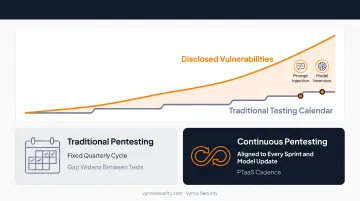
Traditional Pentesting vs. Continuous Pentesting
| Dimension | Traditional Annual Pentest | Continuous Pentesting (PTaaS) |
|---|---|---|
| Frequency | Once a year, point-in-time | Every sprint, every model update |
| Methodology | Manual scoping, fixed checklist | Ongoing, adapts to changing code and AI surface |
| Reporting | Single dense report, weeks later | Real-time findings via dashboard |
| Remediation Speed | Retest at next annual cycle | Same-day retest after fix deployment |
The urgency here isn't hypothetical. The disclosed vulnerability corpus is growing far faster than a static testing calendar can absorb. That's before you even factor in AI-specific risks like prompt injection or model inversion, which barely existed as testing categories five years ago.
Vynox Security builds its PTaaS model around exactly this shift — aligning testing cadence with actual release velocity rather than the calendar.
Key Advantages of Continuous Penetration Testing
The advantages below aren't abstract. Organizations track them as concrete metrics: exposure time, remediation speed, and compliance readiness. Here's how each one plays out.
Closes the Vulnerability Window Between Releases and Model Updates
Traditional annual or quarterly pentests leave gaps of months. During that time, new code ships, features launch, and, for AI products, models get retrained and system prompts get rewritten. None of it gets tested until the next scheduled engagement.
CPT closes that gap by continuously retesting changed endpoints, new deployments, and every AI model or prompt update as it happens.
Why this matters: attackers actively hunt for exactly this "unvalidated exposure window." Rapid7's analysis found the median time between disclosure and exploitation has stayed in single digits since 2021, and 53% of mass-compromise events it studied in 2023 originated from zero-days. A single quarter of untested exposure is a wide window for that kind of speed.
For teams running LLMs, RAG pipelines, or agents, this is even sharper. A single prompt or system update can introduce new attack surface that's completely invisible to a one-time assessment: a changed retrieval path, a new tool-call permission, a guardrail that fails without triggering any alert.
KPIs impacted:
- Mean-time-to-detection
- Exposure window duration
- Vulnerability recurrence rate
This advantage matters most for teams with fast release cadences and anyone actively iterating on AI models or agents. Vynox's PTaaS model aligns testing cadence with sprints and model updates, so new AI attack surface gets caught immediately instead of sitting undetected until the next scheduled test.
Accelerates Remediation and Reduces Breach-Related Costs
CPT pairs continuous discovery with fast, developer-ready remediation guidance instead of a static report that lands weeks after testing wraps. Rapid retest verification after a fix deploys shortens the window a vulnerability stays exploitable, sometimes from months to hours.
The cost logic is straightforward: catching issues early avoids the escalating cost of late-stage fixes or a full breach. IBM's 2026 Cost of a Data Breach Report puts the global average breach cost at $4.99 million, a record high and 12% above the prior year. That's the ceiling continuous testing is designed to help you avoid.
There's also a hidden cost most teams don't budget for: repeated scoping and reporting overhead. Every annual pentest cycle means re-engaging a vendor, re-scoping the attack surface, and waiting on a new report. Continuous models scope once and evolve from there.
Cobalt's own research reinforces this in the pentesting world specifically: organizations running programmatic, continuous testing programs saw a 10-day half-life for high-risk findings, compared to 249 days for ad hoc, bottom-tier programs. That's roughly a 25x difference in how long critical issues stay open.
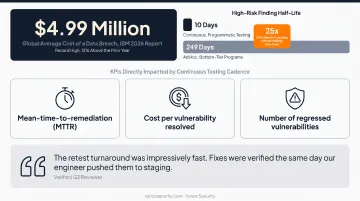
KPIs impacted:
- Mean-time-to-remediation (MTTR)
- Cost per vulnerability resolved
- Number of regressed vulnerabilities
This matters most for high-velocity CI/CD environments and lean security teams that simply can't absorb repeated ramp-up costs every cycle. Vynox's same-day retest turnaround (fixes verified the same day engineers push to staging) is a direct response to this. One verified G2 reviewer put it plainly: "The retest turnaround was impressively fast — fixes were verified the same day our engineer pushed them to staging."
Delivers Continuous, Audit-Ready Compliance Evidence
Frameworks like SOC 2 and ISO 27001 increasingly expect ongoing proof of security testing, not a single annual report filed away until next year. SOC 2's CC4.1 criteria explicitly calls for ongoing or separate evaluations, naming penetration testing as an illustrative example, with scope and frequency expected to vary with risk.
CPT generates continuous findings, retest logs, and evidence mapped directly to specific compliance controls as testing happens, not months later.
Why this matters: it solves the "stale audit" problem. A report can be technically accurate the day it's issued and outdated within weeks once new code ships. Continuous evidence doesn't have that expiration date.
KPIs impacted:
- Audit preparation time
- Number of open findings at audit time
- Compliance cycle length
This matters most for regulated industries and AI-powered businesses pursuing SOC 2 or ISO 27001. Vynox maps findings directly to SOC 2 and ISO 27001 AI-specific control requirements (including OWASP LLM Top 10 categories), giving teams compliance-ready evidence packs without the last-minute scramble before an audit.
What Happens When Continuous Pentesting Is Missing or Ignored
Without CPT, organizations rely on stale annual snapshots. That creates an inconsistent security posture — strong right after the test, weaker and weaker as months pass and nothing gets re-checked.
Common consequences show up fast:
- Undetected vulnerabilities accumulate quietly between test cycles
- Security teams shift into reactive incident response instead of proactive prevention
- Breach remediation costs climb the longer an issue sits unpatched
- Compliance teams scramble to produce fresh evidence right before an audit
The risk sharpens for AI-powered organizations, where LLM behavior, RAG retrieval logic, and agent permissions evolve constantly, sometimes with every deployment.
A one-time assessment can't catch a prompt injection vulnerability introduced by last week's system prompt change, or a data leakage path opened by a new RAG knowledge base update. By the time the next annual test rolls around, that exposure could have been live for months.
How to Get the Most Value from Continuous Penetration Testing
CPT delivers the most value when it's built into CI/CD and sprint cycles, not treated as an occasional bolt-on service.
A few things separate a program that actually works from one that just checks a box:
- Match testing cadence to release velocity: include AI model updates, not just code deployments
- Demand developer-ready fix guidance: generic vulnerability descriptions slow teams down, while reproduction steps and stack-specific remediation speed them up
- Choose a partner whose findings map to your compliance frameworks: evidence accumulates as a byproduct of testing, not a separate scramble
- Review findings quickly: a fast retest cycle is worthless if findings sit unreviewed for weeks
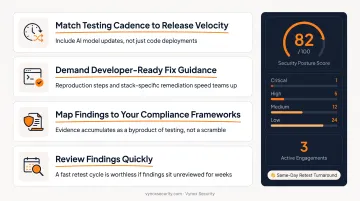
Vynox's real-time vulnerability tracking dashboard reflects this philosophy directly. It shows open vulnerabilities by severity, active engagements, and a security posture score updated as testing happens, with same-day retest turnaround once a fix hits staging. Findings get reviewed and verified within the same sprint they're found, not weeks later.
Conclusion
The importance of continuous penetration testing comes down to closing exposure windows and speeding remediation, while keeping compliance evidence current. None of these are one-time wins.
These advantages compound. Each testing cycle builds on the last, creating a stronger and more mature security posture than any isolated annual snapshot ever could.
For any organization shipping software or AI products at speed, CPT works as an ongoing practice, timed to every sprint and every model update. Treating it as anything less leaves exposure windows open longer than they need to be.
Frequently Asked Questions
How is continuous penetration testing different from vulnerability scanning?
Vulnerability scanning automatically matches known signatures against your systems. Continuous pentesting actively chains exploits, logic flaws, and business-context risks the way a real attacker would, going far beyond signature matching.
How often does continuous penetration testing actually run?
Deployment events and sprint cycles typically drive cadence rather than a fixed calendar. Teams retest critical assets after every significant change, including AI model or prompt updates.
Is continuous penetration testing more expensive than traditional pentesting?
It can look costlier upfront, but it removes the recurring scoping and reporting overhead that traditional annual cycles carry. Most organizations see lower year-over-year costs once that overhead disappears.
Does continuous penetration testing satisfy SOC 2 and ISO 27001 compliance requirements?
Yes, continuous testing can meet and often exceed these requirements when findings are mapped directly to relevant controls. SOC 2's CC4.1 criteria specifically supports ongoing evaluation over a single annual check.
Can continuous penetration testing cover AI systems like LLMs and AI agents?
Yes. AI-native continuous testing platforms like Vynox test LLMs, RAG pipelines, and agents against OWASP LLM Top 10 risks, including prompt injection and model inversion, alongside traditional infrastructure.
What's the difference between PTaaS and continuous penetration testing?
PTaaS is the delivery model — a subscription-based service structure. Continuous penetration testing is the methodology it enables: testing aligned to sprints and releases instead of a single annual event.