This matters more than ever. Companies now expose ML models and LLMs through APIs and chat interfaces every day, and each of those endpoints becomes a query surface an attacker can probe. Traditional security testing — the kind built for SQL injection and broken authentication — doesn't cover this attack class at all.
This guide breaks down what black-box adversarial attacks actually are, the two dominant attack methodologies, how these risks extend into LLMs and RAG pipelines, real-world examples, and what actually works as a defense.
Key Takeaways
- Black-box attacks need only query access to outputs — no weights or architecture required
- Transfer-based (surrogate models) and query-based (iterative probing) methods dominate black-box attacks
- Adversarial training measurably lowers black-box attack success rates in security testing
- LLMs, RAG pipelines, and AI agents face this threat via prompt injection and jailbreaks
- Continuous adversarial testing beats one-time assessments as attack techniques evolve
What Is a Black-Box Adversarial Attack?
A black-box adversarial attack crafts malicious input perturbations that cause a model to misclassify data or misbehave , using only an "oracle" — a system the attacker can query and observe. Feed it an input, get an output, adjust, repeat.
The attacker's constraints are strict:
- No access to model weights, gradients, or architecture
- No visibility into training data
- Only the ability to submit inputs and observe outputs
- Often facing query-count limits or rate throttling
This is exactly the position most real attackers find themselves in against a production system.
White-Box vs. Black-Box Attacks: Key Differences
White-box attacks assume full internal access (gradients, weights, architecture), which enables mathematically precise techniques like FGSM and PGD. These methods compute the loss gradient directly and step in the direction that maximizes model error. They're powerful in research settings but rarely realistic against a deployed system that hides its internals.
Black-box attacks assume only output access, forcing attackers to estimate gradients indirectly or exploit transferability between models. Harder to pull off, but far closer to how real-world threats actually operate.
| Dimension | White-Box | Black-Box |
|---|---|---|
| Information required | Gradients, weights, architecture | Inputs and outputs only |
| Difficulty | Lower (direct optimization) | Higher (indirect estimation) |
| Typical techniques | FGSM, PGD | Transfer-based, query-based |
| Real-world applicability | Rare against production systems | Matches most real attacker scenarios |
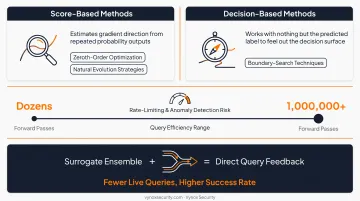
Within black-box settings, there's a further split. Score-based attacks receive probabilities or confidence values and can estimate gradient direction from those numbers. Decision-based attacks get nothing but the final predicted label, a much sparser signal that forces boundary-search techniques instead.
Not every production API hands over confidence scores. Some vision APIs do expose them, but Brendel et al., who introduced the Boundary Attack, noted that confidence scores are unavailable in many real-world deployments — which is exactly why decision-based techniques exist at all. The output contract of your specific endpoint determines which attack class actually applies.
Types of Black-Box Adversarial Attack Techniques
Two paradigms dominate black-box attack research, and each carries different tradeoffs in effort, query volume, and success rate.
Transfer-Based Attacks (Surrogate Models)
The core idea is simple: build or borrow an accessible surrogate model, craft adversarial examples against it using white-box methods, then fire those same examples at the real target. It works because many models share similar decision-boundary blind spots.
The technique has evolved considerably:
- Early methods optimized against a single substitute model
- Ensemble approaches combine multiple surrogate models to boost transfer robustness
- Recent research shows surrogate-target alignment matters more than architecture alone
Research comparing standard and robustly trained surrogates found that switching from a standard to a robust surrogate raised one attack's success rate against a robust Swin-L target from just 1.26% to 12.55%. Matching your surrogate's robustness to your target's robustness changes outcomes substantially.
But here's the limitation that matters most for defenders: transfer attacks that dominate against undefended models can collapse against adversarially trained ones.
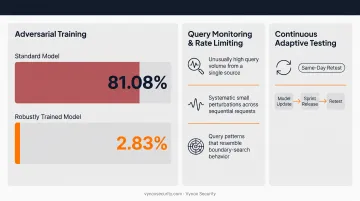
That same study found one technique's success rate against a standard ResNet50 sitting at 81.08%, then dropping to just 2.83% once the target was adversarially trained. Vanilla models are soft targets. Robust ones aren't.
Query-Based Attacks (Score-Based and Decision-Based)
Query-based attacks skip the surrogate entirely and probe the target directly.
- Score-based methods (zeroth-order optimization, natural evolution strategies) estimate gradient direction from repeated probability outputs
- Decision-based methods work with nothing but the predicted label, using boundary-search techniques to feel out where the model's decision surface actually sits
The central challenge is query efficiency. Every query an attacker sends is a chance to trigger rate-limiting or anomaly detection, so successful attacks balance thoroughness against staying under the radar.
Published research spans an enormous range: from a few dozen queries in optimized attacks to over a million forward passes in less efficient decision-based methods.
Hybrid approaches close that gap. Combining a surrogate ensemble with direct query feedback lets attackers spend computation offline on the surrogate, dramatically cutting the number of queries needed against the actual target. The result: high success rates with far fewer live interactions than pure query-based methods require.
Black-Box Attacks Against LLMs, RAG Pipelines, and AI Agents
As organizations shift toward LLM, RAG, and autonomous agent architectures, the black-box threat model applies directly. Attackers interact only through an API or chat interface, with zero access to model weights. That's the exact same constraint as attacking an image classifier.
Prompt injection and jailbreak techniques function as black-box adversarial attacks against an LLM's decision boundary. An attacker sends a prompt, observes the response, adjusts, and repeats, mirroring query-based optimization step for step.
Research on automated jailbreak refinement demonstrated that one LLM can be used to iteratively refine attacks against another, often succeeding in fewer than 20 queries against the target.
Unstructured text output makes this harder to automate than image attacks. There's no clean gradient signal in generated language the way there is in a classifier's confidence score, which is why systematic, technique-driven red teaming outperforms purely automated approaches here.
This same black-box constraint extends beyond the model itself. RAG pipelines introduce a distinct risk layer: attackers don't need to touch the model at all. Manipulating retrievable documents or context can indirectly steer output, since the model treats retrieved text as trusted input by default.
This is the exact gap Vynox Security's AI-native testing methodology addresses. Using a black-box approach with no access to model weights or system prompts, Vynox tests LLM applications and AI agents against 40+ prompt injection and jailbreak techniques, including:
- Direct and indirect prompt injection via documents
- Role-play and persona exploits
- Token manipulation
- Multi-turn attack chains
Findings map directly to the OWASP LLM Top 10, covering LLM-01 (Prompt Injection), LLM-06 (RAG exfiltration), and LLM-08 (agent hijacking). Developer-ready results land in 5–15 business days, compared to the 4–8 week timelines typical of traditional pentest firms.
Real-World Examples of Black-Box Adversarial Attacks
Theory is one thing. Here's how these attacks have actually played out against production systems.
Public image-classification APIs. Researchers demonstrated the substitute-model approach against Amazon's and Google's commercial prediction APIs, querying each service to label synthetic data, training a local substitute, then crafting adversarial examples offline before transferring them to the target.
The results, using just 800 oracle queries and a logistic-regression substitute:
- 96.19% misclassification rate against Amazon's prediction service
- 88.94% misclassification rate against Google's prediction service
- Zero gradient access or internal model details required
- Full success achieved through careful querying alone
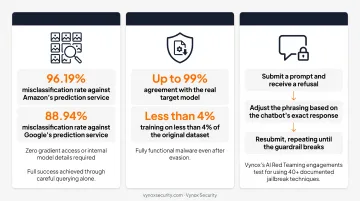
Malware detector evasion. Security researchers extracted surrogates for standalone ML malware classifiers and commercial antivirus products, then generated functionality-preserving modifications to Windows executables that preserved each file's malicious behavior.
The standalone-classifier surrogates delivered:
- Up to 99% agreement with the real target model
- Training on less than 4% of the original dataset
- Fully functional malware even after evasion, proving that model extraction plus transfer can defeat detection without breaking the payload
LLM jailbreak through iterative refinement. This attack looks different but follows the same logic as probing an image classifier's boundary, just conducted in natural language:
- Submit a prompt and receive a refusal
- Adjust the phrasing based on the chatbot's exact response
- Resubmit, repeating until the guardrail breaks
It's the same decision-based, black-box approach covered throughout this guide, and it's exactly what Vynox's AI Red Teaming engagements test for using 40+ documented jailbreak techniques.
How to Defend Against Black-Box Adversarial Attacks
No single control stops every black-box attack. Effective defense combines several layers.
Adversarial training delivers the strongest baseline defense. The same research cited earlier showed adversarial training reducing one attack's success rate from 81.08% against a standard model to just 2.83% against a robustly trained one, under identical conditions.
That gap separates a model that fails almost every time from one that resists the overwhelming majority of attempts.
Query monitoring and rate limiting help catch abnormal querying patterns consistent with model extraction or iterative probing. Watch for:
- Unusually high query volume from a single source
- Systematic small perturbations across sequential requests
- Query patterns that resemble boundary-search behavior
That said, don't treat rate limits as a complete solution. Motivated, well-resourced attackers can work around basic throttling, so monitoring should complement model-level defenses rather than replace them.
Beyond query monitoring, the testing cadence itself needs to keep up. Continuous, adaptive testing beats one-time assessments because AI systems change constantly: new model versions, new fine-tunes, new RAG document sources. A pentest from six months ago tells you nothing about today's attack surface.
Vynox's PTaaS model aligns retesting with every model update and development sprint, keeping defenses in step with how fast both AI systems and attack techniques evolve. Once engineers push a fix to staging, retests complete the same day, closing the exposure window instead of leaving it open until the next scheduled audit.
Frequently Asked Questions
What is the difference between white-box and black-box adversarial attacks?
White-box attacks require full model access, including weights, gradients, and architecture, enabling precise, mathematically optimal attacks. Black-box attacks rely only on input-output queries, making them harder to execute but far more representative of real-world threats.
What is an example of a black-box adversarial attack?
A common example is a query-based attack against an image classification API, where an attacker fools the model using only returned labels or confidence scores. LLM jailbreaks achieved through iterative prompt refinement follow the same underlying logic.
Can black-box attacks work against LLMs and chatbots?
Yes. Prompt injection and jailbreaking function as black-box style attacks against LLMs, since attackers never access model internals — only the responses the system generates.
How many queries do black-box attacks typically need to succeed?
Query counts vary enormously by technique and target robustness. Published research ranges from under 20 queries for some jailbreak methods to well over a million for restrictive label-only attacks against hardened models.
Are black-box attacks more dangerous than white-box attacks?
They're more realistic. Most attackers targeting a deployed system never get internal model access, which makes black-box techniques the threat model that actually matters for production AI systems.
How can organizations test their AI systems against black-box attacks?
Regular adversarial and AI red-team testing is the answer: assessments like Vynox Security's LLM, RAG, and infrastructure security testing identify exploitable weaknesses before real attackers find them first.