Introduction
Most AWS security teams run automated scanners, review a few findings, and call it a pentest. That's a configuration audit, not a pentest. Attackers don't stop at flagged misconfigurations. They chain them.
AWS penetration testing simulates how a real threat actor moves through your cloud environment. It starts from a compromised credential or misconfigured service, escalates privileges, and reaches sensitive resources that no automated tool flagged as connected.
According to a 2024 CSA/Tenable survey of 600 cloud security professionals, 99% of breached organizations attributed their incident to insecure identities — and 95% had experienced a cloud-related breach in the preceding 18 months.
This guide is for security teams, cloud architects, and CTOs running workloads on AWS. It covers what AWS pentesting actually involves (versus what vendors often sell), the step-by-step methodology, key focus areas, and the mistakes most teams make after assuming a config review covered everything.
Key Takeaways
- AWS pentesting actively simulates attacker behavior; configuration reviews only audit settings against benchmarks
- The AWS Shared Responsibility Model puts securing your workloads, IAM, and data entirely on you
- IAM misconfigurations are the root cause of most cloud privilege escalation chains
- AWS no longer requires prior approval for most testing activities, but prohibited actions remain
- Findings should map directly to compliance controls — SOC 2, ISO 27001, and PCI DSS evidence packs depend on it
What Is AWS Penetration Testing?
AWS penetration testing is an authorized, simulated attack against your cloud environment. A tester assumes the perspective of a threat actor who has already gained initial access — through a leaked credential, a compromised EC2 instance, or an overpermissioned developer key — and attempts to escalate privileges and reach sensitive resources.
Pentest vs. Configuration Review
Vendors blur this distinction often — and buyers usually pay the price.
| Configuration Review | Penetration Test | |
|---|---|---|
| Access | Read-only (SecurityAudit) | Active credentials, simulated attacker role |
| Method | Checks settings against benchmarks | Attempts active exploitation |
| Output | List of misconfigurations | Validated, exploitable attack chains |
| Tools | ScoutSuite, Prowler | Pacu, CloudFox, enumerate-iam + manual testing |
| What it misses | Cross-service attack chains | — |
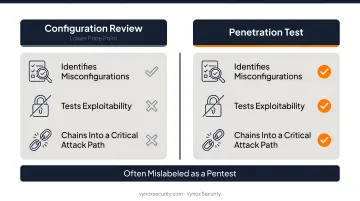
Configuration reviews are sold at lower price points and often labeled as pentests. They identify potential misconfigurations but can't tell you whether those misconfigurations are exploitable or whether they chain into a critical attack path.
The Shared Responsibility Model
AWS secures the physical infrastructure, hypervisor, and managed service layers. Everything running on top is yours: IAM policies, data, configurations, network controls, and application security.
That ownership is exactly what a pentest validates. Understanding the boundary makes it clear why a real engagement — not a configuration review — is the right tool for testing your actual exposure.
Why AWS Pentesting Matters for Cloud Security
AWS environments expose attack surfaces that traditional infrastructure assessments weren't built to find. Security groups drift. Cross-account trust relationships accumulate exceptions. Developer keys get provisioned with more access than anyone intended.
CrowdStrike's 2025 Global Threat Report found that valid-account abuse accounted for 35% of cloud incidents in H1 2024, with new and unattributed cloud intrusions rising 26% year over year.
The real risk is rarely a single misconfiguration. An overly permissive Lambda execution role looks minor in isolation — combined with S3 write access and a developer key in a sibling account, it becomes a path to full administrative compromise. Automated scanners catch the individual issue; they don't assemble the chain.
What Goes Undetected Without Regular Testing
- Credentials over-provisioned during rapid development that never get tightened
- Cross-account access policies that drift as teams and infrastructure evolve
- Serverless functions that accumulate permissions as features are added
- Attack chains spanning multiple services that no single-service scan surfaces
The Compliance Dimension
Those attack chain findings also serve a second purpose: audit evidence. Organizations pursuing SOC 2 or ISO 27001 increasingly need documented proof that cloud infrastructure was tested, not just scanned. The directly relevant controls include:
- SOC 2 CC7.1 — vulnerability detection and monitoring, with penetration testing as a named point of focus
- ISO 27001:2022 A.8.8 — management of technical vulnerabilities
- ISO 27001:2022 A.8.29 — security testing in development and acceptance
A well-scoped AWS pentest generates findings that map to these requirements, making your report audit evidence rather than just a security document.
How AWS Penetration Testing Works: The Methodology
Pre-Engagement Authorization and Scoping
Before any testing begins, you need:
- Written authorization confirming account ownership and approval for testing
- IAM credentials : SecurityAudit-level access for configuration scanning, plus credentials that simulate a realistic compromised principal (developer-level keys or an application execution role)
- Architecture diagram where available, to accelerate enumeration and avoid blind spots
Without documented authorization, testing violates AWS's Customer Support Policy for Penetration Testing. AWS no longer requires advance approval for most testing activities — but prohibited activities remain strictly enforced.
Permitted testing activities include: port scanning, vulnerability scanning, web application scanning, exploitation, injection testing, and fuzzing against approved services (EC2, RDS, CloudFront, Lambda, API Gateway, ECS, Fargate, and others).
Prohibited activities include: DNS zone walking via Route 53, DoS/DDoS simulation outside the separate DDoS Simulation Testing policy, port flooding, protocol flooding, request flooding, and S3 bucket takeover. Violating these triggers AWS Incident Response.
Step 1: Account Mapping and Enumeration
Once initial credentials are obtained, the tester establishes context — effectively a "whoami" for AWS. This involves determining what principal the credential represents, then using tools like Pacu, CloudFox, or enumerate-iam to map which services and permissions the key can access.
The output is a service permission map that guides everything that follows. Without it, testing is guesswork. You'll miss the services where the real attack surface lives.
Step 2: Configuration Scanning
Automated scanners — ScoutSuite and Prowler are the standard choices — run against SecurityAudit credentials to benchmark configurations against best practices.
This step is valuable but limited. Testers manually review output to eliminate false positives, identify valid misconfigurations, and note which services lack automated checks. Those gaps get queued for manual inspection in the next step.
Step 3: Manual Inspection, Cross-Service Chains, and Privilege Escalation
This is where a real pentest separates from a configuration review. Testers move beyond what automated tools flag and inspect individual services for exploitable misconfigurations:
- Lambda execution role permissions — can a compromised role modify function code or access other services?
- EC2 metadata endpoint — is IMDSv2 enforced, or is SSRF-based metadata theft possible?
- S3 bucket policies — what can an authenticated principal read, write, or delete?
- IAM inline policies — are there permissions that don't appear in managed policy summaries?
Individual service findings only tell part of the story. Cross-service chains are where the highest-severity paths emerge. A classic example: S3 write access to a Lambda deployment bucket, combined with an execution role that has broad IAM permissions, creates a credential theft and privilege escalation path that neither S3 nor Lambda scans would surface independently.
Cross-account trust relationships get reviewed here as well — IAM trust policies, AssumeRole configurations, and organizational Service Control Policies (SCPs).
Key Focus Areas in Every AWS Penetration Test
IAM (Identity and Access Management)
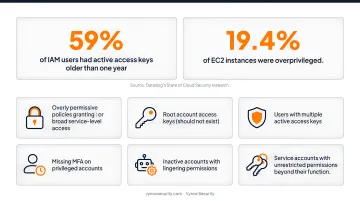
IAM misconfigurations are the root cause of most cloud privilege escalation chains. Datadog's State of Cloud Security research found that 59% of IAM users had active access keys older than one year and 19.4% of EC2 instances were overprivileged.
Key IAM checks include:
- Overly permissive policies granting
*:*or broad service-level access - Root account access keys (should not exist)
- Users with multiple active access keys
- Missing MFA on privileged accounts
- Inactive accounts with lingering permissions
- Service accounts with unrestricted permissions beyond their function
S3 Buckets
Orca's 2024 research found 5% of organizations had at least one S3 bucket granting public Write access, and 21% had a public-facing storage bucket containing sensitive data across multi-cloud environments.
Testing covers public bucket access, missing encryption, ACL configurations, bucket policies permitting unauthorized GET/PUT/DELETE operations, and disabled versioning and access logging. Note that S3 bucket takeover is explicitly prohibited by AWS's penetration testing policy.
EC2 Instances and the Metadata Endpoint
The 2019 Capital One breach — where an SSRF vulnerability in a misconfigured WAF allowed retrieval of EC2 instance metadata credentials and subsequent S3 data exfiltration — is still the clearest real-world example of what happens when IMDSv2 isn't enforced.
Despite this, Datadog found that only 37% of organizations enforced IMDSv2 on every EC2 instance in production. EC2 testing typically covers:
- IMDSv2 enforcement status across all instances
- Security group configurations with overly open inbound rules
- Credentials stored in home directories or environment variables
- Snapshot sharing settings that could expose disk contents to external AWS accounts
Lambda and Container Services
Lambda execution roles are frequently over-permissioned. When a function's execution role has permissions far beyond what it needs, a compromised invocation can become a launchpad for accessing other services or exfiltrating credentials.
Testing focuses on:
- Whether a compromised execution role can modify function code or access other AWS services
- Credentials exposed in environment variables
- ECS and EKS workloads with secrets in container definitions
- IAM role assignments for container tasks that exceed operational requirements
What a High-Quality Report Includes
Every finding documented across IAM, S3, EC2, and Lambda should translate directly into evidence your audit team can use. A strong AWS pentest report delivers:
- Executive summary with business risk context
- CVSS-scored findings with severity ratings
- Reproduction steps and cross-service attack chain documentation
- Developer-ready remediation guidance
- Findings mapped to SOC 2, ISO 27001, and PCI DSS control requirements
That compliance mapping is what transforms a pentest report into audit evidence. Vynox Security's cloud engagements deliver compliance-ready evidence packs against all three frameworks, with most assessments completed within 3–15 business days depending on scope.
Common AWS Pentesting Mistakes
These are the patterns that consistently produce incomplete assessments — and the gaps attackers exploit first.
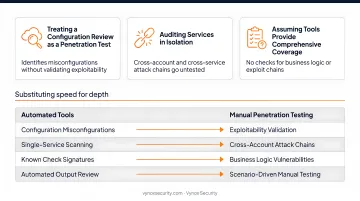
Treating a configuration review as a penetration test. Running ScoutSuite or Prowler and reviewing the output is useful — but it's not a pentest. Configuration reviews identify potential misconfigurations without validating whether they're exploitable or whether they chain into high-severity attack paths. Teams that stop here miss the scenarios that matter most.
Auditing services in isolation. Most dangerous attack chains span multiple services. An overly permissive Lambda execution role, combined with S3 write access and a developer key in a sibling account, creates a critical privilege escalation path that no single-service scan would identify. Cross-account and cross-service relationship testing has to be deliberate, not incidental.
Assuming tools provide comprehensive coverage. ScoutSuite and Prowler have no checks for every AWS service, can't test business logic vulnerabilities, and can't validate exploit chains. Treating automated output as a completed assessment leaves real attack paths unexamined — the kind that only surface under manual, scenario-driven testing.
Each of these mistakes shares a root cause: substituting speed for depth. The table below shows what automated tools cover versus what manual testing adds:
| Testing Approach | What It Catches | What It Misses |
|---|---|---|
| Automated scanner (ScoutSuite/Prowler) | Known misconfigurations, CIS benchmark deviations | Exploit chains, business logic flaws, cross-service paths |
| Manual penetration testing | Chained attack paths, logic abuse, privilege escalation | Broad config coverage at scale |
| Both combined | Comprehensive coverage | — |
Conclusion
AWS penetration testing only works when the full methodology runs — skipping phases leaves real attack paths undetected. A configuration review won't catch what an attacker would actually do with your environment.
Understanding the Shared Responsibility Model, scoping engagements correctly, and getting actionable remediation guidance — not raw vulnerability lists — separates a high-value pentest from a low-quality audit.
Teams looking for a structured, compliance-ready AWS assessment can explore Vynox Security's cloud penetration testing service — developer-ready reporting delivered in 3–15 business days.
Frequently Asked Questions
Do I need AWS's permission before running a penetration test on my own account?
AWS no longer requires prior approval for most penetration testing activities against its approved service list. Customers must stay within published permitted activities and avoid prohibited actions like DDoS simulation and DNS zone walking. Specific scenarios like red team testing or simulated DoS require advance coordination with AWS.
What is the difference between an AWS penetration test and a cloud configuration review?
A configuration review uses read-only access to check settings against benchmarks like CIS or AWS best practices — no active exploitation occurs. A penetration test actively simulates attacker behavior to validate whether misconfigurations are exploitable and chains findings into realistic attack paths with demonstrated impact.
What credentials should I give a pentester for an AWS engagement?
Provide SecurityAudit-level credentials for configuration scanning alongside credentials that simulate your most realistic initial foothold — typically developer-level keys or an application execution role. Temporary credentials are preferable to long-lived IAM user keys for both security and auditability during the engagement.
How long does an AWS penetration test typically take?
Scope determines timeline. A focused single-account startup assessment may complete in 1–2 weeks; a multi-account enterprise engagement with many interconnected services can take several weeks. Vynox delivers most AWS assessments in 5–15 business days, depending on account complexity and scope.
Can AWS penetration testing help with SOC 2 or ISO 27001 compliance?
Yes. Both frameworks include security testing expectations — SOC 2's CC7.1 and ISO 27001's Annex A controls A.8.8 and A.8.29 are directly relevant. A well-structured pentest report with findings mapped to control requirements can serve directly as audit evidence for both frameworks.
What should a good AWS penetration test report include?
A thorough AWS pentest report includes an executive summary, detailed findings with CVSS scores and severity ratings, reproduction steps, cross-service attack chain documentation, and developer-ready remediation guidance. Compliance mappings to SOC 2, ISO 27001, and PCI DSS tie each finding directly to the controls auditors will review — making the report useful beyond remediation.