Introduction
APIs now carry the majority of internet traffic. Imperva's 2024 State of API Security report found that API calls made up 71% of all web traffic it observed that year. That's not a niche attack surface anymore. It's the front door.
Here's the problem: traditional security scans check for known vulnerabilities, not business logic flaws. They won't catch an attacker who simply changes an invoice ID in a request to pull someone else's data.
Real-world breaches prove this gap matters. The 2022 Optus breach, which Australia's telecom regulator alleges stemmed from a coding error in access controls, exposed personal information tied to roughly 9.5 million customers.
This article covers what API penetration testing actually is, the vulnerabilities pentesters find most often, common testing methodologies, and the best practices that keep APIs secure without slowing down development.
Key Takeaways
- APIs handle over 70% of web traffic, making them a primary target for attackers
- Broken Object Level Authorization (BOLA) remains the most exploited API flaw industry-wide
- Automated scanners catch known issues; business logic flaws need manual, expert-led testing
- REST, GraphQL, and AI-connected APIs each carry distinct attack surfaces requiring tailored recon
- Continuous, sprint-aligned testing catches vulnerabilities faster than annual point-in-time audits
What Is API Penetration Testing?
API penetration testing is a simulated attack process. A tester acts like a real adversary, probing an API's endpoints, authentication mechanisms, business logic, and data handling to find exploitable weaknesses before criminals do.
This is different from routine API security testing or monitoring. Automated scanning checks for known signatures continuously in the background.
Pentesting is offensive and human-driven: a skilled tester attempts actual exploitation, not just pattern matching. As NIST's guidance on security testing explains, scanning identifies potential issues, while penetration testing validates whether they're truly exploitable.
The goal isn't a long list of theoretical risks. It's understanding real-world impact and getting clear remediation guidance your engineers can act on.
Different API Types, Different Attack Surfaces
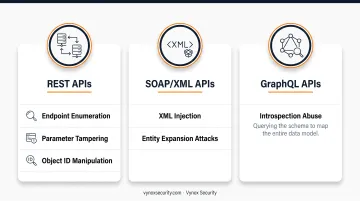
Not all APIs behave the same way under attack:
- REST APIs — vulnerable to endpoint enumeration, parameter tampering, and object ID manipulation
- SOAP/XML APIs — susceptible to XML injection and entity expansion attacks
- GraphQL APIs — exposed to introspection abuse, where an attacker can query the schema itself to map out the entire data model
Why APIs Attract Attackers
APIs often expose backend logic and sensitive data directly, with far less abstraction than a traditional web page. Many organizations also underestimate their "shadow" APIs (undocumented or forgotten endpoints that never made it into official inventories but remain live and reachable).
This risk extends into AI products. APIs connecting to LLMs, RAG pipelines, or autonomous agents introduce attack surface that goes beyond classic API risk. A compromised API feeding a model doesn't just leak data; it can poison what the model learns or serves back to users.
Common API Vulnerabilities Uncovered During Pentesting
Pentesters prioritize testing using the OWASP API Security Top 10, the industry-standard framework for ranking API risks. Here's what shows up most often in real engagements.
| OWASP Rank | Risk |
|---|---|
| API1 | Broken Object Level Authorization |
| API2 | Broken Authentication |
| API3 | Broken Object Property Level Authorization |
| API5 | Broken Function Level Authorization |
| API7 | Server-Side Request Forgery |
| API8 | Security Misconfiguration |
Broken Object & Function Level Authorization (BOLA/IDOR)
An attacker changes an object identifier in a request, say, an invoice or account number, and suddenly sees data that belongs to someone else. OWASP ranks BOLA as API1:2023 for good reason: it's consistently the most commonly found API flaw in assessments. The fix requires checking authorization at the object level on every single request, not just at login.
Broken Authentication & Token Attacks
Weak token generation and JWT misconfigurations open the door to identity forgery. Common culprits include:
- Accepting the JWT "none" algorithm, which strips signature verification entirely
- Algorithm confusion attacks, where an attacker tricks the server into verifying a token with the wrong algorithm
- Brute-forceable signing secrets
Mass Assignment, Data Exposure & Injection Risks
Beyond authentication, some of the most damaging findings come from how APIs handle data and input internally:
- Mass assignment: Auto-bound request parameters let attackers slip in fields like
"role": "admin", escalating privileges without ever touching an admin panel. - Excessive data exposure: APIs often return more fields than the front end displays, so raw responses leak data never meant to leave the server.
- Security misconfiguration: Exposed debug modes and public API documentation make both risks above easier to exploit.
- Injection and SSRF: Unsanitized inputs still enable SQL and command injection, while SSRF lets attackers redirect API requests toward internal systems they were never meant to reach.
Types & Methodology of API Penetration Testing
Black Box, Grey Box & White Box Testing
The access a tester receives shapes what the test can uncover.
| Approach | Access Level | Best For |
|---|---|---|
| Black box | No prior access; simulates an external attacker | Testing real-world exposure |
| Grey box | Partial access, such as test accounts or Swagger files | Testing authenticated user roles |
| White box | Full source code and documentation | Maximum coverage, including hidden logic |
Black box testing best mimics what an outsider actually sees. White box testing exposes trust assumptions buried deep in the code that no external attacker would easily find. Grey box splits the difference, testing authenticated behavior while still preserving some attacker constraints. Vynox typically scopes API engagements grey box, using shared Swagger or Postman collections so testing time goes toward business logic flaws instead of basic endpoint discovery.
Core Testing Process
Most API pentests follow a similar arc:
- Reconnaissance and endpoint discovery: Map every reachable route, including undocumented ones.
- Parameter enumeration: Catalog inputs, headers, and authentication requirements for each endpoint.
- Vulnerability analysis: Test each endpoint against the OWASP API Top 10.
- Exploitation: Validate that a flaw is actually exploitable, not just theoretical.
- Reporting: Document findings with reproduction steps and remediation guidance.
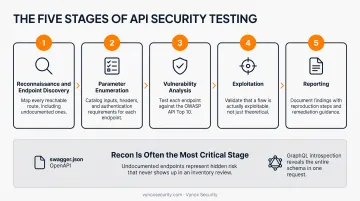
Recon is often the most critical stage. Undocumented endpoints represent hidden risk that never shows up in an inventory review. Testers rely on exposed swagger.json or OpenAPI files, and for GraphQL specifically, introspection queries that reveal the entire schema in one request.
API Penetration Testing Best Practices
Getting real value from an API pentest depends on how it's scoped and run, not just which tools are used.
- Scope for business impact, not endpoint count. Prioritize APIs handling payments, personal data, or admin functions over testing every endpoint at surface level.
- Combine automation with manual expertise. PortSwigger's research on business logic flaws shows these issues resist automated detection; scanners catch signatures, testers catch logic.
- Match testers to API-specific skills. Testers versed in GraphQL introspection or JWT algorithm confusion catch flaws generalists miss.
- Test continuously, not annually. APIs change with every sprint. A point-in-time assessment goes stale the moment a new endpoint ships.
- Demand developer-ready remediation. Findings should include reproduction steps engineers can act on, not a generic CVE reference buried in a 200-page PDF.
- Map findings to compliance frameworks. Connecting results to SOC 2 and ISO 27001 controls speeds up audit prep instead of creating a separate compliance workstream.
Tools & Techniques Used in API Pentesting
Effective API testing blends several tool categories, each serving a different purpose:
- Proxy/interception tools: Burp Suite, Postman, and Insomnia let testers intercept, modify, and replay API requests to probe authorization and validation logic
- Automated scanners: OWASP ZAP provides baseline coverage tuned for OpenAPI, SOAP, or GraphQL definitions
- Endpoint-discovery tools: Kiterunner and ffuf brute-force and fuzz for hidden routes that never made it into documentation
Fuzzing works by sending malformed or unexpected input to an API to see how it responds, often surfacing input validation failures that standard testing misses entirely.
None of these tools replace human judgment. Manual testing remains essential for authorization and business logic flaws, the exact category automated tools consistently fail to catch. It's the gap Vynox's manual API assessments are built to close.
How Vynox Security Approaches API Penetration Testing
Most API pentests stop at the infrastructure layer. Vynox tests APIs as part of a broader stack, which matters when those same endpoints feed an LLM, a RAG pipeline, or an autonomous agent.
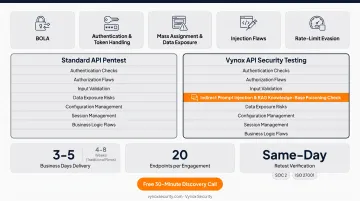
Vynox's API Security Testing covers hand-exercised testing of REST and GraphQL APIs against the full OWASP API Top 10, across up to 20 endpoints per engagement. Focus areas include:
- Broken Object-Level Authorization (BOLA)
- Authentication and token handling attacks
- Mass assignment and excessive data exposure
- Injection flaws
- Rate-limit evasion and resource exhaustion
Where this differs from a standard API pentest: Vynox also checks whether a compromised API can become an indirect prompt injection channel or poison a RAG knowledge base, a risk invisible to conventional scanners.
Beyond the technical scope, a few engagement details set this apart:
- Delivery in 3–5 business days, compared to the 4–8 weeks common among traditional firms for full engagement cycles
- Every finding comes with HTTP-level evidence, reproduction steps, CVSS scores, and stack-specific fix guidance
- Findings map directly to SOC 2 and ISO 27001 evidence requirements
- PTaaS aligns retesting with development sprints, with same-day retest verification once a fix ships to staging
Organizations can book a free 30-minute discovery call to scope an API engagement against their specific stack.
Frequently Asked Questions
What is the difference between API testing and API penetration testing?
API testing validates that an API functions and performs correctly. API penetration testing simulates real attacks to find exploitable security flaws, like broken authorization or injection vulnerabilities.
How often should organizations perform API penetration testing?
Test after major API changes, before compliance audits, and on a continuous or quarterly cadence for actively developed APIs. Sprint-aligned testing catches issues faster than annual reviews.
What is the OWASP API Security Top 10?
It's the industry-recognized list of the most critical API risks, from broken authorization to server-side request forgery. Pentesters use it to prioritize testing scope and coverage.
What's the difference between black box, grey box, and white box API testing?
Black box testing gives testers no prior access, simulating an outside attacker. Grey box provides partial access like test accounts, and white box gives full source code and documentation for maximum coverage.
How long does an API penetration test typically take?
Duration depends on API complexity and scope. Active testing can take as little as 3-5 days, though full engagement cycles at traditional firms often run 4-8 weeks. Faster PTaaS delivery models can cut that down to a matter of days.
What tools are used for API penetration testing?
Common tools include Burp Suite, Postman, and OWASP ZAP for interception and scanning, plus Kiterunner or ffuf for endpoint discovery. Manual expertise remains essential for catching authorization and logic flaws these tools miss.