Introduction
Black box penetration testing simulates a real attacker who knows nothing about your systems beyond what's publicly visible. No source code. No architecture diagrams. No credentials.
This matters for security and engineering leaders, plus compliance owners at AI-powered and SaaS companies. It's often the first hard evidence of what an outsider could actually find and exploit. Get it wrong, and you're either overpaying for a checkbox exercise or under-testing a growing attack surface.
"Black box pentest" gets thrown around loosely in vendor pitches and compliance checklists alike. This article breaks down exactly how the process works, what it can and cannot find, and when it's the right call for your organization.
Key Takeaways
- Testers work with zero internal knowledge, relying solely on public information to mirror a genuine outsider's view
- The process follows a defined sequence: scoping, reconnaissance, scanning, exploitation, and reporting
- It excels at surfacing externally exploitable issues but misses internal logic flaws and AI-specific risks like prompt injection
- Pairing black box testing with gray box, white box, or AI-specific methods closes the coverage gap
What Is Black Box Penetration Testing?
Black box penetration testing is a security assessment where testers approach your system exactly like an anonymous outside attacker would. Testers start with the same limited information a real outside attacker would have:
- Source code: not provided
- Architecture diagrams or documentation: not shared
- Credentials: none, just a company name or a URL to start from
The goal is an honest measurement: what could a real, uninformed attacker discover and exploit from outside your perimeter, using nothing but public information and their own skill? The PCI Security Standards Council defines this boundary clearly, separating black box, gray box, and white box engagements by how much system knowledge testers receive before testing starts.
Here's how the three approaches actually differ:
| Test Type | Access Given | Best For |
|---|---|---|
| Black box | No internal knowledge, no credentials | Realistic outsider risk assessment |
| Gray box | Partial access (limited credentials, some docs) | Balancing depth and realism |
| White box | Full source code and architecture | Deep code-level vulnerability discovery |
Black box engagements are also frequently run covertly, meaning the target's own operations team doesn't know testing is underway. That covertness matters: it validates whether your detection and response team actually notices and responds when something suspicious happens.
That real-world validation starts long before any manual exploitation attempt. Black box testing leans heavily on open-source intelligence (OSINT) and automation to build a picture of what's exposed. Only once that map exists does a tester start probing for weaknesses.
Why and Where Black Box Penetration Testing Is Used
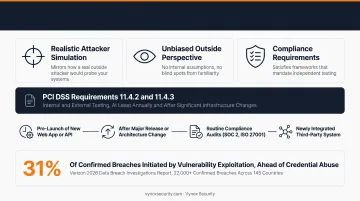
Organizations choose black box testing for three main reasons: realistic attacker simulation, an unbiased outside perspective, and compliance requirements. PCI DSS Requirements 11.4.2 and 11.4.3 explicitly mandate both internal and external penetration testing at least annually and after significant infrastructure changes. It's one of the few frameworks that names testing outright rather than leaving it implied.
Typical points in the lifecycle where black box testing gets applied:
- Pre-launch of a new web app or API, before it's exposed to real users
- After a major release or architecture change
- During routine compliance-driven assessments (SOC 2, ISO 27001 audits)
- When evaluating a newly integrated or acquired third-party system
Skip this outside-in check, and misconfigurations, forgotten subdomains, or weak external boundaries tend to surface only after something's gone wrong. That risk isn't theoretical.
Verizon's 2026 Data Breach Investigations Report, covering more than 22,000 confirmed breaches across 145 countries, found vulnerability exploitation initiated 31% of confirmed breaches — ahead of credential abuse. Externally reachable software is a leading entry point, and it's exactly what black box testing is built to probe.
How Black Box Penetration Testing Works: The Step-by-Step Process
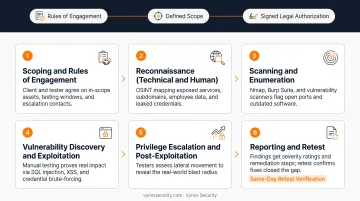
At a high level, the tester starts with nothing but a target name or URL and works forward through discovery, probing, and exploitation exactly as a real attacker would. Before any of that begins, three things need to be locked down: rules of engagement, a defined scope (IP ranges, domains, applications), and signed legal authorization.
Once underway, testers alternate between automated scanning tools and manual exploitation to validate real exploitability, not just flag theoretical findings a scanner spat out. Throughout, a strict scope and rules of engagement keep testers from disrupting production systems or touching live data they shouldn't.
The methodology breaks down into six stages, each building on the last:
- Scoping and Rules of Engagement: The client and tester agree on in-scope assets, testing windows, and escalation contacts before any activity begins. This step also defines what's explicitly off-limits, so nobody accidentally knocks over a production database mid-test.
- Reconnaissance (Technical and Human): Testers gather OSINT: exposed services, subdomains, employee data scraped from LinkedIn, and leaked credentials sitting in breach databases. This mapping exercise defines the entire attack surface before a single exploit attempt happens.
- Scanning and Enumeration: Using tools like Nmap for port scanning, Burp Suite for traffic analysis, and vulnerability scanners for known weaknesses, testers identify open ports, running services, and outdated software versions across the discovered footprint.
- Vulnerability Discovery and Exploitation: This is where automation ends and manual skill takes over. Testers attempt real exploitation, including SQL injection, cross-site scripting, brute-forcing weak credentials, and business logic abuse, to prove actual impact rather than trusting scanner output at face value.
- Privilege Escalation and Post-Exploitation: Once initial access is gained, testers assess how far they can move laterally or escalate privileges. This step demonstrates the real-world blast radius: what happens after the first foothold, not just whether one exists.
- Reporting and Retest: Findings are documented with severity ratings, reproduction steps, and remediation guidance. A retest follows to confirm the fixes actually closed the gap rather than just assuming they did; at Vynox Security, that retest is typically verified the same day fixes land in staging.
Scope, Limitations, and Common Misconceptions
Attack surface size directly drives test duration and depth. A single application with 20 endpoints tests faster and more predictably than a sprawling external footprint spanning dozens of subdomains and third-party integrations. Bigger surface, longer and less predictable timeline — there's no way around that math.
Tester skill and time-boxing are real constraints, too. A black box test is bounded by the hours allocated to it. That means results reflect "what was found in the time given," not "everything that exists" on your perimeter. Two testers with different amounts of time could reasonably surface different findings on the exact same target.
A few misconceptions worth addressing directly:
- "A clean report means we're secure." Not quite. It only reflects what's reachable from outside: internal misconfigurations, insecure code paths behind authentication, or insider-accessible flaws never enter the picture.
- "Black box testing alone satisfies our compliance requirements." Most mature security programs and frameworks recommend pairing it with gray box or white box review for deeper coverage. NIST's own guidance notes that no single assessment technique gives a comprehensive security picture on its own.
- "Traditional black box methodology covers our AI features." It doesn't. Web, API, and network-focused testing was never built for LLM prompt injection, RAG data leakage, or autonomous agent misuse. The OWASP GenAI Security Project ranks prompt injection the top LLM risk precisely because conventional tools can't detect it.
That last point matters more every quarter. For fast-shipping AI products, the attack surface changes every sprint. Treating black box testing as a one-time checkbox exercise, rather than one layer in a continuous program, creates a gap. What shipped last month may not reflect what's actually been tested.
How Vynox Approaches Black Box and AI-Native Penetration Testing
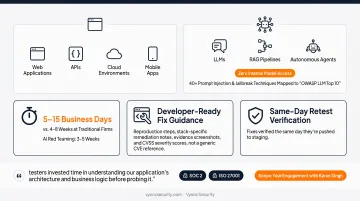
Vynox runs black box engagements across traditional infrastructure (web applications, APIs, cloud environments, mobile apps) while extending genuine black box methodology to AI systems themselves. That means testing LLMs, RAG pipelines, and autonomous agents with zero internal model access, using 40+ prompt injection and jailbreak techniques mapped to the OWASP LLM Top 10.
Rather than leaning on automated scans alone, Vynox pairs AI-augmented tooling with human-led validation. One verified client review put it plainly: testers "invested time in understanding our application's architecture and business logic before probing it." That distinction separates real exploitability from scanner noise.
A few practical advantages speak directly to the limitations covered above:
- Delivery speed: Most engagements complete in 5–15 business days versus 4–8 weeks at traditional firms, with deeper AI Red Teaming engagements running 3–5 weeks.
- Developer-ready fix guidance: Every finding ships with reproduction steps, stack-specific remediation notes, evidence screenshots, and CVSS severity scores, not a generic CVE reference.
- Same-day retest verification: Vynox verifies fixes the same day they're pushed to staging, closing the loop instead of waiting weeks for a scheduled retest.
Findings are also mapped directly to SOC 2 and ISO 27001 evidence requirements, closing the gap that a standalone black box report often leaves open for auditors and enterprise customers alike.
If you're trying to figure out the right scope for your environment, whether that's a single web app, a full AI stack, or both, a scoping call with Karan Singh can help. It's a straightforward way to get clarity before committing to an engagement.
Frequently Asked Questions
What is black box penetration testing?
It's a security assessment where testers simulate an external attacker with zero prior knowledge of the target's internals. They use only public information to find and exploit real weaknesses.
What is the difference between black box and white box penetration testing?
Black box testers get no internal information, while white box testers receive full source code and architecture access. This changes the depth, timeline, and cost of each engagement.
How long does a black box penetration test take?
Most engagements run 3–15 business days, depending on attack surface size, testing windows, and scope. Single-application tests complete faster than sprawling multi-asset footprints.
Is black box penetration testing enough on its own?
It covers externally reachable issues well but misses internal-only flaws like insecure code behind authentication. Pairing it with gray box, white box, or specialized AI testing gives fuller coverage.
What tools are used in black box penetration testing?
Common tools include Nmap for network scanning, Burp Suite and OWASP ZAP for web traffic analysis, and OSINT tools for reconnaissance. Experienced testers combine these with manual exploitation techniques.
Does black box penetration testing cover AI systems like LLMs and RAG pipelines?
Traditional black box methodology wasn't built for AI-specific risks like prompt injection or agent misuse. Specialized providers like Vynox extend black box techniques to test these systems without internal model access.