The stakes are real. NIST's Center for AI Standards and Innovation ran a public competition logging more than 250,000 attack attempts against 13 frontier AI models — and found at least one successful attack against every single one.
Yet many teams still confuse red teaming with "penetration testing but sneakier." That mix-up leads to poorly scoped engagements that either disrupt operations or completely miss real detection gaps. This guide breaks down what a red team engagement actually is, how it runs phase-by-phase, and where it fits into a modern security program — AI systems included.
Key Takeaways
- Simulates real adversaries pursuing one objective, not a vulnerability checklist
- Runs through five linked phases: planning, reconnaissance, simulation, reporting, remediation
- Unlike a pentest, measures whether your team can detect and respond to a live attack
- AI red teaming tests LLMs, RAG pipelines, and agents against prompt injection and jailbreaks
What Is a Red Team Engagement?
A red team engagement is an authorized, adversarial exercise where security professionals emulate the tactics, techniques, and procedures (TTPs) of real attackers. The goal is specific: exfiltrating a dataset, gaining domain admin, or extracting a system prompt from an LLM, achieved through any permitted route.
Vulnerability scans and compliance audits, by contrast, confirm that systems are configured correctly. They don't answer the harder question: can your organization actually detect and stop a determined, creative adversary moving across multiple attack surfaces at once? That's the gap red teaming closes.
How It Differs From Pentesting and Purple Teaming
| Practice | Focus | Format |
|---|---|---|
| Penetration test | Known vulnerabilities in a defined system | Scoped, announced |
| Red team | One objective, across people/process/tech | Often covert |
| Purple team | Collaborative attack-detect-refine loop | Real-time, shared |
Penetration testing identifies exploitable weaknesses in a defined scope. Red teaming pursues an objective and doesn't care which door it uses to get there: network, phishing email, or an unlocked server room.
Engagement Types Vary by Objective
- Covert vs. announced: covert engagements test whether the blue team notices at all; announced ones focus on validating response playbooks
- Full-scope vs. objective-based: full-scope tests everything; objective-based narrows to one specific goal (like reaching a customer database)
- Technical-only vs. physical/social inclusive: some engagements add phishing and physical infiltration; others stay purely digital
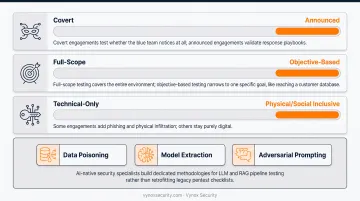
Scope and methodology shift depending on which type you choose, so this decision should happen before any technical work starts.
Looking toward 2026, red teaming has expanded into generative AI. LLMs and autonomous agents introduce attack surfaces (data poisoning, model extraction, adversarial prompting) that traditional red teams were never built to test. This is where AI-native firms like Vynox Security have emerged, building dedicated methodologies for LLM and RAG pipeline testing rather than bolting AI checks onto legacy pentest frameworks.
How Does a Red Team Engagement Work?
A red team engagement runs through four connected stages, each building toward one outcome: a realistic measurement of your detection and response capability.
Planning and Rules of Engagement
Nothing starts without a signed agreement. Stakeholders and the red team jointly define the objective, the scope, and what success looks like before any testing begins. This stage is always manual and collaborative, never automated.
The Rules of Engagement (RoE) document must cover, in writing:
- In-scope and out-of-scope systems
- Permitted TTPs (what's fair game, what isn't)
- Testing windows and blackout periods
- Data handling rules for anything accessed
- Emergency stop contacts on both sides
- A deconfliction process so the blue team knows a detected event is the red team, not a real breach
This is the most commonly rushed phase, and the most costly one to skip. Engagements without signed RoE risk being treated as an actual incident, complete with law enforcement calls. That's why planning often takes 1-2 weeks before a single technical action happens.
Reconnaissance
Once scope is locked, red teamers gather intelligence the same way a real attacker would: passively and actively, using OSINT techniques. Company websites, social media profiles, job postings, and domain registries all get mapped to identify entry points and profile employees.
This stage matters more than it looks. The depth of reconnaissance directly affects how convincing later social engineering or initial-access attempts will be. A rushed recon phase produces obvious phishing emails; a thorough one produces messages an employee would genuinely click.
Attack Simulation and Exploitation
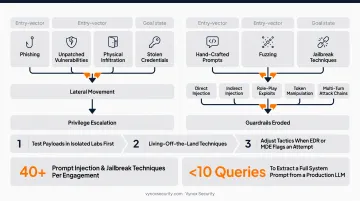
This is where the objective gets pursued. Red teamers gain initial access through phishing, unpatched vulnerabilities, physical infiltration, or stolen credentials, then move laterally to escalate privileges toward the defined goal.
Staying undetected takes discipline:
- Test payloads in isolated labs first to avoid unintended damage
- Use living-off-the-land techniques, relying on built-in tools instead of custom malware, to blend in
- Adjust tactics when EDR or MDE flags an attempt, mirroring how real attackers pivot under pressure
For AI systems, this phase looks completely different. There's no exploit code to write; instead, testers rely on hand-crafted prompts, fuzzing, and jailbreak techniques.
Vynox Security's AI security testing, for instance, runs 40+ distinct prompt injection and jailbreak techniques per engagement, spanning direct injection, indirect injection through documents and tool outputs, role-play exploits, token manipulation, and multi-turn attack chains that erode guardrails gradually. In practice, this kind of testing has extracted full system prompts from production LLMs in under 10 queries.
Reporting and Remediation
The output is a documented attack path: timestamps, techniques used, what was accessed, and whether the blue team detected the activity at all. Many teams map findings to frameworks like MITRE ATT&CK to give the attack chain structure that engineering and leadership can both follow.
From there:
- Findings get prioritized by severity and business impact
- Engineering teams receive reproduction steps and stack-specific fix guidance, not generic CVE advice
- A retest confirms the fix actually closed the gap
Report quality determines how fast things get fixed. Vynox structures every report with reproduction steps, evidence screenshots, CVSS scores, and remediation guidance built for the specific stack in use, whether that's LangChain, OpenAI Assistants API, or a custom orchestration layer, rather than a one-size-fits-all PDF.
That specificity, paired with same-day retest turnaround once a fix hits staging, is what separates a report that gets acted on from one that sits in an inbox.
Where Red Team Engagements Are Used
Red teaming typically comes after baseline vulnerability management and penetration testing are already in place. It functions as a maturity check for programs that already have those foundational controls operating.
It performs best when organizations have:
- An established SOC or blue team capable of detecting an intrusion
- Regulatory drivers like SOC 2, ISO 27001, or financial services frameworks pushing toward adversarial validation
- Plans to test physical and human security alongside technical controls
Red Teaming AI Systems and Applications
As organizations deploy LLMs, RAG pipelines, and autonomous agents, the scope of red teaming has expanded. It now covers prompt injection, model extraction, data poisoning, and unsafe agent actions, gaps most traditional pentest firms simply don't cover.
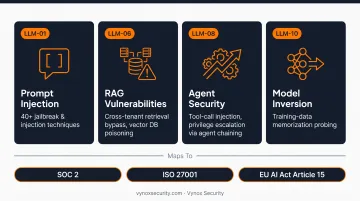
Vynox Security's AI-native methodology covers the full OWASP LLM Top 10 in every engagement, mapping findings directly to:
- LLM-01 (Prompt Injection) through 40+ jailbreak and injection techniques
- LLM-06 (RAG vulnerabilities) via cross-tenant retrieval bypass and vector DB poisoning analysis
- LLM-08 (Agent Security) covering tool-call injection and privilege escalation via agent chaining
- LLM-10 (Model Inversion) through training-data memorization probing
Findings map directly to SOC 2, ISO 27001, and EU AI Act Article 15 adversarial-testing requirements for high-risk AI systems. This lets AI-powered businesses validate both infrastructure and AI attack surface in a single engagement, rather than running two separate vendors.
Conclusion
A red team engagement is only as valuable as its planning discipline, execution rigor, and follow-through. The objective-based approach, chasing one goal across people, process, and technology, is what separates it from a simple vulnerability scan.
Organizations that treat red teaming as a recurring, scoped exercise rather than a once-a-year checkbox build measurably stronger detection and response capability over time. That's true whether the target is a corporate network or a production LLM.
Frequently Asked Questions
What is a red team engagement?
It's an authorized, objective-based simulation of real-world attacker TTPs against an organization's technology, people, and processes. The goal is testing detection and response, not just finding bugs.
What are the rules of engagement in red team?
RoE define scope, permitted tactics, testing windows, data handling rules, and emergency contacts. All of it gets agreed in writing before any testing starts.
What is the red team engagement lifecycle?
Five phases: planning and RoE, reconnaissance, attack simulation, reporting, and remediation with a follow-up retest. Each phase builds on the last.
How is red teaming different from penetration testing?
Pentesting is scoped to finding known vulnerabilities in a defined system. Red teaming pursues one objective across technology, people, and processes to test whether your team detects and responds.
How long does a typical red team engagement take?
Full-scope engagements typically run 5-12 weeks, according to Mindgard's published methodology, covering planning through reporting. Scoped AI red team engagements, like Vynox's, can run 3-5 weeks.
What is the difference between red team, blue team, and purple team?
Red teams attack, blue teams defend and detect, and purple teams combine both in real time. Purple teaming trades independence for faster knowledge transfer between offense and defense.