That shift is reshaping how pentests get scoped and priced. Cost depends on test type, methodology, and the systems in scope — but increasingly, it also depends on whether AI systems like LLMs, RAG pipelines, or autonomous agents sit inside your environment.
This guide breaks down pricing by test type, the factors that push cost up or down, the hidden and recurring costs vendors rarely lead with, and how to budget correctly for both traditional infrastructure testing and the emerging AI/LLM pentest category.
Key Takeaways
- Penetration testing cost runs from single-app baseline checks to six-figure enterprise and continuous programs, driven by scope
- Price scales with methodology depth, tester seniority, compliance needs, and AI systems in scope
- Startups and single-product teams sit lower; regulated enterprises and AI-powered products sit higher
- Spend more only when you need compliance evidence, continuous validation, or AI-specific risk coverage
How Much Does Penetration Testing Cost? (Pricing Overview)
There's no fixed price tag for a penetration test. Every engagement is scoped around the assets involved, the depth of testing required, and the methodology used. A single web app assessment and a red team exercise against a Fortune 500 network simply aren't the same product.
This is exactly where budgets go wrong. Common missteps include:
- Underbudgeting for retesting, then discovering fixes aren't verified
- Mistaking an automated vulnerability scan for a real, manually validated pentest
- Choosing a scope that doesn't actually match the organization's risk profile
Four general pricing categories dominate the 2026 market: entry-level, mid-range, high-end/enterprise, and the newer AI/LLM testing category.
Entry-Level / Basic Testing
This tier typically covers a single web app, API, or small network segment, tested with a black-box approach and limited manual validation layered on top of automated scanning.
Best for: startups, single-product companies, or organizations that just need a baseline compliance check to satisfy an early customer questionnaire or a first SOC 2 cycle.
Mid-Range / Standard Testing
Here, scope expands to a multi-asset footprint: web app, API, and cloud infrastructure together. Testing uses gray-box methodology, where testers have partial knowledge of the system rather than none at all.
What's typically included:
- Compliance-ready reporting mapped to SOC 2 or ISO 27001 evidence requirements
- Coverage across more than one asset type in a single engagement
- Reports built for both engineering teams and auditors
Best for: growth-stage SaaS companies and any organization with active, recurring compliance obligations.
High-End / Enterprise & Specialized Testing
This is where red teaming, full product security assessments, FedRAMP-level audits, and continuous Penetration Testing as a Service (PTaaS) subscriptions live.
Vynox's Deep Secure tier, for example, runs full AI red teaming over 3–5 weeks. That includes threat modeling, attack surface mapping, and exploit chaining into realistic multi-step attack scenarios—a far heavier lift than standard vulnerability enumeration.
Best for: large enterprises, regulated industries, and any company that needs year-round validation rather than an annual snapshot.
AI & LLM Penetration Testing: The Emerging 2026 Cost Category
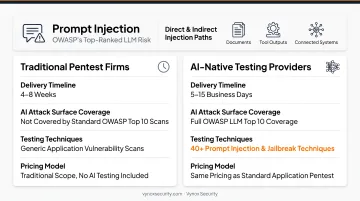
Traditional pentest pricing models simply weren't built for LLM, RAG pipeline, or autonomous agent attack surfaces. Prompt injection, jailbreaks, and data leakage through retrieved content don't show up in a standard OWASP Top 10 scan.
OWASP's own Gen AI security research identifies prompt injection as its top-ranked LLM risk, with both direct and indirect injection paths through documents, tool outputs, and connected systems.
AI-native testing methodologies aren't priced as a separate premium tier. Providers like Vynox run full OWASP LLM Top 10 coverage with 40+ prompt injection and jailbreak techniques at pricing comparable to standard application pentests. The difference is specialized tester expertise, not a bigger invoice.
Speed matters here too. AI-native providers can turn around findings in 5–15 business days, compared with the 4–8 week timelines typical of traditional firms still building AI-testing competency from scratch. For teams shipping model updates every sprint, that gap directly affects how long vulnerabilities sit exposed.
Key Factors That Affect the Cost of Penetration Testing
Pricing depends on three overlapping layers: technical scope, operational depth, and business or compliance context. Each factor below can shift a quote significantly.
Scope & Methodology
NIST's SP 800-115 guidance draws a clear line between the three main methodologies:
- Black-box testing assesses the running system with no source code access, well suited to compiled components, interface behavior, and how a system handles real-world threats
- White-box testing analyzes source code directly, which NIST notes tends to be more efficient and cost-effective for finding defects in custom applications
- Gray-box testing blends both, giving testers partial system knowledge
Deeper access usually yields more thorough coverage. White-box work can find defects more efficiently per hour, but that depth still expands skilled effort versus a surface-level black-box scan, so quotes rise with methodology intensity.
Type of System Tested
Traditional infrastructure testing (network, web, mobile, cloud) follows well-established methodologies. AI systems don't. Testing an LLM, a RAG pipeline, or an autonomous agent needs attack techniques outside standard OWASP Top 10 coverage: cross-tenant retrieval bypass, vector database poisoning, and agent goal hijacking.
Vynox structures this as two distinct testing layers: a primary AI Security Testing layer (LLMs, RAG pipelines, agents, model inversion) and a supporting Infrastructure layer (web, mobile, cloud, network, API). Each layer requires different tooling, different expertise, and gets scoped separately even within the same engagement.
Tester Experience & Certifications
Testers holding OSCP, CISSP, OSCE, or CREST credentials command higher rates than generalist scanners-for-hire. Certification signals manual exploitation skill, not just tool familiarity.
No single published industry hourly benchmark exists for certified testers, but CREST-aligned talent sits meaningfully above commodity-scan pricing.
Compliance & Regulatory Requirements
Regulatory mandates add documentation and testing-depth requirements that raise cost:
| Framework | What it adds to scope |
|---|---|
| PCI DSS | Annual testing plus change-triggered retests, full CDE coverage, segmentation validation |
| HIPAA | Proposed rule would require annual penetration testing and semi-annual vulnerability scans |
| SOC 2 / ISO 27001 | Evidence packs mapped to specific trust criteria and ISMS controls |
| FedRAMP | Full boundary coverage, mandatory attack vectors, 3PAO involvement, annual cadence |
Each of these adds real scoping and reporting work — that's where the extra cost comes from, not from arbitrary markup.
Remediation, Retesting & Reporting Depth
Engagements that include fix validation, retesting, and developer-ready remediation guidance cost more upfront, but they cut time-to-remediation considerably.
Vynox's same-day retest model verifies fixes as soon as engineers push to staging. That is a heavier service commitment than a retest scheduled weeks later, and it closes the exposure window fast.
Cost Breakdown: What's Included Beyond the Quote
The vendor's quoted price is only part of the total cost of running a penetration testing program. Five components typically make up the full picture:
- Initial assessment: One-time cost for scoping, active testing, and exploitation against the agreed scope
- Reporting & remediation guidance: Usually bundled in; stronger reports include reproduction steps, CVSS scores, and stack-specific fix guidance
- Retesting / fix validation: Often an add-on with traditional vendors; providers like Vynox include same-day or unlimited retesting in the engagement
- Internal labor & business disruption: Hidden staff time for scoping calls, tester questions, and reviewing findings
- Continuous testing / PTaaS: Recurring model for teams that need validation on sprint or release cadence, not a single annual snapshot
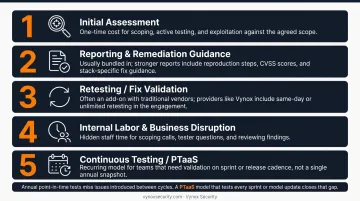
Annual point-in-time tests miss issues introduced between cycles. A PTaaS model that tests every sprint or model update closes that gap.
Low-Cost vs High-Cost Penetration Testing — What's the Difference?
Budget-tier and premium-tier engagements often look similar on paper. In practice, they differ across three areas.
Depth of Testing
- Lower-cost: heavily automated, minimal manual exploitation, limited to known vulnerability signatures
- Higher-cost: manual validation, business logic and workflow abuse testing, and attack-chain analysis that links individual flaws into realistic exploit paths
Reporting & Remediation Support
- Lower-cost: a raw vulnerability list with little context, often written for auditors rather than engineers
- Higher-cost: developer-ready, stack-specific fix guidance with reproduction steps and retest support built in
Long-Term Value & Risk Reduction
A cheap, automated-only test creates a false sense of security. Critical exploit paths involving business logic or chained vulnerabilities go undetected because scanners can't reason about intent.
That gap has a price. IBM's 2026 data puts the global average breach cost at $4.99 million, rising to $6 million for AI-enabled malicious breaches. Against those figures, the price difference between a shallow scan and a thorough manual engagement is small. The real cost is what a missed vulnerability turns into later.
How to Estimate the Right Budget & Avoid Common Cost Mistakes
The right budget matches actual risk and systems in scope. Chasing the lowest quote almost always costs more later, once a missed vulnerability surfaces in production.
Factors to weigh before setting a budget:
- Sensitivity of systems and data in scope, including any AI/LLM components
- Compliance deadlines (SOC 2 audit windows, ISO 27001 certification cycles, EU AI Act obligations)
- How often testing needs to happen — once a year, or aligned to every release
- Whether in-house security capacity can handle triage, or testing needs to be fully outsourced
Common mistakes to avoid:
- Focusing only on the upfront price and ignoring retesting or remediation costs entirely
- Over-scoping test types that don't match actual risk, inflating cost without adding value
- Choosing the cheapest vendor without verifying how much manual testing is actually included
- Treating AI systems as covered by a standard web app pentest when they need dedicated methodology
Budget for the full cycle: initial testing, remediation support, and retesting. Pair that with scope tied to real risk and a methodology that covers AI systems on their own terms, and you spend once instead of paying twice after a production miss.
Frequently Asked Questions
Are penetration tests worth it?
Yes. A thorough pentest typically costs a fraction of the $4.99 million average breach cost IBM reported for 2026. Skipping proper testing to save on price rarely pays off against that risk.
How much do companies pay for penetration testing?
Costs range from a modest fee for a single-app baseline check to six-figure programs for enterprise red teaming and continuous PTaaS coverage. Scope, methodology, and asset count drive most of that spread.
What is the average cost of a penetration test in 2026?
There's no single universal average. Pricing depends heavily on scope and depth. Engagements move toward the higher end when compliance mandates, multi-asset scope, or AI system testing are involved.
Why are some penetration tests priced so cheap?
Very low-cost offerings are frequently automated vulnerability scans mislabeled as pentests. They lack manual exploitation, business logic testing, and the human validation needed to catch real attack paths.
How much does AI or LLM penetration testing cost compared to traditional pentesting?
Pricing is generally comparable to standard application pentests. The real difference is methodology: AI testing needs specialized skills like prompt injection and jailbreak testing that generic infrastructure providers often don't offer.
What's typically included in a penetration testing quote?
Standard quotes cover scoping, active testing, exploitation, and a findings report. Retesting and detailed remediation support are sometimes excluded unless the vendor states otherwise upfront. Always confirm this before signing.