The global average cost of a data breach hit $4.99 million in IBM's Cost of a Data Breach Report 2026, a 12% jump from the year before and a new record. That number keeps climbing because attackers keep finding new entry points, especially in AI systems most security teams haven't learned to test yet.
Penetration testing is how you find those weaknesses before someone else does. This guide covers what it is, the types available, the step-by-step process, why compliance frameworks demand it, and how to pick a partner who won't miss what matters.
Key Takeaways
- Manual penetration testing finds exploitable weaknesses that automated scans miss entirely
- AI systems need testing for prompt injection, jailbreaks, and RAG leakage—not just traditional CVEs
- PCI DSS 11.4 requires penetration testing; SOC 2 and ISO 27001 treat it as strong audit evidence
- Report quality and retest speed matter as much as the testing itself
What Is Penetration Testing?
A penetration test is an authorized, simulated cyberattack carried out by skilled professionals who try to break into your systems the same way a real attacker would. The goal is to prove a flaw can actually be exploited and show exactly what an attacker could do with it.
The end result is a report. A good one details:
- Every vulnerability discovered, ranked by severity
- The exact steps used to exploit each one
- The business risk each flaw creates
- Clear guidance on how to fix it
Penetration Testing vs. Vulnerability Scanning
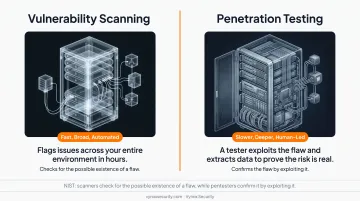
These two get confused constantly, but they're not the same thing. A vulnerability scan is like an X-ray: fast, broad, and automated. It flags things that might be a problem across your entire environment in a matter of hours.
A penetration test is more like an MRI. It's slower, deeper, and human-led. A tester doesn't just flag a possible SQL injection point. They exploit it, extract data through it, and prove the risk is real rather than theoretical. NIST draws this exact distinction: scanners check for the possible existence of a flaw, while pentesters confirm it by exploiting it.
Is Penetration Testing Legal?
Yes, but only under specific conditions. A penetration test is legal when it's performed with explicit written authorization, a clearly defined scope, and a signed rules-of-engagement agreement. Testing systems without that permission is illegal hacking, regardless of intent.
The scope document isn't paperwork for paperwork's sake. It protects the testing team from legal exposure and protects your organization by defining exactly what's fair game, what's off-limits, and how sensitive data gets handled during the engagement.
Types of Penetration Testing
The right test depends entirely on what you're trying to protect. A company running a legacy internal network has different exposure than one shipping an AI-powered SaaS product. Most mature security programs end up needing several types at once.
Network Penetration Testing
Internal and external network tests simulate an attacker trying to break in from outside, or already having a foothold inside, and then escalating privileges. Testers move laterally across network segments to show how far a single compromised machine can take an attacker—and what data or systems sit in that path.
Web Application & API Penetration Testing
This covers login flows, business logic abuse, and API endpoints. Common findings include broken authentication, injection flaws, and data exposure through poorly secured endpoints.
A standard API engagement examines both REST and GraphQL against the OWASP API Top 10. That includes broken object-level authorization, mass assignment, and rate-limit evasion, with HTTP-level evidence for every finding.
Cloud & Mobile Penetration Testing
Cloud environments introduce their own risk categories:
- IAM misconfigurations that grant excessive permissions
- Exposed storage buckets left open to the public internet
- Insecure API integrations between cloud services
Mobile testing focuses on insecure local data storage, weak certificate pinning, and API abuse from the client side.
AI, LLM & RAG Pipeline Penetration Testing
Here's where traditional pentesting methodologies fall short. A network scanner has no concept of a jailbreak. A web app tester's playbook doesn't account for a RAG pipeline leaking one tenant's data into another tenant's chatbot response.
These are new attack surfaces. The OWASP Top 10 for LLM Applications (2025) is the reference standard for risks like prompt injection, sensitive information disclosure, and vector/embedding weaknesses.
Vynox Security tests this layer with 40+ prompt injection and jailbreak techniques across six categories:
- Direct injection
- Indirect injection through documents and retrieved content
- Role-play exploits
- Token manipulation
- Multi-turn attack chains
- Encoding bypasses
That work runs alongside traditional infrastructure testing, so nothing in a modern AI-powered stack goes unchecked.
The Penetration Testing Process: Step by Step
Every credible pentest follows roughly the same arc, though the pace varies by provider.
- Preparation & scoping. The testing team and client agree on goals, in-scope systems, and rules of engagement before any work starts. Skipping this step is how engagements go sideways.
- Reconnaissance & scanning. Testers gather intel and run automated scans to map potential entry points. This is the starting line for manual work, not the finish line.
- Exploitation. Testers manually attempt to exploit what they've found, proving real-world impact rather than flagging theoretical risk.
- Reporting. A detailed report covers an executive summary, technical findings, reproduction steps, and prioritized remediation guidance.
- Retesting. Fixes get verified. Unresolved or partially patched issues show up often on retest—which is exactly why this step can't be skipped.
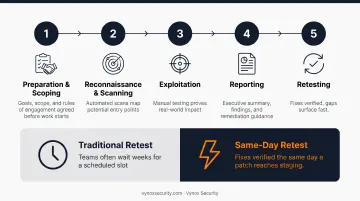
Where most engagements stall is the gap between reporting and retesting. Traditional firms often leave teams waiting weeks for a scheduled slot. Vynox verifies fixes the same day an engineer pushes a patch to staging.
Testing Approaches: Black Box, White Box, and Authenticated Testing
Buyers often mix up these labels. Here’s what each approach actually means.
| Approach | What the tester knows going in |
|---|---|
| Black box (closed-box) | Nothing about internal structure or design |
| White box (open-box) | Full internal architecture and design details |
| Gray box | Partial knowledge, mimicking an informed insider |
Authenticated testing means testers get valid login credentials for one or more user roles. This matters because it lets them evaluate privilege escalation and unauthorized data access directly, rather than spending half the engagement window just trying to get in the door. Unauthenticated testing skips this and evaluates what's reachable without any credentials at all.
Neither authenticated nor unauthenticated testing alone tells the full story. Many real breaches start with a low-value foothold, then pivot into something far more sensitive. A tester who only checks the front door misses how attackers move once they’re inside.
Why Penetration Testing Matters for Compliance and Risk
Several major frameworks build penetration testing directly into their requirements, and getting this wrong slows down audits and certifications.
- PCI DSS v4.0.1, Requirement 11.4 mandates internal and external penetration testing at least every 12 months and after significant change, per the current PCI DSS standard.
- SOC 2 doesn't prescribe a universal annual pentest, but findings serve as strong supporting evidence for monitoring controls.
- ISO 27001:2022 takes a risk-based approach; Annex A.8.29 calls for security testing throughout the development lifecycle.
- HIPAA has no mandated pentest cadence today, though a 2025 proposed rule would require testing at least every 12 months for entities handling electronic protected health information.
Risk exposure makes the same case from another angle. That $4.99 million average breach cost isn't abstract for anyone shipping software to enterprise customers. It's why procurement teams increasingly demand pentest evidence before signing a contract.
Generic vulnerability lists don't speed up an audit. Findings mapped to specific compliance controls do.
Vynox evidence packs map results to SOC 2 and ISO 27001 AI-specific requirements, along with EU AI Act Article 15 adversarial testing, ISO 42001, and India's DPDP Act. Teams get that mapping from a single engagement instead of a separate compliance workstream.
Choosing the Right Penetration Testing Partner
Not every firm calling itself a pentest provider delivers the same depth. A few things separate the good ones from the rest.
Look for real credentials, not just a logo on a website:
- OSCP/OSCP+ for hands-on exploitation ability
- CEH for foundational ethical hacking knowledge
- CISSP for broad security program expertise
- GIAC (GPEN) for structured pentest methodology
Ask for anonymized past engagement examples. Any firm worth hiring will have some to show.
Reporting quality matters just as much as testing quality. A report stuffed with generic CVE descriptions helps no one. Look for methodology explanations, clear reproduction steps, and remediation guidance written for both the engineer fixing the bug and the executive signing off on the budget.
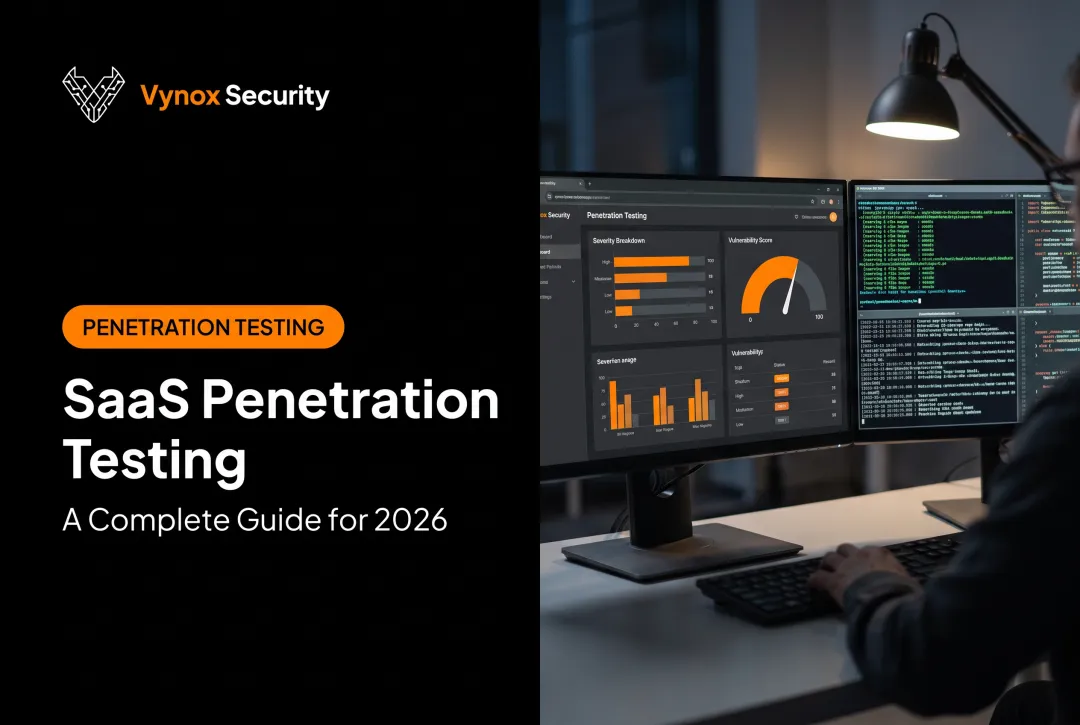
Strong reports go further: CVSS scores, evidence screenshots, and stack-specific fix guidance. Vynox pairs that with a live dashboard that tracks open vulnerabilities and an overall security posture score.
Cost and timeline vary widely by scope. Published 2026 vendor benchmarks give a useful range:
- Web app tests: about $5,000–$30,000
- Most overall engagements: $10,000–$30,000
- Cloud engagements: up to $50,000
- Traditional firm timelines: often 4–8 weeks end to end
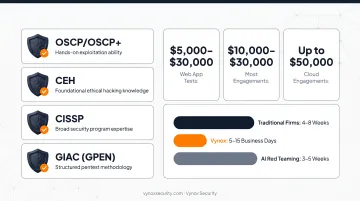
Vynox delivers most engagements, including AI-specific testing, within 5–15 business days. AI red teaming typically runs 3–5 weeks when you need board-level adversarial assurance.
For teams shipping frequent updates, a one-time annual audit leaves gaps between releases. Continuous testing (PTaaS) aligned to sprints and model updates—not a fixed calendar date—closes that gap.
That cadence is how Vynox runs engagements, delivered directly or white-labeled through its Partner Programme for GRC platforms, audit firms, and MSPs. A free 30-minute discovery call, bookable here, is a practical way to scope the right tier and budget accurately.
Frequently Asked Questions
What is penetration testing?
Penetration testing is an authorized, simulated cyberattack performed by security professionals to identify exploitable vulnerabilities before real attackers can use them. It goes beyond flagging risks by proving they're actually exploitable.
Is penetration testing legal?
Yes, but only with explicit written authorization, a defined scope, and a signed rules-of-engagement agreement. Testing any system without that permission is illegal, regardless of the tester's intentions.
How difficult is penetration testing?
It takes strong technical skill and years of hands-on practice to find and chain exploits reliably. That's why most organizations hire certified specialists for the work.
What's the difference between a penetration test and a vulnerability scan?
A vulnerability scan is automated and surface-level, flagging possible issues across a wide area quickly. A penetration test is manual and exploit-driven, proving real-world impact rather than theoretical risk.
How much does a penetration test cost?
Cost varies heavily by scope and complexity. Small, single-application engagements often run several thousand dollars, while large multi-asset enterprise tests can reach $50,000 or more.
How long does a penetration test take?
Most engagements take a few days to about three weeks, depending on scope. Broader AI red-team assessments can run longer—often three to five weeks—while focused application or API tests are frequently done in days.