Getting this choice right isn't academic. It shapes how you spend your security budget, whether you pass a SOC 2 or ISO 27001 audit, and — increasingly — whether you catch AI-specific risks like prompt injection before an attacker does. The stakes keep climbing: the CVE Program logged 48,244 new vulnerability records across its four 2025 quarterly reports, meaning security teams are drowning in more disclosed flaws than ever.
This guide breaks down what vulnerability assessment and penetration testing actually do, when each one fits, and why AI-powered products now need a third layer of testing entirely.
TL;DR
- Vulnerability assessment scans and catalogs known weaknesses; penetration testing simulates attacks to prove which ones are exploitable.
- VA is broad, continuous, and lower-cost. PT is deep, periodic, and resource-intensive — but it validates real-world impact.
- Security-mature organizations facing SOC 2, ISO 27001, or PCI DSS mandates typically need both, not one or the other.
- Companies building LLMs, RAG pipelines, or AI agents need a third layer: AI-native penetration testing traditional VA/PT never covered.
Vulnerability Assessment vs Penetration Testing: Quick Comparison
Both approaches reduce risk. They just do it in fundamentally different ways.
| Dimension | Vulnerability Assessment | Penetration Testing |
|---|---|---|
| Cost | Lower, driven by automated tooling | Higher, driven by manual expert hours |
| Methodology | Automated scanning with periodic manual review | Manual, human-driven exploitation (ethical hacking) |
| Depth & Scope | Broad, surface-level, across all assets | Narrow, exploitation-focused on specific systems |
| Frequency | Continuous or monthly/quarterly | Periodic: annual, biannual, or per release |
| Output | Prioritized risk list with CVSS scoring | Exploitation report with proof-of-concept and fixes |
NIST draws the same line: scanning identifies possible vulnerabilities by matching software versions against known-vulnerability databases, while penetration testing mimics an attack to confirm whether those findings can actually be exploited. A VA produces candidates. A pentest confirms what an attacker can use.
Which One Is Better?
Neither wins outright. The right choice depends on four factors:
- Budget: scanning tools cost a fraction of expert-led testing hours
- Compliance mandate: some frameworks specify exact cadences (more on that below)
- System criticality: a customer-facing payment API deserves more scrutiny than an internal wiki
- Security maturity: newer programs often start with VA before layering in PT
Choose vulnerability assessment when you need continuous hygiene on a limited budget. It catches missing patches, exposed ports, and outdated software before they pile up.
Choose penetration testing when you need to prove exploitability, satisfy a stricter audit requirement, or ship an AI-powered feature that a standard scanner cannot evaluate. If your roadmap includes an LLM feature or autonomous agent, expert-led testing is how you learn what an adversary could actually do with it.
What Is Vulnerability Assessment?
Vulnerability assessment is a systematic process of identifying, evaluating, and prioritizing known security weaknesses across your infrastructure. It forms the backbone of a continuously monitored attack surface: scans run on a set cadence and flag problems before they become incidents.
Core benefits tie directly to operational outcomes:
- Shrinks the window attackers have to exploit a known flaw
- Feeds a prioritized patch management queue instead of a guessing game
- Produces audit-ready documentation with minimal extra work
Common Variations
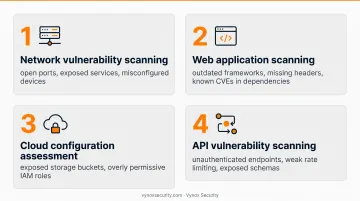
Vulnerability assessment isn't a single tool. It's a category that spans several scopes:
- Network vulnerability scanning — open ports, exposed services, misconfigured devices
- Web application scanning — outdated frameworks, missing headers, known CVEs in dependencies
- Cloud configuration assessment — exposed storage buckets, overly permissive IAM roles
- API vulnerability scanning — unauthenticated endpoints, weak rate limiting, exposed schemas
Use Cases of Vulnerability Assessment
VA fits into the day-to-day security lifecycle rather than a single event. Think routine hygiene checks between patch cycles, pre-audit sweeps, and ongoing monitoring of cloud environments that change weekly.
That same cadence shows up in regulation for payment-handling businesses. PCI DSS v4.0.1 requires internal and external vulnerability scans at least once every three months, plus mandatory rescans after any high or critical finding is remediated.
The quarterly rhythm is why VA is standard in fintech and e-commerce: regulators expect the checkbox filled four times a year.
What Is Penetration Testing?
Penetration testing is an authorized simulated cyberattack. It proves whether identified weaknesses can actually be exploited: not just flagged, but walked through end-to-end the way a real attacker would.
Where the operational payoff differs from VA:
- Validates whether your security investments actually hold up under pressure
- Satisfies stricter compliance mandates that demand independent, human-led testing
- Surfaces business-logic flaws automated scanners can't reason about (for example, a checkout flow that lets you skip payment validation)
Variations Worth Knowing
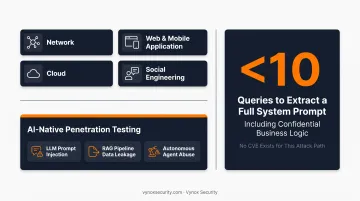
Penetration testing spans several categories: network, web and mobile application, cloud, and social engineering engagements. A newer category has emerged that none of those were built to handle: AI-native penetration testing, covering LLM prompt injection, RAG pipeline data leakage, and autonomous agent abuse.
This is a different discipline, not a rebrand of existing methodology. Traditional pentesting was built to test whether a system enforces access controls correctly. It has no concept of testing whether a language model can be talked out of its guardrails through a cleverly worded prompt.
Firms like Vynox Security were purpose-built around this gap. Engagements run full OWASP LLM Top 10 coverage using 40+ prompt injection and jailbreak techniques, test RAG pipelines for cross-tenant data leakage, and probe autonomous agents for tool-call hijacking.
One concrete finding: a full system prompt, including confidential business logic, can often be extracted in under 10 queries. That path is invisible to a CVE scanner, because there is no CVE for it.
Use Cases of Penetration Testing
Penetration testing fits at specific, high-stakes moments:
- Pre-launch validation before shipping a new feature
- Annual compliance audits and post-incident verification
- Continuous PTaaS aligned to development sprints, not a once-a-year fire drill
Fintech and healthcare have long led on pentest adoption because the compliance stakes are steep. AI-powered SaaS platforms are now catching up fast. Cobalt's 2026 State of Pentesting survey of 450 respondents found that 53% now run programmatic, continuous, risk-driven pentest programs, versus 40% still testing mainly to check a compliance box. The same report found AI/LLM-specific pentests jumped 2.4x year-over-year — a clear signal that teams shipping AI features are no longer treating this as optional.
Real-World Example: When Scanning Alone Isn't Enough
Picture a mid-sized SaaS company that had run vulnerability scans religiously for two years. Their dashboard looked clean. Then they shipped a customer support feature powered by a RAG pipeline pulling from their knowledge base and customer account data.
The gap: their scanner had no idea the RAG pipeline existed as an attack surface. It couldn't test whether a crafted query could pull one customer's documents into another customer's session. It also had no way to flag that the system prompt governing the chatbot could be extracted in a handful of conversational turns.
The trigger: an upcoming SOC 2 audit forced the question: could they prove this feature was actually safe, or just assume it was because the scanner stayed quiet?
What manual testing changed: a dedicated engagement:
- Mapped the entire retrieval path
- Tested cross-tenant access controls through the application layer
- Verified whether prompt-crafted queries could bypass document-level permissions
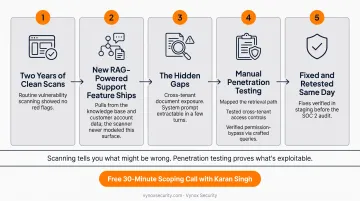
Fixes went to staging and got retested the same day, closing the loop far faster than waiting weeks for a follow-up report.
The takeaway: automated scanning tells you what might be wrong. Penetration testing proves what's actually exploitable, and gives your engineers the reproduction steps to fix it before an auditor or an attacker finds it first.
If you're staring down a similar gap, Vynox Security's team runs free 30-minute scoping calls to map out which combination of vulnerability assessment, penetration testing, or AI-native testing actually fits your stack. Book time with Karan Singh to get a straight answer before your next audit or launch.
Conclusion
There's no universal winner between vulnerability assessment and penetration testing—only a better fit for where you are right now. A startup with a limited budget and no compliance deadline probably starts with continuous scanning. A company heading into a SOC 2 audit, handling sensitive data, or shipping an LLM-powered feature needs manual testing that proves exploitability, not just possibility.
Most mature security programs eventually run both. Organizations building AI products often add a third, specialized track that neither traditional approach was designed to cover.
What matters is whether your current setup would catch a system prompt leak, a cross-tenant data exposure, or a hijacked agent before it becomes an incident report. Answer that honestly, and you get lower breach risk, faster audit readiness, and the confidence to ship AI features without guessing.
Frequently Asked Questions
What is the difference between pen testing and vulnerability assessment?
Vulnerability assessment identifies and catalogs known weaknesses through automated scanning. Penetration testing manually exploits those weaknesses to prove real-world impact and business risk.
What is a pen test in cybersecurity?
A penetration test is an authorized simulated attack used to evaluate how well systems, applications, or networks withstand real intrusion attempts. Skilled testers run it; automated software alone is not enough.
What are the three types of pen tests?
The three types are black box (no prior system knowledge), white box (full internal knowledge), and gray box (partial knowledge). Each simulates a different attacker vantage point.
Do I need both vulnerability assessment and penetration testing?
Most mature organizations combine both — continuous detection through VA plus periodic validation through PT. Teams shipping LLMs, RAG pipelines, or agents also need testing aimed at those AI-specific attack surfaces.
How often should you run a vulnerability assessment vs a penetration test?
Vulnerability assessment typically runs continuously or monthly/quarterly. Penetration testing is usually annual or biannual, or tied to major releases and sprint cycles under a PTaaS model.
Can automated tools replace penetration testing for AI systems like LLMs?
No. Automated scanners can't detect AI-specific risks like prompt injection, RAG data leakage, or agent misuse. Those behavioral risks need AI-native penetration testing designed for that attack surface.