Adoption is accelerating fast. In SANS's 2026 AI Survey, 61% of practitioners reported using AI in red-team work, up from just 33% the year before, a signal that the discipline is evolving as fast as the threats it tests against.
At the same time, compliance mandates and cyber insurance requirements are pushing more organizations toward red teaming before they fully understand what it involves. That gap creates mismatched scope, blown budgets, and missed timelines. This guide breaks down what a red team assessment actually is, how it works stage by stage, and where it fits into a modern security program, including the growing need for AI-specific red teaming.
TL;DR
- Red teaming covertly simulates a real adversary across people, process, and technology
- It differs from penetration testing in scope, stealth, and duration, not just intensity
- The methodology moves through scoping, reconnaissance, exploitation, evasion, and reporting
- LLMs, RAG pipelines, and autonomous agents now fall within the red team attack surface
- Best suited for organizations already running vulnerability management and regular penetration tests
What Is a Red Team Assessment?
A red team assessment is a covert, objective-driven simulation of a real attacker. Testers combine technical exploits, misconfigurations, and social engineering to answer one question: can this organization's people, processes, and technology actually detect and stop a determined adversary?
That question matters because vulnerability scans and penetration tests can't answer it. NIST defines a red team as a group authorized to emulate an adversary's attack capabilities against an enterprise's security posture, demonstrating real-world impact and testing what actually works for defenders.
A scanner finds open ports and outdated software. A red team finds out whether your SOC notices someone chaining those weaknesses into a breach.
What a red team assessment is not:
- A vulnerability scan producing a list of CVEs to patch
- A checklist-driven penetration test scoped to a known set of systems
- An announced, cooperative exercise where IT knows testing is underway
Most staff have no idea the engagement is happening. That's the point. Automated defenses and AI-powered security tools have gotten better at catching known attack patterns. But they still miss the creative, cross-system decisions a skilled attacker makes in real time, along with the human judgment calls a red team engagement is specifically built to test.
Traditional, Purple, and AI Red Teaming
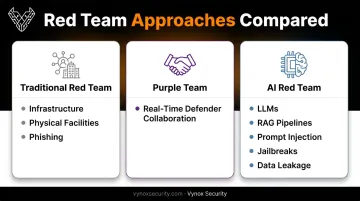
Red teaming now splits into a few distinct categories:
- Traditional red teams target infrastructure, physical facilities, and employees through phishing or pretexting to reach a defined objective
- Purple teams run the same adversarial techniques collaboratively, working alongside defenders in real time rather than staying fully covert
- AI red teams apply the same adversarial mindset to LLMs, RAG pipelines, and autonomous agents, probing for prompt injection, jailbreaks, and data leakage instead of network vulnerabilities
Specialized providers have emerged to cover this newer category. Vynox Security, for example, runs dedicated AI red team engagements covering the full OWASP LLM Top 10, testing everything from system prompt extraction to agent tool-call hijacking, alongside its traditional infrastructure testing.
How Does a Red Team Assessment Work?
Red teaming follows a defined, multi-stage methodology, frequently mapped to MITRE ATT&CK's adversary emulation plans. Each stage moves the engagement from planning through live execution to a final report defenders can act on.
Scoping & Goal-Setting
Every engagement starts manually and collaboratively. A CISO or CIO defines one specific objective, such as compromising a customer database or breaching a CI/CD pipeline, rather than authorizing a broad sweep of the entire network.
Only a small group of leaders know the test is happening. Everyone else, including most of the security team, operates unaware, which is exactly what makes the eventual results meaningful.
Timelines vary by objective complexity. In regulated finance, the EU's TIBER-EU framework requires a minimum 12-week active testing phase for threat-led red team engagements, though that benchmark is specific to financial-sector mandates.
For AI systems, engagements like Vynox's AI Red Teaming typically run 3 to 5 weeks, reflecting the extra time needed to threat-model an AI deployment before adversarial testing even starts.
Common bottleneck: poorly defined or overly broad goals. An objective like "test everything" dilutes focus, inflates cost, and stretches the timeline without producing sharper insight.
Reconnaissance & Exploitation
Testers start with open-source intelligence, mapping the organization's digital footprint: employee names on LinkedIn, exposed subdomains, code repositories, leaked credentials, and technology stack details. From there, they build a threat model based on real attacks against similar organizations, then chain minor findings into a path toward the objective:
- Phishing emails yielding one set of low-privilege credentials
- Misconfigured cloud storage buckets exposing internal documentation
- Exposed API keys discovered in public repositories
- Unlocked doors or unattended workstations creating physical access opportunities
None of these alone would trigger a breach. Chained together, they often do. Success at this stage depends on stealth and creativity, since triggering an automated alert can end the engagement early, before the objective is properly tested.
Operational Security & Evasion
Unlike a penetration test, which is typically visible to the target organization throughout, red teamers continuously watch for signs they've been detected and adapt tactics in real time to stay hidden. If a login attempt looks suspicious to the SOC, the team shifts approach rather than pushing forward and getting caught.
For example, if beacon traffic starts triggering EDR alerts, the operator burns that infrastructure and pivots to a new command channel instead of risking an early shutdown of the engagement.
This stage separates red teaming from every other assessment type. It's the only method that genuinely tests whether the blue team can detect and respond to a live, adaptive intrusion, rather than simply confirming which technical controls are configured correctly.
Reporting & Remediation
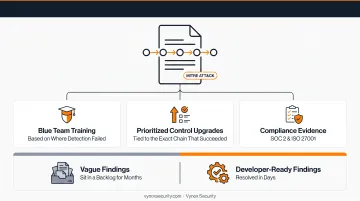
The final deliverable is a detailed report mapping every action to a recognized framework such as MITRE ATT&CK, documenting the specific attack chain, the weaknesses exploited, and the business impact of reaching (or nearly reaching) the objective.
That output feeds directly into downstream security work:
- Blue team training based on where detection actually failed
- Prioritized control upgrades tied to the exact chain that succeeded
- Evidence supporting compliance frameworks like SOC 2 or ISO 27001
Report quality determines how fast remediation happens. Vague findings sit in a backlog. Developer-ready, reproducible findings with clear fix guidance get resolved in days rather than months, which is part of why Vynox structures its engagement reports around stack-specific remediation steps engineers can act on directly, rather than generic CVE lists aimed mainly at auditors.
Where Red Team Assessments Are Used
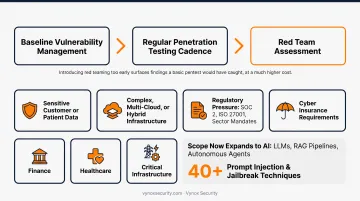
Red teaming isn't a starting point. It fits into a mature security program's lifecycle after an organization has already established baseline vulnerability management and runs penetration tests on a regular cadence. Layering it in earlier tends to produce findings a basic pentest would have caught anyway, at a much higher cost.
It performs best in environments with:
- Sensitive customer or patient data
- Complex, multi-cloud, or hybrid infrastructure
- Regulatory pressure from frameworks like SOC 2, ISO 27001, or sector-specific mandates
- Cyber insurance requirements tied to demonstrated resilience testing
Finance, healthcare, and critical infrastructure organizations are the clearest examples. Regulated finance entities in the EU already face mandates requiring threat-led penetration testing on a recurring cycle, with testers expected to hold red team, penetration testing, and threat intelligence expertise.
The scope keeps expanding, too. As businesses deploy LLMs, RAG pipelines, and autonomous AI agents, red teaming now extends into that attack surface as well.
Platforms such as Vynox Security apply the same adversarial methodology, including more than 40 prompt injection and jailbreak techniques, to AI systems alongside traditional web, API, cloud, and network infrastructure. A single engagement can now cover a customer-facing chatbot and the cloud environment it runs on, instead of treating them as separate assessments run by separate vendors.
Red Teaming vs. Penetration Testing: Key Differences
The two disciplines get confused constantly, but they answer different questions. Penetration testing finds and catalogs as many vulnerabilities as possible within a defined, visible scope. Red teaming pursues one covert objective across the whole organization, testing whether anyone notices.
| Dimension | Penetration Testing | Red Team Assessment |
|---|---|---|
| Goal | Find and document vulnerabilities | Reach one specific objective undetected |
| Visibility | IT team knows and cooperates | Most staff are unaware |
| Duration | Days to a couple of weeks | Several weeks or longer |
| Scope | Defined systems or applications | Whole organization, cross-system |
| Output | Vulnerability list with severity ratings | Attack narrative and detection gaps |
Duration and stealth are the clearest differentiators. Pentests typically run for days to a couple of weeks with active IT cooperation, since the goal is coverage, not concealment. Red team engagements run longer and stay hidden from most of the organization, because concealment is the mechanism that makes the detection test valid in the first place.
That sequencing matters as much as the stealth mechanics. Most organizations should mature through vulnerability scanning and regular penetration testing before layering in red team assessments. Vynox follows this same progression, moving clients from Rapid Secure penetration testing to Deep Secure red team engagements once the fundamentals are covered. Red teaming works best for organizations that have already closed the obvious gaps a scanner or pentest would catch. Running one before that baseline exists usually just confirms what a cheaper pentest would have found anyway.
Conclusion
Red teaming works because it mirrors exactly how real attackers operate: chaining small, seemingly unrelated weaknesses across people, process, and technology into one working attack path. A phished credential plus a misconfigured bucket plus an unmonitored API key rarely looks dangerous in isolation. Strung together, it's how breaches actually happen.
Understanding that methodology changes how organizations scope engagements, set realistic timelines, and choose providers. A red team assessment scoped around a vague goal wastes budget. One scoped around a specific, high-value objective, whether that's a customer database, a CI/CD pipeline, or an LLM-powered application, produces findings that are genuinely actionable.
As AI systems become part of the core attack surface, that same principle applies to LLMs, RAG pipelines, and autonomous agents. Providers covering both traditional and AI-specific red teaming, including firms like Vynox Security, let organizations test their entire stack against a real adversary's mindset. That's a sharper approach than treating AI security as an afterthought bolted onto a legacy pentest.
Frequently Asked Questions
What is the red team assessment approach?
A red team assessment follows a staged approach: scope a single objective, gather OSINT during reconnaissance, then execute stealthy exploitation and lateral movement. Findings get reported against a framework like MITRE ATT&CK, testing detection and response at every stage.
How much does a red team assessment cost?
Cost depends on objective complexity, scope, and duration rather than a fixed rate. AI-specific red teaming often carries different pricing than infrastructure testing because it requires specialized threat modeling and exploit chaining across LLMs, agents, and pipelines.
How long does a red team assessment typically take?
Most engagements require several weeks minimum for a single objective, with added complexity, such as multiple systems or AI components, extending both duration and cost. AI red teaming specifically often runs 3 to 5 weeks given the depth of threat modeling required.
What's the difference between a red team and a blue team?
The red team plays offense, simulating an adversary attempting to reach a specific objective undetected. The blue team plays defense, monitoring, detecting, and responding to that activity. Purple teaming bridges the two, sharing findings collaboratively to speed up defensive improvements.
Is my organization ready for a red team assessment?
Red teaming suits organizations with a mature security posture that already run regular vulnerability scans and penetration testing. Organizations just starting their security program typically get more value from closing baseline gaps first.
Can red team assessments test AI systems like LLMs and chatbots?
Yes. Specialized AI red teaming now tests LLMs, RAG pipelines, and autonomous agents for risks like prompt injection, jailbreaks, and data leakage. This is distinct from traditional infrastructure testing and requires AI-specific methodology and threat models.