Introduction
Web applications are a primary target for attackers — and the numbers back this up. According to the 2026 Verizon Data Breach Investigations Report, Basic Web Application Attacks account for 10% of confirmed breaches. That figure only counts a single breach pattern; the actual exposure across application-layer attack surfaces runs considerably deeper.
Most organizations respond to this risk in one of three ways: they skip formal assessments entirely, treat a quarterly automated scan as sufficient, or run a proper assessment once and assume it holds indefinitely. Each approach leaves exploitable gaps — in customer data, compliance posture, and breach exposure.
The IBM 2025 Cost of a Data Breach Report puts the global average breach cost at $4.44M. Against that figure, even a comprehensive assessment engagement is a rounding error — which makes the decision to skip one harder to justify.
This guide breaks down what a web application security assessment actually involves: the three core assessment types, a six-stage process walkthrough, a realistic scenario, and a framework for choosing the right approach for your organization.
Key Takeaways
- A web application security assessment is a structured evaluation that goes beyond automated scanning
- Three core assessment types exist: vulnerability scans, penetration tests, and code reviews — each suited to different risk levels
- The process follows six defined stages, from scoping and reconnaissance through risk analysis, remediation, and reporting
- Compliance frameworks like SOC 2, ISO 27001, and PCI DSS drive assessment requirements — but compliance and security are not the same thing
- At $4.44M average breach cost globally, proactive assessments are measurably cheaper than reactive response
What Is a Web Application Security Assessment?
A web application security assessment is a structured evaluation of a web application's security posture — identifying weaknesses, technical flaws, and vulnerabilities, then presenting findings with impact assessments and remediation guidance.
Generic security testing stops at finding individual vulnerabilities. An assessment goes further:
- Examines how vulnerabilities interact and chain together
- Evaluates the business impact of each finding
- Prioritizes remediation across the full application lifecycle
- Produces actionable output for both engineering teams and security leadership
When Is an Assessment Needed?
Most external-facing web applications need regular assessment, but certain situations make it non-negotiable:
- Applications handling sensitive customer, financial, or patient data
- Internal tools with privileged access to backend systems
- Applications undergoing compliance certification (SOC 2, ISO 27001, PCI DSS)
- Any significant code changes, new third-party integrations, or cloud migrations
- Pre-launch security validation for new products or features
Why Web Application Security Assessments Are Critical
Most web application breaches don't start with novel exploits. They start with unpatched third-party dependencies, misconfigured headers, and insecure business logic that automated scanners miss entirely. OWASP notes that business logic vulnerabilities are particularly hard to detect automatically because they involve legitimate functionality being used in harmful ways — meaning no scanner alert, no warning, no catch.
Three Core Reasons to Assess Regularly
- Risk reduction — The OWASP Top 10:2025 ranks Broken Access Control (A01) as the #1 web application vulnerability, with a 3.74% average incidence rate and nearly 1.84 million recorded occurrences. Catching that before an attacker does is the point.
- Regulatory compliance — Multiple frameworks require assessed evidence:
| Framework | Relevant Controls |
|---|---|
| PCI DSS v4.0.1 | Req. 11.4.1–11.4.3: Application-layer pentest methodology required annually and after significant changes |
| SOC 2 | CC7.1: Vulnerability detection; CC6.1, CC6.6: Logical access and external threat controls |
| ISO 27001:2022 | A.8.8, A.8.29: Technical vulnerability management and security testing in development |
| HIPAA | 45 CFR 164.308(a)(1): Risk analysis and management; periodic technical evaluation |
Note: PCI DSS is the only framework in this set with an explicit application-layer penetration testing mandate. The others support assessments through broader risk, vulnerability, and testing controls.
- Cost avoidance — IBM's global average breach cost sits at $4.44M. A structured assessment costs a fraction of that. Reactive response consistently runs higher — in direct spend, lost customer trust, and compliance penalties.
Compliance ≠ Security
A compliant application can still harbor critical vulnerabilities. Assessments treated as checkboxes — run once, filed away — don't prevent breaches. They produce documentation. The difference between a compliance exercise and a real assessment is whether findings get fixed — not just filed.
Types of Web Application Security Assessments
A mature security program combines all three assessment types — each surfaces a different class of vulnerability that the others structurally miss.
Vulnerability Scans
Automated, broad-coverage scans that identify known weaknesses — outdated libraries, misconfigured headers, exposed endpoints, missing security controls.
- Best for: Baseline coverage, continuous monitoring, identifying obvious configuration issues
- Limitation: No exploitation attempts; cannot evaluate business logic or chained vulnerabilities
- NIST flags that application scanners produce high false-positive rates, requiring human triage to separate real issues from noise
Penetration Tests
Manual testing performed by skilled security engineers who simulate real-world attack scenarios against the running application. This is the most realistic method for exposing critical vulnerabilities.
- Best for: Exposing exploitability chains, authentication/authorization weaknesses, business logic abuse
- Advantage: Uncovers conditions that scanners structurally cannot — including privilege escalation through workflow manipulation and insecure direct object references
- Methodology follows OWASP's Web Security Testing Guide (WSTG v4.2) and the Penetration Testing Execution Standard
Code Reviews
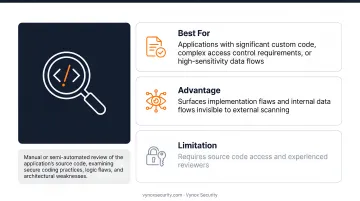
Manual or semi-automated review of the application's source code, examining secure coding practices, logic flaws, and architectural weaknesses.
- Best for: Applications with significant custom code, complex access control requirements, or high-sensitivity data flows
- Advantage: Surfaces implementation flaws and internal data flows invisible to external scanning
- Limitation: Requires source code access and experienced reviewers
The table below summarizes how these three approaches compare across mechanism, coverage area, and primary limitation.
| Assessment Type | Mechanism | Best Coverage Area | Principal Limitation |
|---|---|---|---|
| Vulnerability Scan | Automated external checks | Known detectable patterns | No exploitation; weak on business logic |
| Penetration Test | Real-world attack simulation | Authorization, workflow, chained behavior | Point-in-time, scope-dependent |
| Code Review | Source-level examination | Implementation flaws, data flows | Requires source access and expertise |
How a Web Application Security Assessment Works — Step by Step
What follows is a practical breakdown of the six assessment stages, including what teams most commonly get wrong at each one.
Step 1 — Define Scope and Objectives
Identify all in-scope assets: specific applications, environments (production vs. staging), APIs, authentication flows, and data types being handled. Overlooking third-party integrations or subdomains at this stage creates dangerous blind spots.
Set clear objectives before testing begins:
- Is the primary goal compliance certification?
- Pre-launch security validation?
- Incident-driven review after a security event?
The objective determines which test types and depth of analysis are appropriate. Under-scoping is the most common failure at this stage.
Step 2 — Reconnaissance and Information Gathering
Map all entry points: HTTP endpoints, API routes, authentication mechanisms, session management, third-party dependencies, and exposed infrastructure details. This phase mirrors exactly how a real attacker would begin.
What teams routinely miss here:
- Undocumented or shadow APIs
- Forgotten subdomains still pointed at live infrastructure
- Publicly accessible admin panels excluded from the original scope definition
OWASP's WSTG explicitly classifies API testing as within web assessment scope — not an afterthought.
Step 3 — Vulnerability Discovery and Analysis
Run a layered combination of automated scanning and manual testing. Standard coverage includes all OWASP Top 10:2025 categories — Broken Access Control, Security Misconfiguration, Software Supply Chain Failures, Cryptographic Failures, Injection, Insecure Design, Authentication Failures, and more.
Manual testing is non-negotiable here. Automated tools cannot uncover:
- Privilege escalation through workflow manipulation
- Insecure direct object references across tenant boundaries
- Business logic abuse that uses legitimate application features harmfully
Step 4 — Risk Assessment and Prioritization
Assess each finding based on exploitability, severity, data sensitivity, and business impact — not CVSS score alone. A medium-severity finding in a payment flow often carries higher real-world risk than a high-severity finding in a rarely accessed admin panel.
Produce a risk-ranked finding list that separates critical items requiring immediate action from lower-risk findings suited for scheduled remediation cycles. That distinction shapes how engineering teams sequence their work — and how quickly real exposure gets closed.
Step 5 — Remediation and Verification
Work with development teams to implement fixes — patching, reconfiguring, or rewriting vulnerable components. Retesting every patched item is non-negotiable.
The most common failure here: teams remediate findings but never retest. Fixes sometimes introduce new vulnerabilities. Sometimes they fail to fully close the original issue. Without verification, the assessment's value is incomplete.
Step 6 — Reporting and Security Roadmap
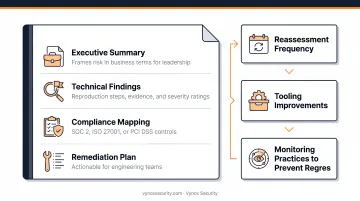
Deliver a structured assessment report containing:
- An executive summary that frames risk in business terms for leadership
- Technical findings with reproduction steps, evidence, and severity ratings
- Compliance mapping showing which SOC 2, ISO 27001, or PCI DSS controls are affected
- A prioritized remediation plan actionable for engineering teams
The report should also include forward-looking recommendations: reassessment frequency, tooling improvements, and monitoring practices to prevent regression.
Web Application Security Assessment in Practice: A Realistic Walkthrough
A B2B SaaS company preparing for its first SOC 2 Type II audit has never formally assessed its customer-facing web application. This scenario is common among fast-growing startups.
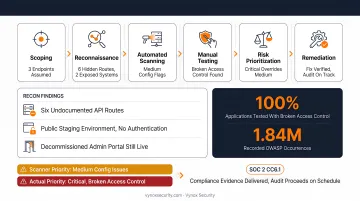
Scoping surfaces the first gap. The team believes they have three external endpoints. Reconnaissance reveals six additional API routes, an exposed staging environment accessible from the public internet, and a forgotten admin portal that was never decommissioned. All are now in scope.
Automation finds the obvious. Manual testing finds what matters. Automated DAST scanning flags several medium-severity issues — missing security headers, an outdated dependency, a misconfigured CORS policy. Manual testing then uncovers a broken access control vulnerability that lets any authenticated user query another user's account data by modifying an object ID in the request. The scanner never flagged it. OWASP data confirms why: broken access control appeared in 100% of applications in their tested dataset, with nearly 1.84 million recorded occurrences — yet automated tools consistently miss exploitable instances because the application logic appears legitimate.
The recon phase also surfaces a pattern worth noting. The initial discovery findings include:
- Six undocumented API routes not included in the original scope
- A staging environment publicly accessible without authentication
- A decommissioned admin portal still live on the internet
Risk prioritization flips the expected order. Despite the scanner ranking the medium-severity configuration issues as top priority, the manual broken access control finding is elevated to critical. It directly exposes customer data and would likely disqualify the company from SOC 2 certification under CC6.1 (logical access controls for external threats).
Remediation closes the loop. The development team patches the broken access control flaw and retests to confirm the fix. The final report delivers both a security assessment and a compliance evidence package, with findings mapped to SOC 2 CC6.1 controls. The company moves forward with its audit on schedule.
How Vynox Security Can Help
Vynox Security was built specifically for the attack surface that traditional penetration testing firms have never fully addressed: AI systems and the web infrastructure surrounding them. Web application security sits within Vynox's infrastructure testing layer, which means clients get rigorous application-layer testing alongside AI system coverage from a single partner — no gaps, no separate vendors.
What Vynox's Web Application Assessment Delivers
Vynox's Web Application Pentest is manual, expert-driven testing — not an automated scan. Standard scope covers up to 20 endpoints, with full OWASP Top 10:2025 coverage. Every engagement explicitly includes:
- Business logic and workflow abuse testing
- Authentication and session management attacks
- Authorization testing across roles and tenants
- Injection, SSRF, and server-side vulnerability chains
A verified G2 reviewer noted: "The depth of manual testing stood out. Rather than relying heavily on automated tooling, the testers clearly invested time in understanding our application's architecture and business logic before probing it." Vynox holds a 4.6/5 rating on G2 across 10 verified reviews.
Compliance-Ready Reporting
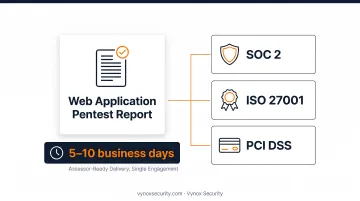
Every Web Application Pentest report includes findings mapped directly to SOC 2, ISO 27001, and PCI DSS control requirements — in assessor-ready format. Clients receive security findings and compliance evidence from a single engagement, eliminating a separate compliance documentation workstream. Typical delivery is 5–10 business days.
Continuous Testing for High-Velocity Teams
For teams shipping frequently, Vynox offers PTaaS (Penetration Testing as a Service) — a sprint-aligned continuous testing model. Testing cadence matches development cycles, and Vynox verifies fixes pushed to staging the same day. This keeps each new release from reintroducing vulnerabilities between annual assessments.
To scope an engagement or request a sample report, book a free 30-minute discovery call with Karan Singh.
Frequently Asked Questions
What is a web application security assessment?
A structured evaluation of a web application's security posture that identifies vulnerabilities, assesses their exploitability and business impact, and produces a prioritized remediation plan. It goes beyond automated scanning to include manual testing, business logic analysis, and risk-based prioritization.
What are the seven steps of pen testing?
The Penetration Testing Execution Standard (PTES) defines seven phases: pre-engagement interactions, intelligence gathering, threat modeling, vulnerability analysis, exploitation, post-exploitation, and reporting. Web application assessments incorporate these phases within a broader process that also covers scoping, risk analysis, and remediation verification.
How long does a web application security assessment take?
Timelines depend on scope and complexity. A targeted single-application pentest typically takes one to two weeks; broader assessments covering multiple environments, APIs, and third-party integrations can take three to four weeks or longer. Vynox's Web Application Pentest typically delivers in 5–10 business days.
What is the difference between a vulnerability scan and a penetration test?
A vulnerability scan uses automated tools to identify known weaknesses without attempting to exploit them. A penetration test involves skilled testers actively exploiting findings to determine real-world impact. Both serve distinct purposes and work best in combination — scans provide breadth; manual testing provides depth and exploitability validation.
How often should a web application security assessment be conducted?
At minimum, annually — and after major code changes, new integrations, cloud migrations, or compliance audits. PCI DSS v4.0.1 requires application-layer testing every 12 months and after significant changes. High-velocity development teams increasingly run continuous or sprint-aligned testing to stay ahead of each release.
What does a web application security assessment report include?
An executive summary with business risk framing, technical findings with severity ratings and reproduction steps, compliance control mappings (SOC 2, ISO 27001, PCI DSS), and prioritized remediation guidance. Reports are structured for two audiences: engineers needing reproduction steps and stack-specific fixes, and leadership needing audit-ready compliance evidence.