This differs from a generic network pentest report in a fundamental way. Where network reports focus on infrastructure — open ports, misconfigured firewalls, unpatched hosts — web app pentest reports target the application layer: authentication flows, session handling, input validation, business logic flaws, and API endpoints. These vulnerabilities live in your code, not your network topology.
This guide covers what every web app pentest report must include, how different audiences should read and act on findings, what a strong finding entry looks like in practice, and how the report supports compliance with SOC 2, ISO 27001, and PCI DSS.
According to the IBM Cost of a Data Breach Report 2025, the global average breach cost sits at $4.44M. A well-structured pentest report is one of the most direct tools for reducing that exposure.
Key Takeaways
- A complete web app pentest report includes six core sections: executive summary, scope and methodology, findings with evidence, risk ratings, remediation recommendations, and appendices.
- Findings should map to OWASP Top 10:2025 and CWE classifications — not just a CVSS score in isolation.
- Risk ratings must account for real-world exploitability and business context, not base severity alone.
- Reports serve two audiences: executives need business impact language, developers need reproduction steps and stack-specific fix guidance.
- A pentest report doubles as a compliance artifact for SOC 2, ISO 27001, and PCI DSS audits.
What Makes a Web App Pentest Report Different
Web app pentest reports are scoped specifically to application-layer attack surfaces. According to the OWASP Web Security Testing Guide (WSTG), the testing domains covered include:
- Authentication and session management
- Authorization controls (IDOR, privilege escalation)
- Input handling (SQL injection, XSS, SSRF, command injection)
- Business logic flaws
- Client-side behavior
- API endpoints
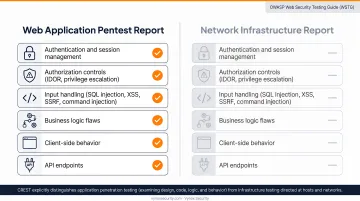
None of these appear in a standard network infrastructure report — which is why scope definition matters before testing begins. CREST explicitly distinguishes application penetration testing (examining design, code, logic, and behavior) from infrastructure testing directed at hosts and networks.
Testing Approach Matters for Finding Severity
How the test was conducted changes how findings are rated. An unauthenticated XSS in a public-facing form is a different risk than the same payload executing inside an authenticated admin panel. Reports must document which testing states were used: unauthenticated access, authenticated user roles, and elevated privilege scenarios. Without this context, teams can't prioritize findings accurately.
AI-Integrated Features Require a Separate Layer
Many web applications now embed LLM input fields, AI-powered search, or autonomous agent functionality. These features introduce attack vectors the OWASP Top 10 doesn't cover — prompt injection, system prompt leakage, guardrail bypass, and indirect injection via documents or tool outputs. The OWASP LLM Top 10:2025 is a separate framework that governs these risks.
That's why a single-layer report falls short for AI-powered applications. Vynox's approach separates concerns: the web application pentest covers traditional OWASP Top 10 surface across up to 20 endpoints, while AI-integrated features are tested under a dedicated AI Security engagement mapped to the full OWASP LLM Top 10.
Essential Sections of a Web Application Pentest Report
Executive Summary
The executive summary is written for non-technical stakeholders — CISOs, CTOs, board members — and should fit in one to two pages. It communicates:
- Overall risk posture
- Total findings by severity (Critical, High, Medium, Low)
- Which critical business assets were accessible during testing
- High-level next steps
The key is translating technical findings into business language. Not "stored XSS in user profile" but "an attacker could execute code in any administrator's browser session, exposing all customer records accessible to that admin." Potential data exposure, regulatory penalties, and reputational damage belong here — vulnerability names don't.
Scope and Methodology
This section defines the boundaries of the test and makes findings reproducible and defensible. It must include:
- Which URLs, endpoints, and user roles were in scope
- Which were explicitly excluded
- The testing window and rules of engagement
- The methodology framework used — OWASP WSTG v4.2, PTES, or NIST SP 800-115 — with the version named explicitly
- Tools used (Burp Suite, OWASP ZAP, custom scripts) for reproducibility and audit purposes
- Any testing limitations: WAF interference, rate limiting, restricted test accounts
Undisclosed limitations are a serious credibility problem. If a WAF blocked certain payloads during testing, that must be documented — otherwise findings may represent an incomplete picture of the actual attack surface.
Findings and Evidence
Each finding must include:
| Field | What It Contains |
|---|---|
| Title | Short, specific vulnerability name |
| Affected Component | Specific URL or endpoint |
| Description | What the vulnerability is and where it exists |
| Proof of Concept | Screenshots, HTTP request/response pairs, or payloads |
| Steps to Reproduce | Detailed enough for another tester to validate |
| OWASP/CWE Mapping | Classification against Top 10:2025 and CWE |
| Remediation | Specific, actionable fix guidance |
Findings should map to OWASP Top 10:2025 categories — A01 Broken Access Control, A05 Injection, A07 Authentication Failures — and CWE identifiers for standardized tracking. MITRE's CWE records the underlying weakness class, which is critical for compliance mapping and tracking recurrence across test cycles.
That classification only holds weight when the evidence behind it is solid. A stored XSS payload executing in an admin session is a validated risk. An unproven theoretical finding is a hypothesis — and auditors treat them very differently.
Risk Ratings and Prioritization
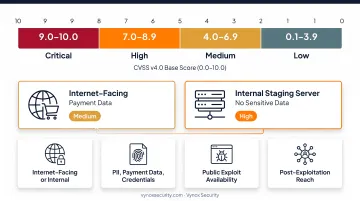
CVSS v4.0 is the current scoring standard, with scores from 0.0 to 10.0:
- Critical: 9.0–10.0
- High: 7.0–8.9
- Medium: 4.0–6.9
- Low: 0.1–3.9
CVSS measures severity — not risk. As NVD explicitly states, CVSS does not account for deployment context. A "Medium" CVSS vulnerability on an internet-facing checkout page that processes payment data may demand faster remediation than a "High" on an internal staging server with no sensitive data. Strong reports contextualize severity using:
- Whether the asset is internet-facing or internal
- The sensitivity of data at risk — PII, payment data, credentials
- Whether a working exploit is publicly available
- What an attacker can reach post-exploitation
CVSS v4.0 includes Threat and Environmental metric groups specifically to capture this context. Skipping those groups and reporting raw Base scores distorts the picture of actual risk.
Remediation Recommendations
Generic guidance — "sanitize inputs," "implement proper authentication" — doesn't constitute remediation. Each finding needs at least one concrete, actionable fix. For example:
- SQL injection: Implement parameterized queries using
PreparedStatementin Java, per OWASP's SQL Injection Prevention guidance - XSS: Apply a strict nonce-based
Content-Security-Policyheader as defense-in-depth alongside output encoding - IDOR: Perform server-side authorization checks validating the authenticated user's session against the requested resource ID — changing or hiding identifiers is not sufficient
Strong reports also distinguish short-term tactical fixes (patch a config, update a library) from longer-term architectural changes (redesign the authentication flow, adopt an API gateway with rate limiting).
Vynox's reports take this further with developer-ready, stack-specific fix guidance that includes actual code-level reproduction steps — so engineering teams can act without requesting clarification from the testing team.
Appendices
Appendices hold supporting artifacts that would clutter the main body:
- Raw tool output and full scan results
- Detailed request/response logs
- Network diagrams
- Tool version information
- Change logs
These should be referenced from specific findings, not dropped as a standalone data dump. Appendices serve auditors who need to verify completeness, not the primary reader.
What a Strong Web App Finding Entry Looks Like
Here's an anonymized example of a well-structured IDOR finding:
| Field | Content |
|---|---|
| Finding Title | IDOR on /api/users/{id} endpoint |
| Severity | High |
| CVSS Score | 7.5 |
| Affected Asset | /api/users/ |
| OWASP Category | A01:2025 Broken Access Control |
| CWE | CWE-639: Authorization Bypass Through User-Controlled Key |
| Description | Attacker can enumerate other users' profile data by modifying the numeric ID in the request. No server-side authorization check validates that the authenticated session matches the requested resource. |
| Proof of Concept | HTTP GET /api/users/1043/profile sent with User A's session token returns User B's full PII. Screenshot included. |
| Steps to Reproduce | 1. Authenticate as User A. 2. Capture request to /api/users/{your_id}/profile. 3. Increment ID by 1. 4. Observe full profile data returned for a different user. |
| Remediation | Implement server-side authorization checks validating the authenticated user's session against the requested resource ID. Scope database queries to the verified session user. Apply row-level security at the database layer as defense-in-depth. |
Every field serves a distinct audience. Executives scan severity and CVSS. Developers follow the reproduction steps. Auditors pull the OWASP and CWE classifications. When a finding is written this way, no one has to come back with questions — and that saves remediation cycles.
How to Read and Act on a Web App Pentest Report
For Executives and Security Leaders
Focus on the executive summary and the risk rating summary. The key questions to answer:
- Which findings put sensitive or regulated data at risk?
- What is the regulatory exposure if these vulnerabilities were exploited?
- What budget, headcount, or tooling is needed to close critical issues within acceptable SLAs?
For Developers and Engineers
Technical teams should work through findings in this order:
- Triage by severity and exploitability — Critical and High findings with working proof-of-concept evidence first
- Assign ownership to the relevant code owner or team
- Reproduce in a local or staging environment using the report's steps before applying fixes
- Integrate tickets into existing workflows — Jira, Linear, GitHub Issues — not a separate security silo
- Retest every fix before marking it verified closed. Retesting is mandatory, not optional
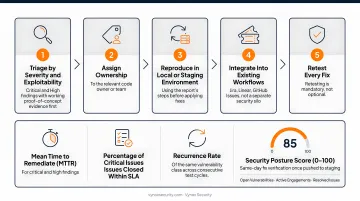
Once fixes are deployed, use these KPIs to measure how effectively your team is closing the gap:
- Mean Time to Remediate (MTTR) for critical and high findings
- Percentage of critical issues closed within SLA
- Recurrence rate of the same vulnerability class across consecutive test cycles
Vynox's PTaaS model verifies fixes the same day they're pushed to staging, with a real-time dashboard tracking open vulnerabilities, active engagements, and resolved issues — plus a Security Posture Score (0–100) so leadership can see progress without digging through tickets.
Web App Pentest Reports and Compliance
A properly structured web app pentest report serves as primary audit evidence across multiple frameworks:
| Framework | Key Expectation from a Web App Pentest Report |
|---|---|
| PCI DSS v4.0.1 (Req. 11.4) | Internal and external penetration testing at least annually and after significant changes; application- and network-layer testing required; retesting to verify correction of exploitable vulnerabilities; tester must have organizational independence |
| ISO 27001:2022 | Relevant Annex A controls: 8.8 (technical vulnerability management), 8.29 (security testing in development/acceptance), 8.34 (protection during audit testing); findings should map to applicable controls |
| SOC 2 | CC4.1 (evaluation activities) and CC7.1 (vulnerability management) are relevant evidence mappings; report documents the organization's vulnerability management process |
| HIPAA | 45 CFR 164.308(a)(1)(ii)(A) requires risk analysis of ePHI systems; a pentest report supports this but does not automatically satisfy the full requirement |
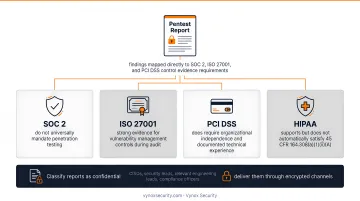
A few caveats worth keeping in mind before submitting a report as compliance evidence:
- PCI DSS does not require QSA or ASV certification for the tester, but does require organizational independence and documented technical experience
- ISO 27001 and SOC 2 do not universally mandate penetration testing — but a pentest report is strong evidence for vulnerability management controls during audit
- HIPAA risk analysis requirements extend beyond a pentest; the report supports but does not automatically satisfy 45 CFR 164.308(a)(1)(ii)(A)
Classify reports as confidential, distribute them only to authorized personnel (CISOs, security leads, relevant engineering leads, compliance officers), and deliver them through encrypted channels.
Vynox structures web app pentest reports with findings mapped directly to SOC 2, ISO 27001, and PCI DSS control evidence requirements — so the same report works for your engineering team and stands up to auditor scrutiny without additional translation work.
Frequently Asked Questions
What should be included in a web application penetration testing report?
A complete report includes six core sections: executive summary, scope and methodology, findings with evidence and proof-of-concept, risk ratings using CVSS with business context, remediation recommendations with specific fix guidance and owner assignments, and appendices with supporting artifacts. Every finding should include an OWASP Top 10 and CWE mapping.
How is severity determined for web application vulnerabilities in a pentest report?
CVSS v4.0 provides the baseline score (0.0–10.0), but severity must be adjusted for deployment context. A medium CVSS score on an internet-facing payment page may warrant high priority treatment, while a high CVSS finding on an internal staging environment with no sensitive data may be deprioritized.
How long does it take to receive a web application pentest report?
Timelines vary by scope. Traditional firms typically require 4–8 weeks. Vynox delivers web application pentest reports within 5–10 business days (or 5–15 business days for broader VAPT engagements), with scope complexity — endpoints, authenticated roles, business logic depth — determining where within that range the engagement lands.
Who should receive a copy of the web application pentest report?
Distribution should be tightly controlled: CISOs, security leads, relevant engineering leads, and compliance officers. The report contains confirmed exploitable vulnerabilities and should be treated as confidential, encrypted in transit and at rest.
Can a web app pentest report satisfy SOC 2 or ISO 27001 audit requirements?
Yes — a properly structured report serves as audit evidence for both frameworks, provided it documents scope, methodology, findings, and remediation steps. Mapping findings directly to relevant control requirements (SOC 2 CC7.1, ISO 27001 Annex A 8.8) strengthens the evidence substantially.
What's the difference between a web app pentest report and a vulnerability assessment report?
A vulnerability assessment report identifies potential weaknesses through automated scanning without proving exploitability — scanners produce false positives that require manual review. A pentest report documents manually confirmed, exploited vulnerabilities with proof-of-concept evidence. For remediation priority and compliance purposes, the pentest report carries more weight.