?](https://file-host.link/website/vynoxsecurity-jps4q3/assets/refined-images/1786535639924000_1eca88768d76401986bb5ae77ce5eff2/360.webp)
Introduction
Web applications are still one of the easiest ways into a company's systems. In 2025, Basic Web Application Attacks accounted for 12% of breaches analyzed in the Verizon Data Breach Investigations Report, up from 9% the year before. Stolen credentials showed up in 88% of those cases.
Most teams assume they're covered because a scanner runs every week. An automated scan only flags potential issues. It doesn't confirm which ones an attacker could actually exploit, or what a breach would cost the business.
Others treat one annual assessment as a compliance checkbox, then forget about it until the next audit.
This guide covers what a real web application security assessment involves. You'll get the four core testing methods, the step-by-step process, and how to tell whether your application security program is actually working.
Key Takeaways
- Treat assessments as manual testing plus automated scanning and business-impact analysis—not a scan alone
- SAST, DAST, IAST, and SCA each catch vulnerability classes the other methods miss
- Expect a defined lifecycle: scoping, reconnaissance, discovery, risk analysis, remediation, and reporting
- Track posture with vulnerability density, mean-time-to-remediate, and OWASP Top 10 coverage
- SOC 2, ISO 27001, PCI DSS, and HIPAA increasingly require assessed evidence over raw tool output
What Is a Web Application Security Assessment?
A web application security assessment is a structured evaluation of an application's security posture. It identifies vulnerabilities, determines whether they're actually exploitable, weighs their business impact, and produces a prioritized plan to fix them.
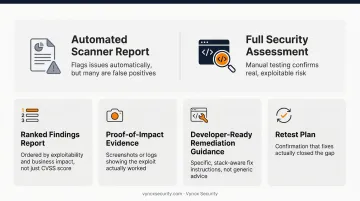
Teams that stop at an overnight scanner report often ship with false confidence. A real assessment layers manual testing on top of automated tools, applies context about how the application handles data and money, and confirms flagged issues are genuinely exploitable—not just theoretical.
A complete assessment should hand you four things:
- A ranked findings report - vulnerabilities ordered by exploitability and business impact, not just CVSS score
- Proof-of-impact evidence - screenshots or logs showing the exploit actually worked
- Developer-ready remediation guidance - specific, stack-aware fix instructions, not generic advice
- A retest plan - confirmation that fixes actually closed the gap
Scan, Pentest, or Assessment?
These three terms get used interchangeably—and they shouldn't:
| Term | What It Does | What It Doesn't Cover |
|---|---|---|
| Vulnerability scan | Automated identification of known weaknesses | Confirming exploitability |
| Penetration test | Active exploitation attempts under defined rules | Business-impact analysis or compliance mapping |
| Security assessment | Scanning, manual testing, risk analysis, and reporting combined | Continuous monitoring or incident response |
A vulnerability scan tells you a door might be unlocked. A penetration test tries the handle. A security assessment figures out what's behind the door, how much it's worth, and how to lock it properly.
When Is an Assessment Needed?
Certain triggers should move an assessment up your priority list:
- Applications handling sensitive data, such as payment details or health records
- Pre-launch validation before a new product or feature goes live
- Compliance certification milestones (SOC 2, ISO 27001, PCI DSS audits)
- Major code changes, especially to authentication or payment flows
- New third-party integrations or API connections added to the stack
Four Types of Web Application Security Testing
Mature security programs don't rely on one testing method. Each type looks at the application from a different angle, and each one structurally misses what the others catch. Layering all four is how you get real coverage instead of a partial picture.
Static Application Security Testing (SAST)
SAST examines source code without running the program. It scans line by line for insecure coding patterns, buffer overflows, and injection flaws early in the development lifecycle, before code reaches production.
The catch: SAST struggles with authentication logic, access control, and cryptographic issues because these often depend on runtime context static analysis can't see. It's also prone to false positives and can't prove a flaw is exploitable on its own.
Dynamic Application Security Testing (DAST)
DAST tests the running application from the outside, the way an attacker actually would. It sends malicious payloads at live inputs and watches how the application responds. No source code required.
This surfaces runtime issues SAST can't see:
- Authentication bypasses
- Input and output validation failures
- SQL injection and cross-site scripting
- Server misconfigurations
The tradeoff: DAST can't see inside the code, so it misses many logic flaws and usually gives less specific fix guidance than white-box methods.
IAST and Manual Penetration Testing
Interactive Application Security Testing (IAST) sits inside the running application. Sensors observe code execution, data flow, and back-end connections while the app is exercised in real time. That internal visibility catches issues pure black-box testing misses.
Manual penetration testing adds what tools still can't replicate. A skilled tester can chain several low-severity findings into a serious exploit, or abuse legitimate business logic in ways no scanner is built to find — for example, manipulating a checkout flow to apply a discount twice, or escalating from a standard user role into an admin panel.
Software Composition Analysis (SCA)
SCA scans third-party and open-source dependencies for known CVEs and licensing risk. This matters more than most teams assume: modern applications often contain more open-source code than original code.
Attackers increasingly target popular packages rather than custom application logic. Continuous monitoring beats a one-time dependency check, since new CVEs get disclosed against existing packages constantly.
How a Web Application Security Assessment Works: Step-by-Step
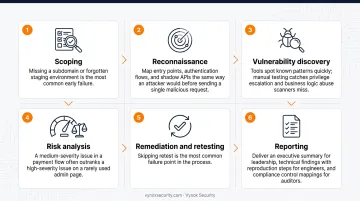
A real assessment follows a defined process, not an ad hoc scan-and-report cycle.
- Scoping: Define in-scope assets—applications, APIs, staging vs. production—and clear objectives (compliance, pre-launch validation, or incident investigation). Missing a subdomain or forgotten staging environment is the most common early failure.
- Reconnaissance: Map entry points, authentication flows, and shadow APIs the same way an attacker would before sending a single malicious request.
- Vulnerability discovery: Combine automated scanning with manual testing. Tools spot known patterns quickly; manual testing catches privilege escalation and business logic abuse scanners miss.
- Risk analysis: Prioritize findings by exploitability and business impact, not CVSS alone. A medium-severity issue in a payment flow often outranks a high-severity issue on a rarely used admin page.
- Remediation and retesting: Work with developers to fix confirmed issues, then retest to verify the fix holds. Skipping retest is the most common failure point in the process.
- Reporting: Deliver an executive summary for leadership, technical findings with reproduction steps for engineers, and compliance control mappings for auditors.
Why Assessments Matter — and How to Measure Application Security
Three forces drive investment in assessments: risk reduction, cost avoidance, and compliance pressure.
Broken Access Control has held the #1 spot on the OWASP Top 10 for years running. In the OWASP Top 10:2025 report, an average of 3.73% of tested applications had at least one of the 40 CWEs mapped to that category, covering everything from privilege escalation to insecure direct object references. That's a lot of applications where the wrong user can reach data they shouldn't.
The financial argument is just as direct. The global average cost of a data breach hit $4.99 million in 2026, a 12% jump from the prior year and a record high, according to IBM. An assessment costing a fraction of that figure is not a hard sell once leadership sees the comparison.
Compliance adds further pressure. SOC 2, ISO 27001, PCI DSS, and HIPAA increasingly require documented, assessed evidence rather than raw tooling output. An auditor wants to see that findings were reviewed, risk-rated, and remediated, not just a scanner PDF.
But compliance and security aren't the same thing. A compliant application can still get breached; passing an audit confirms you followed a process, not that every exploitable flaw is gone.
Key Metrics for Measuring Application Security
Track these to know whether your program is actually working:
- Vulnerability density - number of findings per release or per 1,000 lines of code
- Mean-time-to-remediate - how long confirmed vulnerabilities stay open
- OWASP Top 10 coverage - percentage of categories actively tested, not assumed
- Retest pass rate - percentage of "fixed" issues that actually stay fixed
- Assessment cadence vs. release velocity - whether testing keeps pace with how often you ship
How Vynox Security Can Help
Vynox Security's Web Application Pentest is built around one idea: manual, expert-driven testing catches what automated scanning alone cannot.
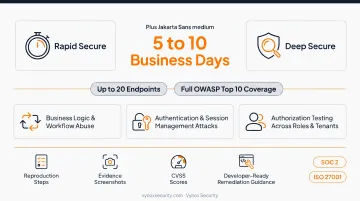
The engagement covers a standard scope of up to 20 endpoints with full OWASP Top 10 coverage. That goes beyond the injection and XSS checks scanners handle well to include:
- Business logic and workflow abuse
- Authentication and session management attacks
- Authorization testing across roles and tenants
For multi-tenant SaaS products, that last check confirms one tenant can't reach another's data, and a standard user can't quietly escalate into an admin role.
The Web Application Pentest is available as either Rapid Secure, built for teams that need compliance-ready results fast, or Deep Secure, a more comprehensive adversarial engagement for mature security programs. Both follow the same core methodology and typically deliver within 5 to 10 business days.
Every finding ships with:
- Reproduction steps
- Evidence screenshots
- CVSS scores
- Developer-ready remediation guidance
Reports are assessor-ready for SOC 2 and ISO 27001 audits, so the output doubles as evidence your compliance team can hand straight to an auditor.
For teams shipping frequently, Vynox also offers PTaaS: continuous testing aligned to development sprints rather than a once-a-year point-in-time test. One verified customer noted that fixes were verified the same day their engineer pushed them to staging, which keeps security validation from becoming a bottleneck between releases.
Want to see what a real report looks like before committing to anything? Request a sample report or book a free discovery call with Karan Singh to scope your engagement.
Frequently Asked Questions
What is an application security assessment?
It's a structured evaluation that identifies vulnerabilities, determines their real business impact, and provides remediation guidance. When scoped to browser-facing functionality specifically, it's called a web application security assessment.
What are the four types of application security testing?
SAST, DAST, IAST, and SCA:
- SAST reviews source code
- DAST tests the running app externally
- IAST observes runtime behavior from inside the app
- SCA checks third-party dependencies for known vulnerabilities
How do you measure the security of an application?
Track vulnerability density per release, mean-time-to-remediate, percentage of OWASP Top 10 categories actively tested, and retest pass rate. Together, these show whether your program is improving or falling behind.
How long does a web application security assessment take?
Most assessments take one to several weeks depending on scope. Vynox's Web Application Pentest typically delivers within 5 to 15 business days.
What is the difference between a vulnerability scan and a penetration test?
A vulnerability scan automatically identifies known weaknesses without confirming they're exploitable. A penetration test actively attempts exploitation under controlled conditions to prove real-world impact.
How often should a web application security assessment be conducted?
At minimum, annually and after any major change to the application. PCI DSS, for example, requires penetration testing at least annually and after significant changes.