Introduction
Your team just got the email: "Penetration Test Complete." Attached is a 40-page PDF. Someone in engineering skims it, someone in compliance forwards it to an auditor.
The CISO asks the question nobody can answer: is this actually a penetration test, or did we just pay for a fancier vulnerability scan?
That confusion is common. Report quality, structure, and depth vary wildly across vendors. NIST and the PCI Security Standards Council both draw a hard line between automated scanning and true penetration testing that attempts exploitation and validates real-world impact, as outlined in NIST Special Publication 800-115: scanning alone is not a pentest.
This guide breaks down what a penetration testing report really is, the components every credible report must contain, and how to tell whether the one sitting in your inbox is driving remediation or just collecting dust.
Key Takeaways
- A real pentest report proves exploitability with evidence, not scanner output alone
- Credible reports need six parts: summary, scope, findings, risk ratings, remediation, and appendices
- Context (exposure, data sensitivity) should adjust raw CVSS scores, not replace them
- AI systems now need LLM- and RAG-specific findings that legacy templates skip entirely
- Report speed matters — a finding delivered weeks late may already be stale
What Is a Penetration Testing Report?
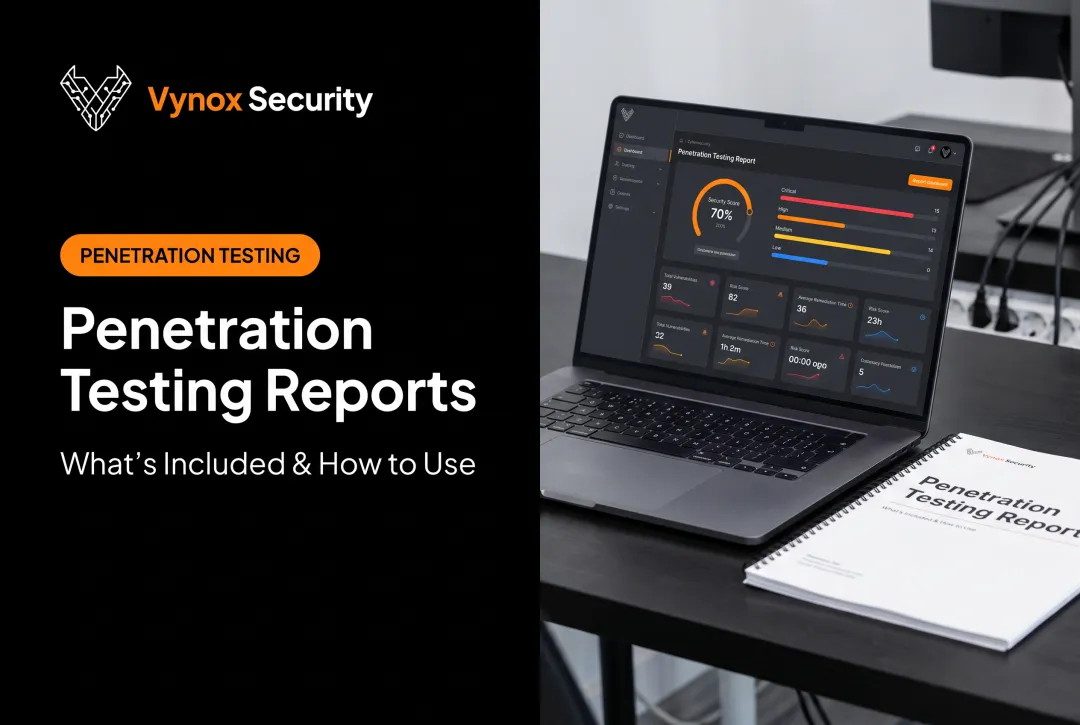
A penetration testing report is the formal deliverable from a simulated cyberattack. It translates technical exploitation into prioritized, business-relevant risk with remediation guidance a team can actually act on. It is not a printout.
NIST SP 800-115 describes the process behind it: assessors mimic real-world attacks, attempt exploitation, and confirm impact rather than just flag a theoretical weakness. That's the line separating a report from a scanner export.
Why It's Different From Raw Scanner Output
A vulnerability scanner tells you a port might be exploitable. A pentest report tells you it was exploited, how, and what happened next. That difference shows up in three things:
- Attack path reasoning: how one weakness connects to another to create real risk
- Proof-of-concept exploitation: evidence the vulnerability was actually triggered
- Business-context explanation: why this specific finding matters to this specific company
For example, a scanner might flag an exposed admin panel as a possible risk. A pentest report proves it: testers log in with default credentials, pivot to the database, and pull sample records, the end-to-end chain a scan alone can't show.
Multiple Audiences, One Document
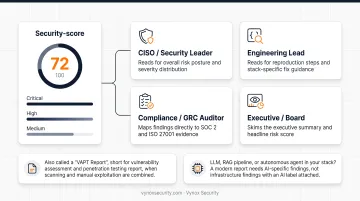
The same report gets read very differently depending on who opens it:
| Audience | What they extract |
|---|---|
| Executives | Overall risk posture, business impact |
| Security engineers | Attack chains, technical root cause |
| Developers | Reproduction steps, exact fix guidance |
| Auditors/compliance | Control mapping, evidence of testing rigor |
You'll also see this deliverable called a VAPT report (vulnerability assessment and penetration testing report), a combined label rather than a separate standard, used when an engagement includes both automated scanning and manual exploitation.
One more shift worth flagging: if your product includes an LLM, a RAG pipeline, or an autonomous agent, a modern report needs findings specific to those systems, not just infrastructure findings with an AI label slapped on top. Most legacy pentest firms simply don't test for this.
The Core Components of a Penetration Testing Report
Formatting differs by vendor, but every professional report is built around six components. Skip one, and the report falls short of a complete deliverable.
Executive Summary
Written in plain language, this section states overall risk posture, testing dates, and whether critical assets were compromised, without jargon or CVE numbers.
A good executive summary includes both weaknesses and strengths. Leadership needs a balanced picture, not just a failure list. If your identity and access controls held up under attack, say so. That context helps a board understand what's actually at risk versus what's working.
Scope & Methodology
This section documents:
- In-scope and explicitly excluded assets
- Testing windows and rules of engagement
- Referenced frameworks (PTES, OWASP, NIST SP 800-115)
Documenting what wasn't tested matters just as much as what was. PCI SSC's own penetration testing guidance makes this explicit: a report that hides its limitations creates a false sense of security. If your API layer was out of scope, the report should say so in plain terms, not bury it in a footnote.
Findings & Evidence
Each finding should include:
- Description and affected components
- Proof of concept
- Steps to reproduce
- CWE/OWASP mapping
Evidence is what separates a validated risk from a guess. A finding with no proof of exploitation is a suggestion. Screenshots, request/response pairs, and reproduction steps are what give a finding credibility with both engineers and auditors.
Risk Ratings & Prioritization
CVSS gives you a baseline severity score, but context should adjust it. FIRST's CVSS v4.0 specification separates Base, Threat, Environmental, and Supplemental metrics precisely because a raw score without context is incomplete.
Here's the practical example: a critical score on an isolated dev box is less urgent than a high score on a production system holding customer data. Environmental context (exposure, data sensitivity, exploitability) should shape the final priority, not just the base number.
Remediation Recommendations
"Apply patches" isn't remediation guidance. Every finding needs:
- A specific, stack-appropriate fix
- An assigned owner
- A retest status: verified-fixed, risk-accepted, or partially remediated
Generic advice forces the developer to do the interpretation work the report should have already done.
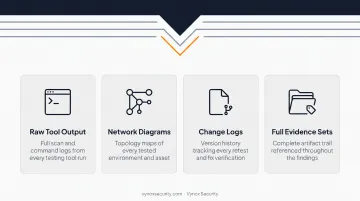
Appendices
This is where supporting artifacts live: raw tool output, network diagrams, change logs, and the full evidence sets referenced throughout the findings section. It keeps the executive summary clean while giving technical teams everything they need to dig deeper.
Types of Penetration Testing Reports
Report content shifts depending on how much access the tester had going in:
- Black-box: no prior knowledge, simulating an outside attacker
- White-box: full internal access, simulating an insider or compromised credential scenario
- Gray-box: partial knowledge, the most common real-world middle ground
Reports also vary by target: external network, internal network, web/mobile application, API, cloud, and increasingly, AI systems like LLMs and RAG pipelines.
Cloud and AI reports carry extra complexity that traditional templates weren't built for:
- Shared responsibility models: AWS, GCP, and Azure each split provider-managed infrastructure from customer-managed configuration, and the report must state exactly where that line falls
- Ephemeral workloads: containers and functions that may not exist by the time the report is read
- Novel attack classes: prompt injection, for example, alters model behavior in unintended ways that a human reviewer may never see, per OWASP's definition. Standard network-pentest templates have no field for it.
What Separates a Great Report From a Generic One
Not every report labeled "penetration test" meets the same bar. CREST's Defensible Penetration Test standard sets a useful benchmark: traceable scope, documented tester qualifications, activity logs, evidence-backed risk ratings, and issue-level remediation.
Quality markers to look for:
- Contextual risk ratings tied to real business impact, not just a CVSS number
- Clear attack-chain narratives, not a pile of isolated findings
- Language that shifts appropriately between the executive summary and technical sections
- Visible tester credentials and clean, professional formatting. Non-technical readers judge quality by presentation as much as content
Red flags to watch for:
- Reports padded with low-value informational findings to look thorough
- Generic remediation text copy-pasted across multiple findings
- Delivery so delayed the findings no longer reflect the current environment
That last point matters more every year. A report delivered four weeks after testing may already be irrelevant by the next sprint or deployment. The code it describes might not even exist anymore.
Penetration Test Reports vs. SAST/DAST and Vulnerability Assessment Reports
These terms get used interchangeably, and they shouldn't be.
| Deliverable | Mechanism | What it proves |
|---|---|---|
| SAST report | Static code analysis | Code-level weakness location |
| DAST report | Dynamic testing of a running app | Runtime, externally observable flaws |
| Vulnerability assessment | Automated, broad scanning | Breadth of possible known issues |
| Pentest report | Manual, human-led exploitation | Validated, exploitable impact |
A pentest report proves exploitability through manual attack chains. SAST and DAST reports flag code-level or runtime flaws automatically, usually inside a CI/CD pipeline. Vulnerability assessment reports give broad, continuous coverage of known issues, but without the manual validation or business context a pentest provides.
None of this makes one better than the other. They're complementary. Automated tools catch known issues at scale and continuously, while pentesting uncovers the logic flaws and chained exploits that automated tools structurally can't detect.
A business logic bypass or a multi-step privilege escalation rarely shows up in a scanner report. It shows up when a human tries to break the system the way an attacker would.
How Vynox Security Structures Reports for Faster, Confident Remediation
Most of the frustration teams have with pentest reports comes down to one thing: the findings are technically accurate but practically useless. Vynox builds reports to close that gap.
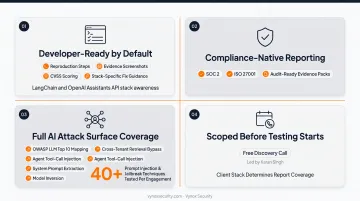
Developer-ready by default. Every finding ships with reproduction steps, evidence screenshots, CVSS scoring, and , stack-specific fix guidance. If your agent orchestration runs on LangChain or your assistant sits on top of the OpenAI Assistants API, the remediation guidance reflects that, not a generic "sanitize your inputs" note.
No separate compliance workstream. Findings map directly to SOC 2 and ISO 27001 control requirements, giving compliance teams audit-ready evidence packs alongside the technical write-up.
Full coverage of the AI attack surface. For clients running LLMs, RAG pipelines, or autonomous agents, reports include full OWASP LLM Top 10 mapping. They also cover categories most templates skip entirely, including cross-tenant retrieval bypass, agent tool-call injection, system prompt extraction, and model inversion. This is tested using 40+ prompt injection and jailbreak techniques per engagement.
Scoped before testing starts. Engagements begin with a free discovery call, led by team members like Karan Singh, where the client's actual stack, rather than a generic checklist, determines what the final report will cover. That scoping conversation is why the report a client receives actually matches what they run in production.
Frequently Asked Questions
What are penetration testing reports?
A penetration testing report is the formal document summarizing simulated attack findings, methodology, risk ratings, and remediation guidance delivered at the end of an engagement. It confirms which vulnerabilities are actually exploitable, backed by evidence from the test.
What are SAST and DAST reports?
SAST reports come from static analysis of source code without running the application. DAST reports come from dynamic testing of a live, running application. Both are automated and distinct from a manual pentest report.
What are the 7 phases of penetration testing?
The common phases are pre-engagement/planning, reconnaissance, scanning, vulnerability analysis, exploitation, post-exploitation, and reporting. Reporting is the final phase where findings become an actionable deliverable.
How long does it take to produce a penetration testing report?
Traditional firms often take several weeks after testing concludes to deliver a final report. Faster providers, including PTaaS-based models, deliver in 5-15 business days depending on scope and complexity.
Who should receive a copy of the penetration testing report?
CISOs, security engineers, developers, compliance/audit teams, and executives should all receive it — each extracts different value, from technical reproduction steps to board-level risk summaries.
How often should penetration testing reports be produced?
Frameworks like PCI DSS require testing at least annually and after any significant infrastructure or application change. Many teams now test more frequently, aligning reports with sprint cycles or major model updates.