According to IBM's 2025 breach study of 600 organizations, 13% reported breaches of AI models or applications — and 97% of that subset lacked proper AI access controls. Prompt injection, RAG pipeline poisoning, and excessive agency aren't theoretical edge cases. They're active attack vectors against deployed systems that most security programs weren't designed to assess.
This guide walks through how AI penetration testing works, what gets tested, and what preparation looks like before the first payload is sent.
Key Takeaways
- AI pentesting targets how models interpret input — not just code flaws or network misconfigurations
- The OWASP LLM Top 10 (2025) is the foundational scoping framework for every LLM engagement
- Prompt injection, RAG poisoning, and excessive agency are the highest-priority attack vectors
- Every LLM integration must be in scope — including APIs, vector databases, and agent tools, not just the model itself
- LLM systems need retesting after every model update, new integration, or agent capability change
How to Conduct AI Penetration Testing on LLM Systems
Step 1: Define the Attack Surface and Scope
The first and most consequential scoping decision is identifying everything that needs to be tested — not just the model itself.
A complete LLM attack surface includes:
- The model and its system prompt configuration
- API endpoints receiving user input or returning model output
- RAG pipelines, vector databases, and document stores
- Plugin and tool integrations accessible to the model
- Agent workflows that execute actions autonomously
- Supporting cloud infrastructure hosting the system
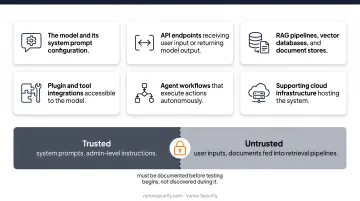
Once the components are mapped, establish trust boundaries. Determine which inputs are treated as trusted (system prompts, admin-level instructions) versus untrusted (user inputs, documents fed into retrieval pipelines). This distinction drives the entire testing methodology — and it must be documented before testing begins, not discovered during it.
Step 2: Gather Intelligence on the Model's Behavior and Integrations
Map every downstream connection the LLM can reach: internal databases, external APIs, file systems, code execution environments. Each integration is a potential lateral movement vector. A prompt injection that reaches a connected file system is far more dangerous than one that merely produces off-policy text.
Two factors determine whether the engagement follows a black-box or white-box approach:
| Deployment Type | Typical Methodology |
|---|---|
| Hosted API (e.g., GPT-4 via OpenAI) | Black-box — no direct model access |
| Self-hosted open-weight model | Grey-box — application-layer access, some config visibility |
| Custom fine-tuned model | Grey/white-box — model configuration and training data potentially reviewable |
Vynox's RAG Pipeline Security Testing, for example, is conducted entirely through the application layer as an attacker would operate — no direct database credentials required. This mirrors real-world threat conditions more accurately than internal audits with privileged access.
Step 3: Execute Prompt Injection and Jailbreak Testing
Direct prompt injection tests whether user-supplied inputs can override system-level instructions, bypass safety guardrails, or extract the system prompt. Vynox's testing has demonstrated that a full system prompt can be extracted in under 10 queries — entirely invisible to CVE scanners.
Indirect prompt injection tests whether adversarial content embedded in external sources — documents, web pages, database entries — is executed as instructions when the LLM retrieves and processes it. Research by Greshake et al. demonstrated concrete indirect injection attack paths against LLM-integrated applications including Bing Chat, identifying the blending of data and instructions as the enabling condition.
Jailbreak testing covers five primary technique categories:
- Direct injection: inputs that override system prompt authority
- Indirect injection via documents and tool outputs: adversarial payloads in retrieved content
- Role-play and persona exploits: DAN-style bypasses, fictional framing, unrestricted persona adoption
- Token manipulation and boundary attacks: instruction smuggling via encoding tricks, context overflow
- Multi-turn attack chains: gradual context manipulation across conversation turns to erode guardrails
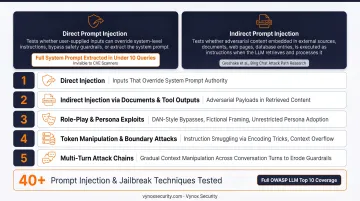
Vynox applies 40+ prompt injection and jailbreak techniques across all five categories in every LLM engagement, covering the full OWASP LLM Top 10 attack surface.
Step 4: Test RAG Pipelines, Agent Workflows, and Supporting Infrastructure
RAG Pipeline Testing
RAG pipeline testing assesses whether adversarially crafted documents can be injected into the vector database to corrupt retrieval outputs. PoisonedRAG research achieved a 90% attack success rate after inserting five malicious texts per target question.
Specific RAG techniques to assess:
- Query manipulation to surface restricted or unauthorized documents
- Cross-tenant retrieval bypass in multi-tenant environments
- Access-control bypass via adversarial prompt crafting
- Vector DB poisoning path analysis
- Embedding inversion — reconstructing source content from stored embeddings
Agentic System Testing
Agentic systems require a separate testing track. When an LLM has tool access, the failure modes shift: a hijacked agent doesn't just return bad text — it can send emails, exfiltrate files, or delete records. Test for tool-call injection, privilege escalation through agent chaining, goal hijacking, and data exfiltration through legitimate tool channels. Destructive tests should always run against staging environments with pre-agreed production guardrails.
Supporting API Layer Testing
API layer testing should cover authentication across user roles, broken object-level authorization (BOLA), rate-limit evasion, and sensitive data leakage in responses. APIs feeding AI systems are high-value targets — compromised inputs can carry prompt injection payloads directly into the model's context.
Step 5: Analyze Findings and Deliver Remediation Guidance
Every confirmed vulnerability should be mapped to the OWASP LLM Top 10 framework and assigned a severity rating using CVSS scores. Severity weighting must account for real business impact: data leakage, regulatory exposure, and operational disruption — not just exploitability alone.
Remediation guidance must be stack-specific, not generic. For example:
- Prompt injection findings → input validation approaches specific to the framework in use, instruction hierarchy enforcement, output filtering, multi-turn context controls
- RAG poisoning findings → content sanitization before context window injection, access control enforcement at the retrieval layer, vector DB write controls, embedding inversion mitigations
Reproduction steps are non-negotiable. Engineering teams need to replicate the exploit in their own environment to validate both the vulnerability and the fix.
Key LLM Vulnerabilities Tested During AI Penetration Testing
LLMs have no clear separation between code and data. A user's natural language input and a developer's system instructions coexist in the same context window — which is why AI-specific vulnerabilities are structurally different from SQL injections or buffer overflows.
The table below maps the five vulnerability classes most commonly exploited during AI penetration testing, along with what they expose and how severe the real-world impact has been.
| Vulnerability | OWASP ID | What Gets Exploited | Documented Impact |
|---|---|---|---|
| Prompt Injection | LLM01 | User inputs override system instructions; indirect injection hides directives in retrieved data | Prefix injection against GPT-4 reached 99% success in undefended configurations |
| Sensitive Information Disclosure | LLM02 / LLM07 | Targeted extraction surfaces training data, system prompts, API keys, or cross-session user data | Aligned production models can emit memorized training data at dramatically elevated rates |
| RAG Pipeline Poisoning | LLM08 | Adversarial content injected into retrieval systems; embedding similarity manipulated to surface malicious documents | LLM acts on false or attacker-controlled content treated as authoritative context |
| Excessive Agency / Insecure Tool Use | LLM06 | Prompt manipulation triggers unauthorized tool calls when LLMs have system access | InjecAgent benchmark showed attack success from 7.1% to over 80% — outcomes include data theft and unauthorized system actions |
| Data and Model Poisoning | LLM04 | Malicious training data introduced into fine-tuned or continuously updated models | Backdoors insertable via ~1,000 malicious tokens; trigger-based behaviors remain dormant under normal conditions |
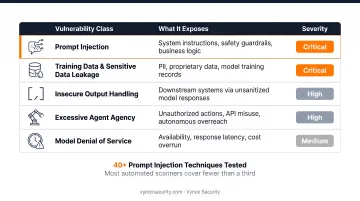
Each of these attack classes requires different testing techniques. Prompt injection testing alone involves 40+ distinct techniques across direct, indirect, and multi-turn scenarios — and most automated scanners cover fewer than a third of them.
What You Need Before Starting an LLM Penetration Test
Skipping prep doesn't just slow an LLM pentest down — it actively narrows the attack surface assessed. Without documentation of intended behavior, integration maps, and access controls, entire categories of risk go untested before the first payload runs.
System and Integration Documentation
At minimum, an architecture diagram showing:
- LLM connections to external tools, retrieval systems, APIs, and data stores
- Agent workflow configurations and tool access boundaries
- RAG pipeline topology from user query to retrieved content
Without this, testers routinely scope out RAG pipelines and agent workflows by default — leaving the most exploitable attack paths unassessed.
Test Environment and Access Requirements
Confirm a dedicated staging environment or clearly scoped sandbox is available before testing begins — for agentic systems, this is a hard requirement. Tool-calling agents can send emails, write to databases, and make outbound API calls. Destructive test payloads need a controlled environment that cannot reach production data or downstream services.
Scope Agreement and Compliance Considerations
Before testing begins, confirm the following are explicitly scoped:
- Which LLM components and integration endpoints are included
- Which user roles and permission levels will be tested
- Whether any production systems, third-party APIs, or downstream services are off-limits
For teams pursuing SOC 2, ISO 27001, or ISO 42001 compliance, confirm that findings will be mapped to AI-specific control requirements from the outset. That way the engagement produces audit-ready evidence alongside technical remediation guidance — no separate GRC workstream required afterward.
Common Mistakes When Pentesting LLM Systems
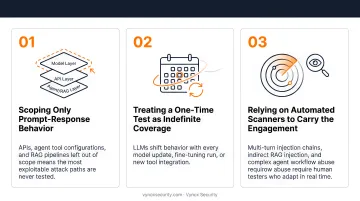
Three patterns consistently leave LLM systems exposed after a pentest engagement closes:
- Scoping only the model's prompt-response behavior — APIs, agent tool configurations, and RAG pipelines left out of scope means the most exploitable attack paths are never tested.
- Treating a one-time test as indefinite coverage — LLMs shift behavior with every model update, fine-tuning run, or new tool integration. Shipping model updates on sprint cycles without triggering a new security review accumulates unvalidated attack surface continuously.
- Relying on automated scanners to carry the engagement — scanners cover broad surface area, but multi-turn injection chains, indirect RAG injection, and complex agent workflow abuse require human testers who adapt in real time based on how the model responds.
When Should Your LLM System Undergo Penetration Testing?
Not every LLM deployment carries the same risk profile. The urgency depends on deployment context, data sensitivity, and how frequently the system evolves.
AI pentesting becomes essential when:
- An LLM is customer-facing and handles PII or sensitive data
- Agentic systems have autonomous tool-calling capabilities
- A RAG pipeline is connected to proprietary internal knowledge bases
- The organization requires SOC 2, ISO 27001, or ISO 42001 compliance evidence covering AI systems
Teams shipping AI products on continuous development cycles get more value from a recurring pentest cadence tied to model updates and sprint releases than from annual testing. Vynox's PTaaS model supports this directly — security validation runs in parallel with development, with same-day retest turnaround once engineers push fixes to staging.
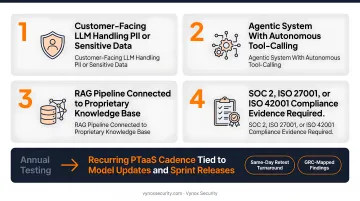
Each testing cycle also produces GRC-mapped findings, so compliance evidence builds continuously rather than in a last-minute audit scramble.
Frequently Asked Questions
How is AI penetration testing different from traditional penetration testing?
Traditional pentesting focuses on code flaws, network misconfigurations, and known CVEs. AI pentesting specifically targets how models interpret inputs, what data they expose, and whether they can be manipulated through prompt injection, adversarial inputs, or RAG pipeline abuse — attack vectors that traditional tools are not designed to detect and have no visibility into.
What is the OWASP LLM Top 10 and why does it matter for AI pentesting?
The OWASP LLM Top 10 (2025) is the industry-standard framework cataloging the most critical vulnerabilities in LLM applications — including prompt injection, sensitive data disclosure, excessive agency, and vector/embedding weaknesses. Every AI pentesting engagement should map findings against this framework for structured, comprehensive coverage of the AI attack surface.
How often should LLM systems be penetration tested?
LLM systems should be tested after every significant model update, new tool integration, or RAG pipeline change — not just annually. Teams with rapid development cycles should adopt a continuous testing cadence where each deployment sprint triggers a corresponding security validation.
Can automated tools fully replace manual AI penetration testing?
Automated tools help with initial surface coverage and known vulnerability scanning, but multi-turn prompt injection chains, indirect RAG injection attacks, and agentic workflow abuse require expert human testers who adapt techniques in real time based on how the model responds. Automated prompting engines lack the adaptive reasoning these attack classes require.
What happens after prompt injection vulnerabilities are confirmed during LLM pentesting?
Confirmed findings are documented with full reproduction steps and a CVSS-based severity rating tied to potential attacker impact — data leakage, guardrail bypass, or tool misuse. Remediation guidance is stack-specific, covering input sanitization, output filtering, instruction hierarchy enforcement, and context isolation.
Does AI penetration testing support SOC 2 or ISO 27001 compliance?
AI pentesting findings map directly to AI-specific controls in SOC 2, ISO 27001, and ISO 42001. Organizations that receive an assessor-ready evidence pack alongside their technical report can submit pentest results directly into an audit without a separate GRC workstream to reformat or reinterpret findings.