This guide is written for security teams, engineering leaders, and AI-powered businesses who need to scope a VAPT engagement or satisfy compliance requirements like SOC 2, ISO 27001, or PCI DSS. If you've ever wondered where the "vulnerability assessment" part ends and the "penetration testing" part begins, you're not alone — plenty of teams treat VAPT as one checkbox rather than two distinct disciplines with different goals and outputs.
Here's what this article covers: what VAPT actually is, why organizations run it, how the process unfolds step-by-step, where it applies across your stack, and when traditional VAPT stops being enough — particularly once LLMs, RAG pipelines, and autonomous agents enter the picture.
Key Takeaways
- VAPT pairs Vulnerability Assessment's breadth with Penetration Testing's depth for a complete risk picture
- SOC 2, ISO 27001, PCI DSS, and HIPAA all require VAPT-style evidence for compliance
- The standard process covers scoping, scanning, manual exploitation, reporting, and retesting
- Coverage spans web, mobile, API, cloud, network, and AI systems such as LLMs and autonomous agents
- Annual one-off tests fall short; tester expertise and cadence matter more than frequency alone
What Is VAPT?
VAPT is a dual-layered cybersecurity methodology that combines automated vulnerability detection with manual, real-world attack simulation. The goal is concrete proof of which weaknesses an attacker could actually exploit, and how much damage they could do once inside.
Ethical hackers who push further than a scanner ever could sit at the center of this approach. According to NIST's foundational security testing guidance, penetration testers mimic real-world attacks and may launch actual exploits or chain multiple vulnerabilities together to bypass security controls entirely.
Run vulnerability assessment alone and you get breadth without depth. A scanner flags a thousand possible issues but can't tell you which ten actually matter. Run penetration testing alone and you get depth without breadth: a skilled tester manually probing a system nobody scanned first wastes hours rediscovering what a scanner would find in minutes.
VAPT sequences the two so scanning narrows the field first, and manual testing proves real-world impact second.
Vulnerability Assessment (VA) Explained
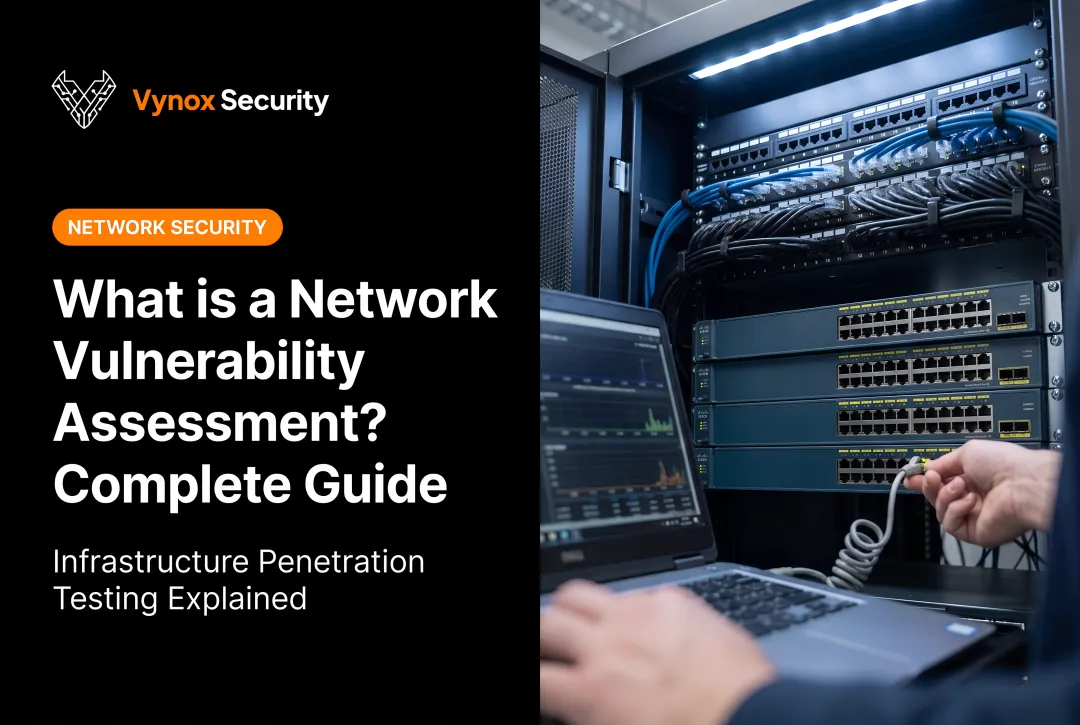
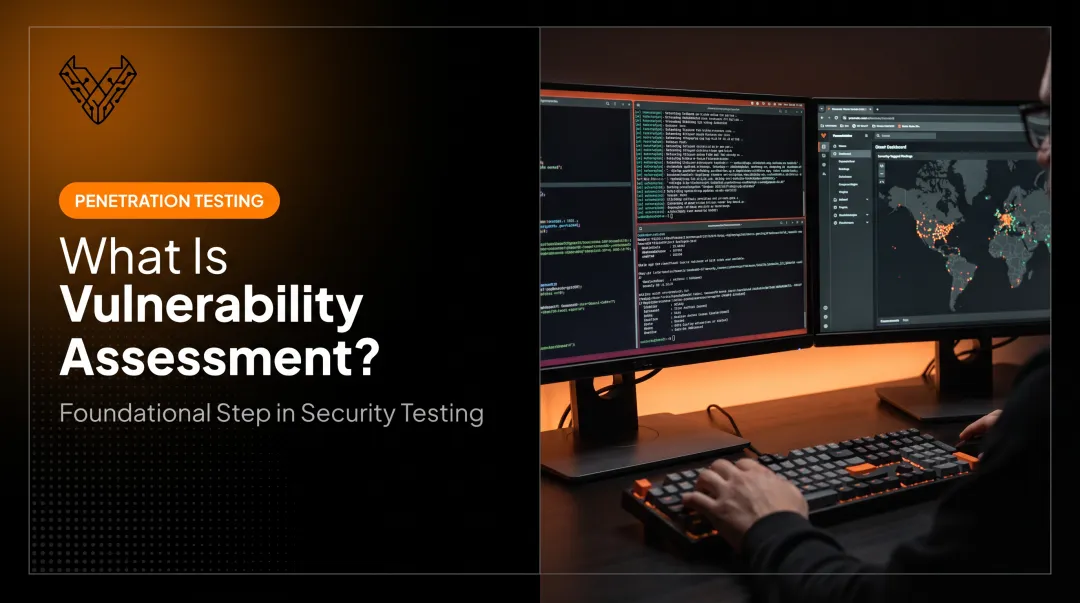
Vulnerability assessment relies on automated tools and scanners to sweep systems for known weaknesses, without attempting to exploit anything. VA typically flags:
- Known CVEs and unpatched software versions
- Misconfigured servers, databases, and cloud storage buckets
- Outdated components and expired certificates
- OWASP Top 10-style issues at scale
It's fast, repeatable, and covers a large attack surface in hours rather than weeks. What it can't tell you is whether a flagged issue is actually reachable by an attacker, or just theoretical noise sitting in a report.
Penetration Testing (PT) Explained
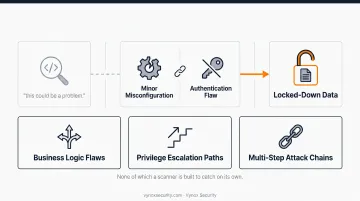
Penetration testing hands the work to ethical hackers who combine manual technique with the same tooling scanners use, then push further. A pentester doesn't stop at "this could be a problem." They try to prove it, chaining a minor misconfiguration with an authentication flaw, for example, to reach data that should be locked down.
This manual layer is where business logic flaws, privilege escalation paths, and multi-step attack chains surface — none of which a scanner is built to catch on its own.
Why VAPT Is Essential for Modern Organizations
Organizations run VAPT because the alternative is finding out about weaknesses from an attacker instead of a tester. In the 2026 DBIR, Verizon found that vulnerability exploitation now accounts for 31% of all breaches, overtaking stolen credentials as the leading breach entry point.
That figure makes the shift plain: known gaps are now the top breach entry point, so finding them before attackers do is no longer optional.
What Modern Environments Demand
Software ships faster than most security teams can review it. APIs multiply, cloud footprints sprawl across AWS, GCP, and Azure, and every sprint introduces new code paths. VAPT gives teams a way to continuously validate that security controls still hold as the environment changes, not once a year, but as code actually ships.
What Goes Wrong Without It
Skip VAPT, or run it poorly, and a few patterns show up reliably:
- Vulnerabilities accumulate silently across forgotten services and shadow APIs
- Automated scans create false confidence: a clean report does not mean a system is safe
- Business logic flaws go undetected because scanners read signatures, not checkout flows or payment skips
The Regulatory Layer
VAPT isn't only best practice; it's often required. PCI DSS 11.4.2 mandates internal penetration testing at least once every 12 months for organizations handling card data. SOC 2, ISO 27001, and GDPR (Article 32) all require organizations to regularly test the effectiveness of their security controls, even where the exact method isn't spelled out line by line.
The Gap Traditional Scopes Miss
Here's where it gets harder for AI-powered businesses. Standard VAPT scopes were built for web apps, networks, and cloud infrastructure, not for LLMs, RAG pipelines, or autonomous agents that reason and act on their own.
A clean web app pentest tells you nothing about whether your model can be pushed into leaking a system prompt, or whether your RAG pipeline lets one tenant retrieve another tenant's documents.
That is the gap Vynox Security focuses on: full OWASP LLM Top 10 coverage on every AI engagement, rather than treating AI as an add-on to an infrastructure scope.
How VAPT Works (Step-by-Step Process)
VAPT follows a structured flow: define what's in scope, run automated and manual testing, then deliver a final report and verify that fixes actually hold.
Before testing starts, scoping defines the target systems, applications, APIs, and assets involved, along with rules of engagement: agreed testing windows, safety boundaries to avoid downtime, and whether testers get authenticated or unauthenticated access.
The end deliverable is a prioritized remediation roadmap, patched vulnerabilities, and—where compliance is on the line—a retest confirmation or audit-ready report.
Step 1: Scoping & Reconnaissance
Scope defines which systems, environments, and testing type will be assessed:
- Black-box: no prior knowledge
- Gray-box: partial access
- White-box: full access, including source code
This stage also maps the attack surface to catch blind spots: forgotten subdomains, exposed staging environments, or third-party integrations nobody remembered were internet-facing.
A scope that's too narrow leaves real risk untested. One that's too broad without proper rules of engagement risks unintended downtime on production systems.
Step 2: Automated Vulnerability Scanning
With scope agreed, automated tools scan for known CVEs, misconfigurations, outdated components, and OWASP Top 10-style issues across every asset in range. This is the vulnerability assessment phase doing what it does best: covering breadth quickly.
The output here is a long list of potential issues, most of which need manual follow-up to separate the exploitable from the irrelevant.
Step 3: Manual Penetration Testing
This is where ethical hackers take the scanner's output and start working manually. They look for chained exploits, authentication bypasses, and business logic flaws: the things automated tools consistently miss because they don't understand what a system is supposed to do.
For AI systems, this step looks different again. Instead of chaining CVEs, testers attempt prompt injection, try to extract a system prompt, or probe whether a RAG pipeline leaks another tenant's documents. Vynox Security's AI engagements, for example, test more than 40 prompt injection and jailbreak techniques at this stage alone.
Step 4: Reporting & Remediation Verification
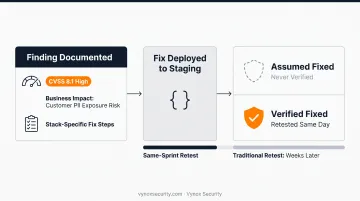
Testers document findings with severity ratings (typically CVSS-scored), business impact framing, and remediation steps engineers can act on. Guidance is stack-specific, with reproduction steps rather than generic advice.
Then comes the part many providers skip: retesting. A vulnerability marked "fixed" that was never verified isn't actually fixed. It's only assumed fixed. Some testing providers verify remediations the same day a fix lands in staging, which keeps validation inside the same development sprint instead of pushing it into a separate engagement weeks later.
Where VAPT Is Applied & What Affects Its Effectiveness
VAPT applies wherever software runs and data moves:
- Web applications and APIs (REST and GraphQL)
- Mobile apps on iOS and Android
- Cloud infrastructure across AWS, GCP, and Azure
- Internal and external networks
- Increasingly, AI systems : LLMs, RAG pipelines, and autonomous agents
Common triggers for running VAPT include major releases, infrastructure changes, upcoming compliance audits, or a continuous cadence aligned with development sprints. That continuous model is often called PTaaS (Penetration Testing as a Service).
Instead of one test per year, testing happens every sprint and every model update, catching issues before they compound.
What actually determines whether VAPT is effective:
| Factor | Why It Matters |
|---|---|
| Scope depth | Narrow scopes leave real attack paths untested |
| Tester expertise & manual-to-automated ratio | Scanners alone miss business logic and chained exploits |
| Testing frequency | One-time snapshots go stale the moment code ships |
| Environment complexity | Hybrid, multi-cloud, multi-service setups need broader coverage |
| Compliance requirements | Dictate testing depth and report format needed for audit evidence |
Two engagements labeled "VAPT" can produce wildly different risk pictures depending on these five variables alone.
Common Misconceptions & When Traditional VAPT May Not Be Enough
Misconception 1: VAPT is an annual checkbox. Treating VAPT as a once-a-year formality misses the point. Security controls degrade the moment new code ships, a new API goes live, or infrastructure changes. Tying testing to release cycles, not the calendar, is what actually reduces risk.
Misconception 2: More findings mean more risk. A scan returning 200 "vulnerabilities" doesn't mean an organization is 200 times more exposed than one with two findings.
Automated scanners flag anything matching a signature, regardless of whether it's reachable. Manual testing separates real risk from noise. One exploitable authentication bypass matters more than a hundred unreachable low-severity CVEs.
Where Traditional VAPT Falls Short for AI Systems
Conventional network and web pentesting was never designed to catch:
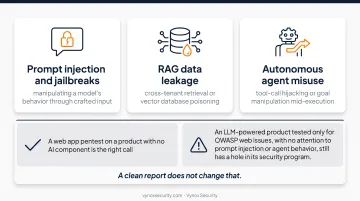
- Prompt injection and jailbreaks — manipulating a model's behavior through crafted input
- RAG data leakage — cross-tenant retrieval or vector database poisoning
- Autonomous agent misuse — tool-call hijacking or goal manipulation mid-execution
These require dedicated methodologies, not just a broader scan. That gap is what AI-native security testing providers like Vynox Security address. They run dedicated LLM penetration testing and RAG pipeline security testing rather than bolting AI onto a standard infrastructure scope.
Correct scoping matters more than running VAPT by default. A web app pentest on a product with no AI component is the right call. An LLM-powered product tested only for OWASP web issues, with no attention to prompt injection or agent behavior, still has a hole in its security program. A clean report does not change that.
Frequently Asked Questions
What does VAPT stand for?
VAPT stands for Vulnerability Assessment and Penetration Testing, a two-part methodology combining automated scanning with manual, exploitation-based testing to cover both breadth and depth of risk.
What's the difference between VAPT and pentesting?
Penetration testing is one half of VAPT — the manual exploitation phase. VAPT also includes the automated vulnerability assessment phase that runs first and narrows the field for broader coverage.
Who can do VAPT testing?
VAPT is typically performed by certified ethical hackers or specialized security firms with expertise in the specific systems being tested, whether network, web, mobile, cloud, or AI infrastructure.
What tools are used in VAPT?
Vulnerability assessment relies on scanners like Nessus and OpenVAS to flag known issues. Penetration testing adds manual exploitation frameworks like Metasploit and web testing tools like Burp Suite.
How often should VAPT be performed?
Most compliance frameworks, including PCI DSS, require testing at least once every 12 months. Best practice is continuous or sprint-aligned testing, especially after major infrastructure or application changes.
How long does a VAPT engagement typically take?
Vulnerability assessments alone can run 24-72 hours. Full penetration testing engagements typically take 5-15 business days depending on scope, though AI red teaming can extend to 3-5 weeks.