Introduction
ISO 27001 penetration testing is a simulated, authorized cyberattack exercise. Its job is simple: prove whether the technical security controls inside your Information Security Management System (ISMS) actually hold up, or whether they just look good on paper.
This guide is for security leaders, compliance officers, and IT/engineering teams working toward or maintaining ISO 27001 certification, including AI-powered businesses, SaaS companies, and healthcare organizations handling sensitive data.
Penetration testing comes up constantly in Annex A discussions, yet most teams don't truly know if it's mandatory, how often to run it, or how to scope it without leaving gaps.
Here's what this article covers: what ISO 27001 penetration testing is, whether it's legally required, and how the process runs step-by-step. It also breaks down how to scope, schedule, and avoid the audit pitfalls that trip up first-time and returning certification candidates alike.
Key Takeaways
- ISO 27001 never says "penetration testing," but Annex A 8.8, 8.29, and 8.34 expect it as proof
- Auditors use pentesting to confirm controls work in practice, not just on paper
- Annual testing is the baseline, with extra rounds after major changes or before audits
- Scope must match your Statement of Applicability (SoA) exactly; partial testing is a top nonconformity trigger
- Findings should map to your risk register with retest evidence, not a relabeled vulnerability scan
What Is ISO 27001 Penetration Testing?
ISO 27001 penetration testing is a simulated, authorized attack against your systems, applications, and networks, run specifically to check whether the Annex A security controls described in your ISMS survive real-world exploitation attempts.
The goal is documented, evidence-based assurance that the risk treatment decisions in your ISMS actually work in practice, not just on the whiteboard where you designed them. A simple list of vulnerabilities doesn't provide that proof.
Pentesting vs. Vulnerability Scanning
These two terms get confused constantly, and auditors notice when they're conflated:
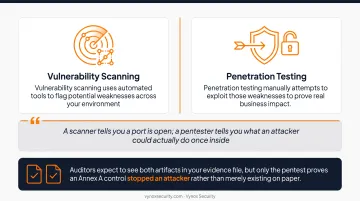
- Vulnerability scanning uses automated tools to flag potential weaknesses across your environment
- Penetration testing manually attempts to exploit those weaknesses to prove real business impact
- A scanner tells you a port is open; a pentester tells you what an attacker could actually do once inside
Auditors expect to see both artifacts in your evidence file, but only the pentest proves an Annex A control stopped an attacker rather than merely existing on paper.
Pentesting vs. the ISO 27001 Audit Itself
The audit reviews your documentation, policies, and process maturity. The pentest actively attacks your technical environment to stress-test whether those policies hold up against a determined human.
That technical proof needs to cover real ground: scope typically spans web and mobile applications, APIs, internal and external network infrastructure, and cloud environments. For organizations building AI products, that scope increasingly extends to LLMs, RAG pipelines, and autonomous agents — attack surfaces that a standard infrastructure pentest simply wasn't designed to touch.
Is Penetration Testing Required for ISO 27001?
Let's be direct: ISO 27001 does not use the literal phrase "penetration testing" as a mandatory clause anywhere in the standard. But auditors treat it as a practical necessity anyway, because four Annex A controls create a technical link that's hard to satisfy any other way.
| Control | What it requires | Why pentesting satisfies it |
|---|---|---|
| 8.8 – Management of technical vulnerabilities | Identify vulnerabilities and evaluate exposure in a timely way | Proves exploitability instead of theoretical risk |
| 8.29 – Security testing in development and acceptance | Security testing before systems go live | Directly calls for testing at key lifecycle stages |
| 8.34 – Protection of systems during audit testing | Independent testing must be planned and agreed with management | Governs how a pentest is authorized and controlled |
| 5.36 – Compliance with policies and standards | Regular review of compliance with security rules | Supports evidence that testing commitments are being met |
This maps directly to ISO 27001's Plan-Do-Check-Act cycle. Clause 9 covers monitoring, internal audit, and management review (the "Check" phase), and penetration test results are the clearest technical evidence you can feed into it.
Skipping pentesting isn't an automatic nonconformity. But the pressure to run it keeps building. ISO/IEC 27001 certificates grew from 58,687 in 2021 to 71,549 in 2022, a 21.9% jump in a single year that means far more organizations (and their auditors) now expect rigorous technical evidence as a baseline requirement.
The cost of getting it wrong is climbing too. IBM's 2026 Cost of a Data Breach Report puts the global average breach cost at $4.99 million, a record high and 12% above the prior year. Auditors know this number. It's part of why "we have a policy" no longer satisfies anyone reviewing your ISMS.
How ISO 27001 Penetration Testing Works (Process Flow)
At a high level, the process moves through scoping and rules of engagement, reconnaissance and active exploitation, then reporting, retesting, all mapped back to your risk register.
What feeds into scoping: your ISMS boundary, the Statement of Applicability, asset inventory, and prior risk assessment findings. These define exactly what needs testing, not what's convenient to test.
Step 1: Scoping & Planning
Testers define target systems against the SoA and ISMS boundaries, agree on a recognized methodology (OWASP, PTES, or NIST SP 800-115), and finalize rules of engagement with stakeholders before anything else happens.
Step 2: Active Testing & Exploitation
Ethical hackers combine automated tooling with manual exploitation attempts, typically using a gray-box methodology (the most common approach for ISO 27001 engagements). This is where reconnaissance turns into proof: testers don't just flag a vulnerability, they attempt to exploit it and show real-world impact.
Controlling that exploitation requires guardrails. Rules of engagement, agreed testing windows, and safeguards keep this phase controlled, often through staging environments that mirror production, avoiding disruption to live business operations.
Step 3: Reporting, Remediation & Retesting
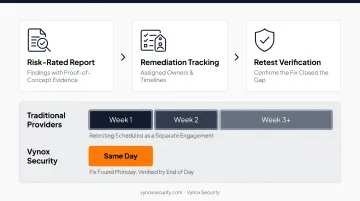
The final report delivers risk-rated findings with proof-of-concept evidence. Remediation gets tracked against assigned owners and timelines, then retesting confirms the fixes actually closed the gap before anything becomes formal audit evidence.
This stage is where turnaround time matters most for certification timelines. Traditional providers often stretch retest cycles across multiple weeks because retesting is scheduled as a separate engagement. Vynox Security compresses that into same-day retest verification once a fix lands in staging: a fix found Monday can be verified by end of day rather than sitting in a queue for weeks.
Scoping, Frequency, Methodology & Common Pitfalls
Defining the Right Scope
Your pentest scope should mirror your full ISMS boundary and SoA. Common targets include:
- Internet-facing infrastructure and internal networks
- APIs and admin panels
- Mobile applications (iOS and Android)
- AI components (LLMs, RAG pipelines, and autonomous agents) for organizations shipping AI products
How Often to Test
Annual testing is the accepted industry minimum. But testing once a year leaves long exposure windows open after infrastructure or code changes ship in between.
With surveillance audits happening yearly and full recertification every three years, CREST's guidance recommends critical systems undergo testing at least yearly and after any major change to business processes, applications, or IT infrastructure. Treat that as the minimum; many organizations test more often based on their risk profile.
Continuous or PTaaS-style testing cadences are increasingly favored by auditors precisely because they close those exposure gaps. Instead of one snapshot a year, testing aligns with development sprints or model updates, so evidence accumulates continuously rather than getting assembled under deadline pressure right before a surveillance audit.
Recognized Methodologies
Auditors generally recognize these frameworks:
- OWASP Top 10 / WSTG: web applications, APIs, and web services
- PTES: end-to-end engagement governance across seven phases
- OSSTMM: operational security measured across five channels
- NIST SP 800-115: a four-phase general technical assessment model
Common Pitfalls That Trigger Nonconformities
A few mistakes show up again and again in audits:
- Relabeling a vulnerability scan as a pentest report. Auditors can tell the difference immediately, and it's one of the fastest ways to get flagged.
- Scope that doesn't match the full ISMS/SoA. Testing a narrow subset while claiming full compliance leaves controls completely unvalidated.
- Low-cost providers leaning almost entirely on automated tools. Minimal manual hours means missed business logic flaws and false assurance.
- Findings that never reach the risk register. A vulnerability sitting in a PDF that no one tracks against a treatment plan represents a broken control loop rather than usable compliance evidence.
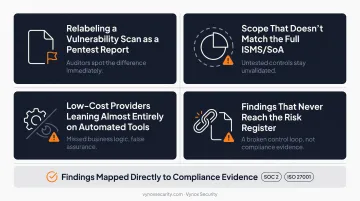
Findings need to land somewhere actionable, mapped directly to compliance evidence rather than handed over as a standalone technical document.
Vynox Security's compliance-ready evidence packs are built for SOC 2 and ISO 27001 audits. Each finding is tagged to the control it satisfies, so auditors receive testing evidence in the exact format their process expects.
Conclusion
ISO 27001 penetration testing is the practical proof point that shows whether your ISMS's technical controls actually work, beyond what's written in a policy document.
ISO 27001 never explicitly names penetration testing as mandatory. Yet Annex A controls 8.8, 8.29, and 8.34 point clearly in that direction. Add in the expectations of any auditor who's reviewed a breach cost report, and it becomes a de facto requirement for any certification effort worth taking seriously.
Correct scoping, methodology, and frequency matter far more than simply checking a box. Getting those right starts with proper scoping, often through a discovery call like the ones Vynox Security's team runs before every engagement. That groundwork helps you avoid the exact audit gaps covered in this guide.
Frequently Asked Questions
Does ISO 27001 require penetration testing?
Not by name. But Annex A 8.8, 8.29, and 8.34 make it the expected method for validating technical controls, and most auditors expect to see recent evidence of it.
What is the frequency of ISO 27001 penetration testing?
Annual testing is the accepted minimum. Add tests after major infrastructure or application changes, before certification or surveillance audits, and ideally on a continuous cadence.
What are the 5 stages of penetration testing?
Scoping and planning, reconnaissance, vulnerability discovery, exploitation, and reporting with remediation. This sequence synthesizes NIST's four phases and PTES's seven sections into a practical flow.
What is the NIST standard for penetration testing?
NIST SP 800-115 is the technical guide to information security testing and assessment, commonly accepted alongside OWASP and PTES for ISO 27001 engagements.
How much does an ISO 27001 penetration test typically cost?
Pricing depends on scope size, target count, and testing depth rather than a fixed number. Price should never be the primary factor, given what a compliance failure or breach costs.
What's the difference between vulnerability scanning and penetration testing for ISO 27001 purposes?
Scanning automatically flags potential weaknesses. Penetration testing manually validates exploitability and business impact, which is the depth of evidence most auditors require before granting certification.