Introduction
Your SaaS platform ships new features every sprint, and lately, more than a few of those features run on large language models. That pace is great for customers, but it's also expanding your attack surface faster than most security teams can track.
Compliance is catching up to this reality. In Secureframe's 2025 benchmark survey, 61% of security, compliance, and IT professionals said achieving compliance was required to win or renew customer contracts. Penetration testing evidence has become part of that conversation, not an afterthought.
This guide covers what SaaS penetration testing actually involves and why it matters heading into 2026, including the AI attack surface most legacy providers still miss. You'll also learn how the testing process works and how to pick a partner who won't leave gaps in your coverage.
Key Takeaways
- SaaS pentesting covers the full stack: web apps, APIs, cloud infrastructure, and embedded AI/LLM features
- PCI DSS mandates security testing outright; SOC 2 and ISO 27001 treat it as core compliance evidence
- The process runs through five stages: scoping, assessment, exploitation, reporting, and retest
- AI-powered SaaS products need testing for prompt injection, jailbreaks, and data leakage beyond standard web and API checks
- Picking a partner hinges on methodology, turnaround speed, compliance mapping, and AI-specific testing depth
What Is SaaS Penetration Testing?
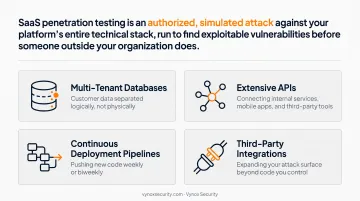
SaaS penetration testing is an authorized, simulated attack against your platform's entire technical stack, run to find exploitable vulnerabilities before someone outside your organization does. That's the simple definition. The complicated part is what "entire technical stack" means for a modern SaaS product.
Unlike a single on-premise application, SaaS architecture is layered and interconnected by design:
- Multi-tenant databases that separate customer data logically, not physically
- Extensive APIs connecting internal services, mobile apps, and third-party tools
- Continuous deployment pipelines pushing new code weekly or biweekly
- Third-party integrations that expand your attack surface beyond code you control
How SaaS Testing Differs From Generic Web App Testing
A generic web app test checks for SQL injection, XSS, and broken authentication. SaaS pentesting does that too, but it adds checks specific to multi-tenant products:
- Cross-tenant data isolation, confirming one customer's account can't touch another's records
- Subscription and billing logic abuse, like manipulating plan tiers or bypassing payment gates
- Role-based access control validation across every customer account type, not just one demo user
Why Buyers Ask for Proof
Enterprise buyers no longer take a vendor's word for it. A recent Secureframe compliance benchmark found that nearly 70% of organizations rely on security questionnaires and RFPs to vet vendors before signing, and a pentest report is often the exact evidence they request. Without one, sales cycles stall.
The 2026 Shift: AI Is Now Part of the Stack
Here's what's changed. Most SaaS platforms now ship with an embedded copilot, chatbot, or autonomous agent somewhere in the product. That means the scope of "SaaS pentesting" has to stretch to cover these AI-native components too, not just the infrastructure sitting underneath them. A copilot that can query your database is a new door into your data, and it needs to be tested like one.
Why SaaS Penetration Testing Matters in 2026
The Attack Surface Keeps Growing
Web and application-layer attacks remain a persistent entry point for breaches. Verizon's 2026 Data Breach Investigations Report found Basic Web Application Attacks accounted for 10% of breaches analyzed, with vulnerability exploitation responsible for a sizable share of initial access across the broader dataset. SaaS products, with their public-facing APIs and authenticated web layers, sit squarely in that exposure zone.
Compliance Isn't Optional Anymore
SOC 2 Type II and ISO 27001 audits both point to security testing as core evidence. SOC 2's CC7.1 criteria call for detecting vulnerabilities through periodic scans and evaluation, while ISO 27001's Annex A control 8.29 covers security testing during development.
Neither standard hands you a fixed "test once a year" rule, but auditors consistently expect documented, recurring testing. A missing pentest report is one of the fastest ways to stall an enterprise deal mid-review. A clean, current report does more than satisfy an auditor: it shortens the back-and-forth during security reviews, because the prospect's security team isn't left guessing.
The AI Attack Surface Gap
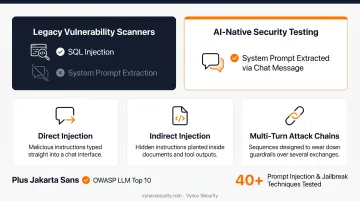
This is where most traditional pentest firms fall short. SaaS products embedding LLMs, RAG pipelines, or autonomous agents introduce risks like prompt injection, jailbreaks, and data leakage that legacy scanning tools were never built to catch. A scanner looking for SQL injection has no concept of a system prompt being extracted through a cleverly worded chat message.
Closing that gap is exactly what AI-native testing providers are built to do. Vynox Security, for instance, runs full OWASP LLM Top 10 coverage alongside 40+ prompt injection and jailbreak techniques in every AI engagement, including direct injection, indirect injection through documents and tool outputs, and multi-turn attack chains designed to wear down guardrails over several exchanges.
The Real Cost of Getting It Wrong
The cost of skipping that testing isn't limited to stalled deals, either. IBM's Cost of a Data Breach study found public-cloud-only breaches averaged $5.17 million in 2024, well above the global average across all environments. Weigh that against the cost of a scoped penetration test, and the math favors testing every time.
Annual Testing Isn't Enough Anymore
Teams shipping code weekly or biweekly can't rely on one pentest a year. New features, new integrations, new model versions: each one can quietly open a gap that sits unpatched until the next scheduled audit. That's the exact problem continuous, sprint-aligned testing models (PTaaS) are built to solve, with security validation running alongside development instead of trailing behind it by months.
Types and Scope of SaaS Penetration Testing
Testing Approaches by Knowledge Level
Testers generally scope pentests based on how much they know going in:
- Black box: Zero prior knowledge, simulating an external attacker starting from scratch
- Gray box: Partial access, such as test credentials or API documentation, balancing realism with depth
- White box: Full source code and architecture access, enabling deep logic review
Gray box testing is the most common approach for SaaS products. It gives testers enough context, like role-based accounts and API details, to dig into authenticated attack paths and tenant boundaries without burning days on pure reconnaissance.
What Gets Tested in a Modern SaaS Pentest
A comprehensive engagement covers:
- Web application layer: OWASP Top 10, business logic, authentication and session management
- APIs: REST and GraphQL endpoints, authorization checks, rate-limit handling
- Cloud infrastructure: AWS, Azure, and GCP misconfigurations, IAM privilege paths, public exposure
- Mobile companion apps: iOS and Android binaries, local storage, transport security
- Third-party integrations: Data flows and access points outside your core codebase
For AI-powered SaaS products, scope needs to extend further still: the LLM, RAG pipeline, and agent layer. This is where most 2026-era assessments should be headed, and it's still the piece many traditional providers skip entirely. Vynox's two-layer model treats AI security testing (LLMs, RAG pipelines, autonomous agents, model inversion) as the primary layer. Infrastructure testing runs as the supporting layer underneath it, covering the rest of the stack.
The SaaS Penetration Testing Process: 5 Key Stages
Stage 1: Pre-Engagement and Scope Mapping
Before any active testing starts, the tester and client agree on:
- Goals and compliance requirements
- In-scope systems (apps, user roles, cloud infrastructure, APIs)
- Timelines and cost Vynox handles this through a free 30-minute discovery call, mapping the AI and infrastructure attack surface and recommending the right tier before pricing is even discussed.
Stage 2: Vulnerability Assessment
Automated scanning tools sweep the environment for known vulnerabilities, covering the OWASP Top 10 and published CVEs. This step doesn't replace manual work; it directs where manual testers should spend their time.
Stage 3: Manual Exploitation
Testers manually attempt to exploit what the scan flagged, using real-world attack techniques to confirm impact and filter out false positives. This is where automated tools stop being useful. A scanner can flag a suspicious endpoint, but only a human tester can chain that flaw with a business logic flaw to prove real-world impact.
Stage 4: Reporting and Collaboration
Findings get documented with severity ratings, reproduction steps, and business impact. A static 200-page PDF is the old standard.
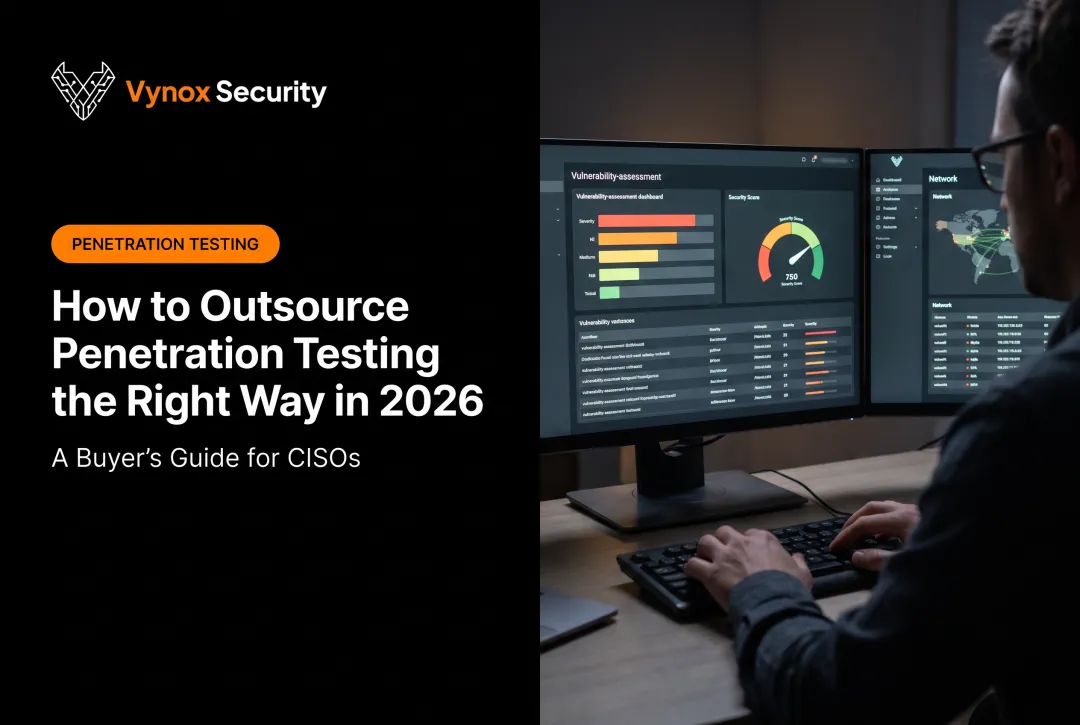
A better approach: a live dashboard that tracks:
- Open vulnerabilities by severity
- Active engagements in progress
- Resolved issues and fix history
- Overall security posture score
Engineering and security leads see the current state, not last quarter's snapshot.
Stage 5: Remediation, Retesting, and Certification
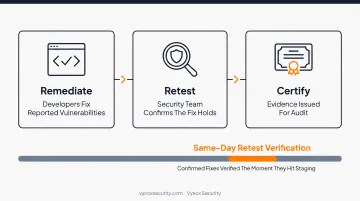
Developers fix what's reported, the security team retests to confirm the fix holds, and evidence is issued for audit purposes.
Turnaround here matters more than people assume: the longer a confirmed vulnerability sits unpatched, the longer it's exploitable. Same-day retest verification once a fix hits staging keeps that exposure window as short as possible.
Choosing the Right SaaS Penetration Testing Partner
Not all pentest providers are built the same way, and the differences show up fast once you're mid-engagement.
Methodology and Credentials
Look for transparency about how testing actually happens, plus tester credentials like OSCP, OSWE, or the newer OSCE3 pathway. Credentials matter less than proof of manual, expert-led testing though. A certified tester running an automated scan isn't giving you much more than a scanner would on its own.
Turnaround Time and Retest Policy
This is where the gap between legacy and modern providers is widest:
| Criteria | Legacy consultant-led firms | Modern PTaaS providers (such as Vynox Security) |
|---|---|---|
| Standard engagement | 4-8 weeks | 5-15 business days |
| Retest turnaround | Days to weeks | Same-day, once fixes hit staging |
| Fix guidance | Generic findings list | Developer-ready, stack-specific steps |
Compliance Mapping
Choose a provider whose findings map directly to SOC 2 and ISO 27001 control requirements. That turns your pentest report into audit-ready evidence instead of a separate document your compliance team has to translate later.
Vynox's Compliance Readiness offering, for example, maps findings from a single engagement to:
- SOC 2
- ISO 27001
- EU AI Act Article 15
- ISO 42001
- India's DPDP Act
AI-Specific Testing Depth
If your product embeds AI features, ask the provider directly whether their methodology tests the LLM, RAG pipeline, and agent layer, or only the infrastructure sitting around it. This is quickly becoming a non-negotiable line item as AI features move from novelty to standard SaaS functionality.
Frequently Asked Questions
How much does SaaS penetration testing typically cost?
Pricing depends on scope, application complexity, and provider model. Look for transparent, stage-appropriate pricing from startup to enterprise; vague "contact us" stalling is a red flag.
How long does a SaaS penetration test take?
Traditional consultant-led tests often take 4-8 weeks from scoping to final report. Modern PTaaS-style providers typically deliver results in 5-15 business days, with AI red teaming engagements running 3-5 weeks given their scenario-driven depth.
How often should a SaaS company conduct penetration testing?
At least annually for compliance purposes, plus additional testing after major feature releases or architecture changes. Teams shipping frequently often align testing to development sprints through continuous testing models instead.
Does SaaS penetration testing cover third-party APIs and integrations?
Most engagements test the APIs and integrations the SaaS provider owns and controls. External third-party services are typically out of scope unless explicitly added during scoping.
What compliance frameworks require SaaS penetration testing?
PCI DSS explicitly mandates recurring penetration testing. SOC 2, ISO 27001, HIPAA, and GDPR reference security testing or evaluation more broadly, and a documented pentest serves as strong evidence for all of them.
How is SaaS penetration testing different from testing AI features like LLMs or chatbots?
AI features need specialized testing for prompt injection, jailbreaks, and data leakage, risks that don't exist in traditional web or API code. Traditional methods weren't built to catch these risks, so AI-native testing adds this layer without replacing conventional pentesting.