Introduction
Shipping fast and staying compliant used to be two separate problems. For AI startups in 2026, they're the same problem.
Enterprise buyers, investors, and regulators now want proof of how you handle training data, model outputs, and autonomous agent behavior, not just uptime and firewalls. Many founders still treat SOC 2 like a checkbox their sales team needs closed.
That approach is starting to fail audits.
SOC 2 remains the trust signal enterprise buyers expect before they'll sign a contract with an AI vendor. But auditors are reading the same five Trust Services Criteria through a distinctly AI-specific lens in 2026.
This article breaks down exactly what they're looking for, where legacy pentests fall short, and how to build a security program with evidence ready before the auditor ever asks.
Key Takeaways
- SOC 2 criteria now cover training data provenance, model bias, and agent permissions
- Generic pentests miss prompt injection, RAG leakage, and agent misuse auditors expect
- A workable program blends governance, continuous testing, and TSC-mapped evidence
- Pairing a CPA auditor with an AI-native partner speeds audits and cuts failed controls
SOC 2 and the AI Startup Landscape in 2026
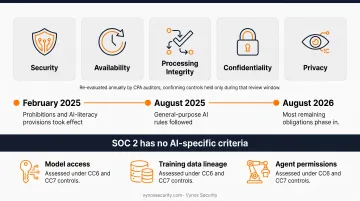
SOC 2 is a CPA-issued attestation report built around five Trust Services Criteria: security, availability, processing integrity, confidentiality, and privacy. Auditors re-evaluate these controls annually — a report only confirms they worked during that review window, not that they'll hold forever.
That ongoing scrutiny matters more heading into 2026, when the regulatory backdrop got a lot more crowded. The EU AI Act rolled out in stages:
- February 2025 – Prohibitions and AI-literacy provisions took effect.
- August 2025 – General-purpose AI rules followed.
- August 2026 – Most remaining obligations phase in, per the EU AI Act's implementation timeline.
Enterprise procurement teams have taken notice, and SOC 2 is increasingly the baseline question on vendor security questionnaires before an AI tool even gets a pilot.
Here's the part founders often miss: SOC 2 itself has no AI-specific criteria. It's still outcome-based. The framework doesn't say "test your RAG pipeline" anywhere in its language.
What's different is the interpretation. Auditors evaluating an AI company now ask pointed questions about model access, training data lineage, and agent permissions when they assess the same old CC6 and CC7 controls. Documentation written for a pre-AI SaaS product won't hold up under that scrutiny.
What Regulators and Auditors Actually Watch in 2026: Five AI-Specific Focus Areas
Auditors aren't just checking whether policies exist anymore. They're asking how AI systems are governed end-to-end, from data ingestion through model output. Five areas get the most attention right now.
Data Privacy, Training Data & Model Inputs
Auditors want to see where your training data came from and whether you had the right to use it. Expect questions on:
- Data lineage documentation tracing datasets from source to model
- Lawful basis for any personal data used in training or fine-tuning
- PII/PHI handling procedures, including detection and redaction
- Data minimization practices that limit what's collected in the first place
- Encryption at rest and in transit for both training and inference data
If you can't produce a dataset register with source, license, and consent records on request, that's a gap.
Algorithmic Bias & Processing Integrity
Processing integrity used to mean "does the system process transactions correctly." Auditors now extend it to model behavior itself:
- Validation testing across demographic or use-case slices, not just aggregate accuracy
- Disparate impact assessments for models feeding decisions with real consequences
- Ongoing monitoring for model drift, with documented thresholds for retraining
Skipping this lets models degrade in production undetected, often for months, until a customer complaint forces the issue into the open.
Model & Infrastructure Security Controls
This is where access control failures show up most often, and the data backs it up. IBM's 2025 study of 600 breached organizations found that 13% had suffered an AI-model or AI-application breach, and 97% of those victims lacked proper AI access controls.
Auditors want evidence of:
- RBAC and MFA enforced on model weights, prompt repositories, and fine-tuning pipelines
- Regular vulnerability scanning across AI infrastructure, not just web servers
- Logged access to model registries and cloud storage holding training artifacts
A single misconfigured storage bucket can leak model weights, training data, and source code at once, and auditors consistently name this as the most common root cause behind AI breaches.
Third-Party AI & Vendor Risk Management
Almost no AI startup builds its foundation model from scratch. That means your vendor risk assessment now has to cover:
- Foundation model providers (OpenAI, Anthropic, and similar)
- Third-party APIs feeding data into your models
- Subprocessors handling any portion of the AI pipeline
Contracts should spell out data handling terms, retention limits, and whether your data trains the provider's models. Auditors increasingly ask for the actual contract language, not just a vendor list.
Governance, Explainability & Human Oversight
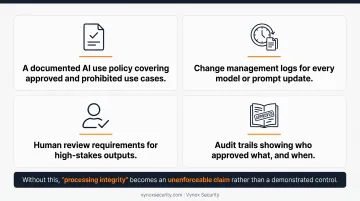
Finally, auditors want proof that a human is actually in the loop where decisions matter. That means:
- A documented AI use policy covering approved and prohibited use cases
- Change management logs for every model or prompt update
- Human review requirements for high-stakes outputs
- Audit trails showing who approved what, and when
Without this, "processing integrity" becomes an unenforceable claim rather than a demonstrated control.
The Hidden AI Attack Surface Traditional Audits and Pentests Miss
Here's the uncomfortable truth: most penetration tests were built for web apps and network infrastructure. They weren't built for LLMs. That leaves evidence gaps that auditors flag more often now, not less.
Prompt injection and jailbreak testing is the clearest example. Auditors expect to see this tested as evidence for security and processing integrity criteria. The OWASP GenAI Security Project's 2025 Top 10 ranks prompt injection as the single highest risk facing LLM applications, ahead of sensitive information disclosure and supply chain vulnerabilities.
Comprehensive testing today covers dozens of documented attack patterns, including direct injection, indirect injection via retrieved content, multi-turn attack chains, and encoding-based bypasses.
RAG pipelines introduce their own set of problems that generic pentests simply don't check for:
- Cross-tenant data leakage, where one customer's documents surface in another's query results
- Retrieval poisoning, where manipulated content gets injected into the vector database
- Embedding inversion, where sensitive source documents get reconstructed from vector embeddings
These map directly to confidentiality and privacy criteria, and they're invisible to a scanner looking for SQL injection.
Autonomous agents raise the stakes further. A hijacked agent doesn't just return a bad answer. It can send emails, delete records, or call tools it was never meant to touch.
Auditors now expect testing that covers:
- Excessive tool-calling permissions, where agents access functions beyond their intended scope
- Privilege escalation through agent chaining, where one compromised agent grants access to others
- Goal hijacking, where attackers redirect an agent's objective mid-task
All three map directly to security and availability criteria.
This is the exact gap Vynox Security was built to close. Rather than running a generic web pentest and calling it done, Vynox runs full OWASP LLM Top 10 coverage in every AI engagement. That includes 40+ documented prompt injection and jailbreak techniques, cross-tenant RAG retrieval testing, and agent tool-call security reviews.
Findings get mapped directly to SOC 2 and ISO 27001 control requirements, so the output isn't a generic report an auditor has to interpret. It's a compliance-ready evidence pack with reproduction steps, CVSS scores, and developer-ready fix guidance built in.
Building a SOC 2-Ready AI Security Program: A Practical Roadmap
A SOC 2 program built for AI can't be an afterthought bolted onto legacy documentation. It needs to start with the AI stack itself.
Run a gap analysis against your actual AI stack. Map every model, RAG pipeline, agent, and API to the relevant TSC criteria before an auditor does it for you. Generic checklists miss the components that matter most.
Implement layered technical controls built for AI behavior. Encryption, access management, and logging need to account for how models get accessed and updated, not just how servers get patched.
Shift from annual testing to continuous validation. Point-in-time pentests leave gaps between audit cycles. A cadence aligned to sprint releases and model updates catches vulnerabilities in the same cycle they're introduced, not twelve months later.
Keep structured evidence on hand year-round. Audit trails, model versioning records, incident logs, and retest confirmations should be organized so an auditor can review them quickly, not scattered across a dozen tools.
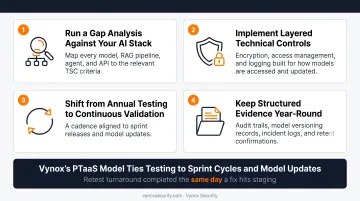
That shift from annual testing to continuous validation is exactly what Vynox's PTaaS model delivers, tying testing to sprint cycles and model updates rather than a single annual snapshot, with retest turnaround completed the same day a fix hits staging. That means compliance evidence accumulates progressively through the year, rather than becoming a scramble the month before renewal.
Choosing the Right Auditors and Security Testing Partners
Not every CPA firm has audited an AI company before. That distinction matters more than it sounds.
Look for auditors with demonstrated SOC 2 experience specifically in AI or SaaS environments, not just a generic checklist they run for every client regardless of industry. An auditor who's never asked about RAG data isolation will miss questions your enterprise buyers will absolutely ask later.
Pairing your CPA auditor with an AI-native security testing partner closes the evidence gap before it becomes a delay. Vynox Security builds its GRC-aligned reporting and 5-15 business day delivery window specifically for this handoff. The result is assessor-ready findings that plug directly into your auditor's evidence requirements, no reformatting needed.
When evaluating partners, weigh three things heavily:
- Retest turnaround. AI development moves faster than annual audit cycles. A partner offering same-day retest verification keeps remediation from blocking your sprint velocity.
- Reporting clarity. Findings need to work for both your engineers and your auditor. If the report requires translation before either group can act on it, that's lost time you don't have.
- Compliance mapping. Findings should tie directly to specific SOC 2 or ISO 27001 control requirements, not generic risk ratings your auditor still has to translate.
Frequently Asked Questions
Does SOC 2 apply to AI startups that don't process PII?
Yes. SOC 2 applies broadly to any organization handling customer data or delivering critical services. Even without direct PII exposure, enterprise buyers often require SOC 2 for model security, IP protection, and availability assurance.
What's the difference between SOC 2 Type I and Type II for AI companies?
Type I assesses control design at a single point in time. Type II evaluates whether those controls actually operated effectively over a period, typically 3-12 months. Enterprise buyers increasingly require Type II for AI vendors given ongoing model risk.
Can traditional penetration testing satisfy SOC 2 requirements for AI systems?
Not fully. Traditional pentesting covers infrastructure and web layers well but typically misses LLM-specific risks like prompt injection or RAG data leakage, which auditors now expect tested separately.
Do AI startups need ISO 42001 in addition to SOC 2?
ISO 42001 is an AI management system standard, not a substitute for SOC 2's CPA attestation. The two frameworks are complementary, and many enterprise-bound startups pursue both as AI-specific regulatory scrutiny increases.
How long does SOC 2 certification typically take for an AI startup?
Type I engagements move faster since there's no observation period. Type II adds a 3-12 month window on top of readiness and remediation work. Continuous evidence collection throughout the year can shorten renewal cycles.
What is the OWASP LLM Top 10 and why does it matter for SOC 2?
It's an industry-recognized list of the most critical LLM vulnerabilities, including prompt injection and sensitive data disclosure. Auditors now reference full coverage of this list as a benchmark for AI-specific security testing evidence.