That persistence isn't an accident. It reflects how many applications still ship with unvalidated inputs, missing tokens, and weak session controls. Akamai's telemetry recorded a 60% year-over-year jump in SQL injection attack volume between January 2023 and December 2024, covering both web application and API traffic, according to Akamai's State of Apps and API Security report.
This guide breaks down what each vulnerability actually does, how they differ, and what detection and prevention look like in practice.
Key Takeaways
- SQLi attacks the database, XSS attacks the browser, and CSRF abuses session trust
- All three remain leading causes of breaches and account takeover, despite two decades of documentation
- Each needs a distinct fix: parameterized queries, CSP-backed encoding, and anti-CSRF tokens
- Scanners catch known patterns but routinely miss logic-based and chained flaws
- Knowing which layer is under attack helps teams fix real risk, not chase generic checklists
What Are Web Application Security Vulnerabilities and Why Do They Matter?
A web application vulnerability is a flaw in code, configuration, or logic that lets someone act outside what the application was designed to allow. It's not always a bug you can spot by reading code line by line — sometimes it's a workflow that behaves exactly as built, just not as intended.
Most vulnerabilities trace back to a handful of root causes:
- Unvalidated or unsanitized inputs that let attackers smuggle commands into fields meant for plain text
- Misconfigured servers that expose debug endpoints, default credentials, or verbose error messages
- Insecure design decisions made early in development, before security requirements were even discussed
OWASP Sets the Reference Point
The OWASP Top Ten project is the industry-standard list of critical web application risks, maintained by the OWASP Foundation as a nonprofit, community-driven effort. When security teams talk about "the Top 10," this is the list they mean.
Leaving these gaps unaddressed carries real cost. The global average data breach reached $4.44 million in 2025, per IBM's Cost of a Data Breach report. That's down from $4.88 million the year before, but still a figure that lands hard on any startup or mid-market company.
Beyond the direct cost, unresolved vulnerabilities routinely block SOC 2 and ISO 27001 certification, which many B2B buyers now require before signing a contract.
SQLi, XSS & CSRF: The Three Vulnerabilities Explained
These three are not interchangeable, even though they get grouped together constantly. Each one attacks a different layer of the stack: the database, the browser, or the trust between a session and the server. Recognizing which layer is under fire is the first step toward picking the right defense.
SQL Injection (SQLi)
SQL Injection happens when an attacker inserts malicious SQL commands into an input field, tricking the backend into running commands it was never supposed to execute. At a high level, it works by exploiting unsanitized query inputs to read, modify, or delete data, and in the worst cases, escalate to full database control.
Unlike XSS or CSRF, SQLi targets the data store directly. There's no browser trickery involved; it's a straight line to whatever the database holds.
Real-world impact: An attacker enters ' OR '1'='1 into a login field and bypasses authentication entirely. Or they manipulate a search box to pull an entire user table, including hashed passwords and email addresses.
This is exactly the mechanism behind the MOVEit Transfer breach (CVE-2023-34362), where the CL0P group exploited a previously unknown SQLi flaw to access databases and exfiltrate data from organizations worldwide.
Prevention snapshot:
- Use parameterized queries and prepared statements for every database call
- Apply least-privilege database accounts so a compromised query can't touch everything
- Avoid relying on escaping alone; OWASP explicitly discourages it as a primary control
Cross-Site Scripting (XSS)
XSS is a malicious script injected into a webpage that runs in a victim's browser instead of the attacker's. There are three main flavors:
- Stored XSS: the script is saved on the server and served to every visitor who views the affected page
- Reflected XSS: the script rides along in a crafted link or request and fires immediately
- DOM-based XSS: client-side JavaScript moves attacker data into an unsafe part of the page without the server ever inserting it
Where SQLi goes after the database and CSRF exploits session trust, XSS goes straight for the person sitting at the keyboard.
Real-world impact: A malicious comment on a forum or a crafted link in a phishing email executes a script that steals session cookies, letting the attacker hijack the victim's account without ever touching a password.
The Roundcube Webmail flaw (CVE-2024-37383), exploited against a government organization in 2024, used a crafted email with SVG animate attributes to run JavaScript and steal credentials the moment the message was opened.
Prevention snapshot:
- Apply context-specific output encoding everywhere untrusted data touches HTML, JavaScript, or URLs
- Sanitize any HTML you must accept from users
- Layer on Content Security Policy (CSP) headers as defense in depth, not a substitute for encoding
Cross-Site Request Forgery (CSRF)
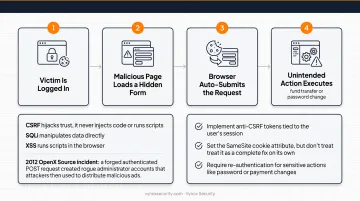
CSRF tricks an already-logged-in user's browser into submitting a request they never intended to send. There's no code injection here; the attacker relies entirely on the app's blind trust in cookies or session tokens that the browser sends automatically.
That's the core distinction from SQLi and XSS: CSRF doesn't manipulate data directly or run scripts. It hijacks legitimate trust, and it only works if the victim is logged in at the time.
Real-world impact: A victim visits a malicious page containing a hidden form that auto-submits to their banking site or admin dashboard. Because their browser still holds a valid session cookie, the request goes through, potentially triggering a fund transfer or a password change.
This mirrors what happened in the 2012 OpenX Source incident, where a forged authenticated POST request created rogue administrator accounts that attackers then used to distribute malicious ads.
Prevention snapshot:
- Implement anti-CSRF tokens tied to the user's session
- Set the SameSite cookie attribute, but don't treat it as a complete fix on its own
- Require re-authentication for sensitive actions like password or payment changes
How to Detect and Prevent SQLi, XSS & CSRF Attacks
Effective prevention relies on layered, vulnerability-specific defenses built into how the application is coded and deployed.
Baseline controls that apply everywhere:
- Enforce strict input validation and sanitization on every piece of user-supplied data, both client-side and server-side
- Use parameterized queries and prepared statements for all database interactions to neutralize SQLi at the source
- Apply output encoding and CSP headers to close off script execution paths that XSS depends on
- Implement anti-CSRF tokens, SameSite cookies, and step-up authentication for high-risk actions
A Web Application Firewall (WAF) can act as a compensating layer while deeper code fixes roll out, but OWASP is clear that a WAF doesn't repair the underlying application; it needs ongoing rule maintenance and shouldn't be the primary fix.
Where Manual Testing Comes In
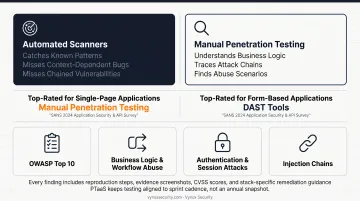
Automated scanners are good at catching known patterns, but they consistently miss context-dependent and chained vulnerabilities: the kind that require understanding how an application is supposed to work before you can spot how it's being abused. In the SANS 2024 Application Security & API Survey, respondents rated manual penetration testing as the top method for evaluating single-page applications, while DAST tools led for traditional form-based apps, showing that neither approach alone covers everything.
This is where developer-ready web application assessments, like those offered by Vynox Security, fill the gap. Vynox's Web Application VAPT engagements cover the full OWASP Top 10 plus business logic and workflow abuse, authentication and session attacks, and injection chains that scanners aren't built to recognize. Every finding ships with reproduction steps, evidence screenshots, CVSS scores, and stack-specific remediation guidance. For teams shipping code weekly, PTaaS keeps that testing aligned to sprint cadence rather than an annual snapshot.
Common Mistakes That Leave Web Apps Exposed
Even teams that take security seriously fall into a few recurring traps:
- Scanner-only testing. Automated tools miss business-logic flaws, like a checkout flow that skips payment steps. Catching these requires a human who understands the app's intent.
- One-time pre-launch testing. Treating a pentest as a pre-launch checkbox, rather than an ongoing practice, leaves new vulnerabilities unnoticed for months.
- Trusting client-side validation alone. Front-end checks improve user experience, but attackers can send requests directly to the server. Every input needs server-side validation, no exceptions.
Continuous testing, not one-off scans, closes these gaps. Vynox Security's Rapid Secure and Deep Secure engagements pair automated coverage with human-led business-logic testing on every release, not just before launch.
Conclusion
SQLi, XSS, and CSRF have been documented for over twenty years, yet they remain three of the most exploited web application vulnerabilities today. That's because each targets a different layer: the database, the browser, and session trust. No single fix covers all three.
Defense has to be layered and specific: parameterized queries for SQLi, encoding and CSP for XSS, tokens and SameSite cookies for CSRF, backed by regular manual testing to catch what automation can't.
Partnering with a specialized provider like Vynox Security, which combines manual penetration testing with source code review, helps engineering teams uncover these vulnerabilities and others across the full stack before an attacker finds them first.
Frequently Asked Questions
What is a web application security vulnerability?
It's a flaw in code, configuration, or design that attackers can exploit to compromise data, users, or application functionality. It can stem from a coding mistake, a misconfigured server, or an overlooked business-logic gap.
What are some common web application security vulnerabilities?
SQL Injection, Cross-Site Scripting, CSRF, broken access control, and security misconfiguration are among the most frequently seen. All of these appear regularly in OWASP's Top 10 rankings.
What is the biggest security threat to a web application?
Injection flaws, including SQLi, along with broken access control, are consistently ranked among the highest-severity threats. Both carry the potential for full data compromise or account takeover.
Which project lists the top 10 web application vulnerabilities?
The OWASP Top Ten project is the industry-standard reference. It's maintained by the OWASP Foundation and updated periodically based on real-world vulnerability data.
How is XSS different from CSRF?
XSS injects malicious code that runs directly in the victim's browser. CSRF injects no code at all — it tricks an already-authenticated browser into submitting a request the user never intended to make.
Can automated tools fully detect SQLi, XSS, and CSRF vulnerabilities?
Automated scanners catch many known patterns, but they often miss logic-based or chained flaws that require understanding the application's intended behavior. That's why manual penetration testing, the kind Vynox Security runs on every engagement, stays essential for catching what automation overlooks.